South Korean Young Hoon Kim, who claims a world-record IQ of 276, has converted all his assets to Bitcoin and predicts the crypto could surge [...]South Korean Young Hoon Kim, who claims a world-record IQ of 276, has converted all his assets to Bitcoin and predicts the crypto could surge [...]

Bloomberg Analyst Says ETF Approval Odds Now 100% After SEC Order – XRP, DOGE, ADA ETFs Incoming

A Bloomberg analyst says the odds of crypto ETF approvals are now 100% after the Securities and Exchange Commission (SEC) asked issuers to withdraw pending 19b-4 filings, clearing the way for ETFs including XRP, ADA, and DOGE to advance.

The withdrawals follow the SEC’s Sept. 18 approval of generic listing standards, which make 19b-4 filings unnecessary.

Exchanges including Nasdaq, Cboe BZX, and NYSE Arca can now list ETFs that meet predefined criteria, allowing issuers to move directly to S-1 registration, the final step before launch.

”Honestly the odds are really 100% now,” said Bloomberg ETF analysts Eric Balchunas. “Generic listing standards make the 19b-4s and their “clock” meaningless. That just leaves the S-1s waiting for formal green light from Corp Finance. And they just submitted amendment #4 for Solana. The baby could come any day. Be ready.”

92 Crypto ETFs In The Queue

There are currently around 92 ETF applications awaiting approval from the SEC, according to Bloomberg Intelligence ETF Analyst James Seyffart. 

They range from meme coins like Pudgy Penguins (PENGU) to larger cryptos such as Litecoin (LTC), Polkadot (DOT), and Chainlink (LINK).
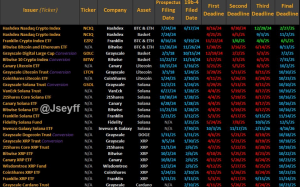
Some of the pending crypto ETF applications

Some of the crypto ETF filings pending approval (Source: X)

The SEC’s calls for ETF issuers to withdraw their applications for the various crypto products comes just days before the agency was required to deliver decisions on multiple ETF filings for digital assets. 

SEC And CFTC Work Together To Advance Crypto Regulation In The US

The SEC’s push to streamline the crypto ETF approval process is part of the agency’s “Project Crypto” initiative that was unveiled by Chair Paul Atkins earlier this year. 

Acting on recommendations from US President Donald Trump’s crypto working group, the SEC is working towards easing licensing requirements for firms operating in the crypto space. 

The agency is also collaborating with the US Commodity Futures Trading Commission (CFTC) to advance crypto regulation that provides investors with protections but does not block innovation in the digital asset sector. 

Earlier this year, the CFTC announced the launch of its “Crypto Sprint” initiative as well, which also seeks to act on recommendations received from the White House’s digital asset working group.

For years, the SEC and CFTC have clashed over how to regulate crypto, especially with the debate over whether some digital assets are securities or commodities. However, the two agencies are now working in unison.

At a roundtable yesterday, CFTC Acting Chair Caroline Pham said that the “turf war” between the SEC and the CFTC “is over.” 

 “There’s no question that because we both oversee related parts of the financial markets, the regulatory lanes for our two agencies aren’t always clear or intuitive,” Pham said. 

“At times, this has led to unnecessary friction between the two agencies and avoidable headaches for the market participants who depend on us,” she added. 

That comes as rumors begin to circulate that the CFTC and SEC could be merged into one agency. However, SEC Chair Paul Atkins has once again refuted these rumors. 

“Let me be clear: our focus is on harmonization, not on a merger of the SEC and CFTC, which would be up to Congress and the President,” Atkins said at the same roundtable. 

“Fanciful talk of reorganizing the government risks distracting us from the monumental opportunity we have in front of us,” he added. 

Disclaimer: The articles reposted on this site are sourced from public platforms and are provided for informational purposes only. They do not necessarily reflect the views of MEXC. All rights remain with the original authors. If you believe any content infringes on third-party rights, please contact service@support.mexc.com for removal. MEXC makes no guarantees regarding the accuracy, completeness, or timeliness of the content and is not responsible for any actions taken based on the information provided. The content does not constitute financial, legal, or other professional advice, nor should it be considered a recommendation or endorsement by MEXC.

You May Also Like

Wormhole launches reserve tying protocol revenue to token

Wormhole launches reserve tying protocol revenue to token

The post Wormhole launches reserve tying protocol revenue to token appeared on BitcoinEthereumNews.com. Wormhole is changing how its W token works by creating a new reserve designed to hold value for the long term. Announced on Wednesday, the Wormhole Reserve will collect onchain and offchain revenues and other value generated across the protocol and its applications (including Portal) and accumulate them into W, locking the tokens within the reserve. The reserve is part of a broader update called W 2.0. Other changes include a 4% targeted base yield for tokenholders who stake and take part in governance. While staking rewards will vary, Wormhole said active users of ecosystem apps can earn boosted yields through features like Portal Earn. The team stressed that no new tokens are being minted; rewards come from existing supply and protocol revenues, keeping the cap fixed at 10 billion. Wormhole is also overhauling its token release schedule. Instead of releasing large amounts of W at once under the old “cliff” model, the network will shift to steady, bi-weekly unlocks starting October 3, 2025. The aim is to avoid sharp periods of selling pressure and create a more predictable environment for investors. Lockups for some groups, including validators and investors, will extend an additional six months, until October 2028. Core contributor tokens remain under longer contractual time locks. Wormhole launched in 2020 as a cross-chain bridge and now connects more than 40 blockchains. The W token powers governance and staking, with a capped supply of 10 billion. By redirecting fees and revenues into the new reserve, Wormhole is betting that its token can maintain value as demand for moving assets and data between chains grows. This is a developing story. This article was generated with the assistance of AI and reviewed by editor Jeffrey Albus before publication. Get the news in your inbox. Explore Blockworks newsletters: Source: https://blockworks.co/news/wormhole-launches-reserve
Share
BitcoinEthereumNews2025/09/18 01:55
Top Altcoins To Hold Before 2026 For Maximum ROI – One Is Under $1!

Top Altcoins To Hold Before 2026 For Maximum ROI – One Is Under $1!

BlockchainFX presale surges past $7.5M at $0.024 per token with 500x ROI potential, staking rewards, and BLOCK30 bonus still live — top altcoin to hold before 2026.
Share
Blockchainreporter2025/09/18 01:16
Best Crypto to Buy as Saylor & Crypto Execs Meet in US Treasury Council

Best Crypto to Buy as Saylor & Crypto Execs Meet in US Treasury Council

The post Best Crypto to Buy as Saylor & Crypto Execs Meet in US Treasury Council appeared on BitcoinEthereumNews.com. Michael Saylor and a group of crypto executives met in Washington, D.C. yesterday to push for the Strategic Bitcoin Reserve Bill (the BITCOIN Act), which would see the U.S. acquire up to 1M $BTC over five years. With Bitcoin being positioned yet again as a cornerstone of national monetary policy, many investors are turning their eyes to projects that lean into this narrative – altcoins, meme coins, and presales that could ride on the same wave. Read on for three of the best crypto projects that seem especially well‐suited to benefit from this macro shift:  Bitcoin Hyper, Best Wallet Token, and Remittix. These projects stand out for having a strong use case and high adoption potential, especially given the push for a U.S. Bitcoin reserve.   Why the Bitcoin Reserve Bill Matters for Crypto Markets The strategic Bitcoin Reserve Bill could mark a turning point for the U.S. approach to digital assets. The proposal would see America build a long-term Bitcoin reserve by acquiring up to one million $BTC over five years. To make this happen, lawmakers are exploring creative funding methods such as revaluing old gold certificates. The plan also leans on confiscated Bitcoin already held by the government, worth an estimated $15–20B. This isn’t just a headline for policy wonks. It signals that Bitcoin is moving from the margins into the core of financial strategy. Industry figures like Michael Saylor, Senator Cynthia Lummis, and Marathon Digital’s Fred Thiel are all backing the bill. They see Bitcoin not just as an investment, but as a hedge against systemic risks. For the wider crypto market, this opens the door for projects tied to Bitcoin and the infrastructure that supports it. 1. Bitcoin Hyper ($HYPER) – Turning Bitcoin Into More Than Just Digital Gold The U.S. may soon treat Bitcoin as…
Share
BitcoinEthereumNews2025/09/18 00:27