Startups On Our Radar spotlights African startups solving African challenges with innovation. This week, we explore five African startups in the artificial intelligenceStartups On Our Radar spotlights African startups solving African challenges with innovation. This week, we explore five African startups in the artificial intelligence
5 African startups powering clouds, compliance tools, and cross-border rails
Startups On Our Radar spotlights African startups solving African challenges with innovation. In our previous edition, we featured five game-changing startups pioneering artificial intelligence, agriculture, cryptocurrency, and job matching. Expect the next dispatch on February 13, 2026.
This week, we explore five African startups in the artificial intelligence, fintech and cloud services sectors and why they should be on your watchlist. Here are our picks for today:
Yamify is building a local cloud for AI agents (AI, Democratic Republic of Congo [DRC])
When Luc Okalobe, a cloud and reliability engineer, returned to Congo-Brazzaville after spending the previous 15 years working at Silicon Valley, in companies including Apple, TikTok, Pinterest, and IBM, he was met with recurring complaints from engineers about the unreliability of Africa’s cloud infrastructure. So, he teamed up with Mike Kabangu, a business developer, to create a solution. In December 2025, they launched Yamify.
Yamifi is a cloud infrastructure startup building local cloud environments for African businesses that want to run automation and AI agents without hosting their core operations on United States or Europe.
Yamify addresses this gap by providing local cloud infrastructure for AI agents, starting with workflow automation tools. The platform’s first use case is hosting n8n, an open-source automation and AI-agent framework used by marketers, freelancers, and web agencies. Instead of running n8n on US-based servers, Yamify installs and operates it on physical servers located in African data centres, beginning with Open Access Data Centres (OADC) in Kinshasa, Democratic Republic of Congo (DRC).
Yamify’s dashboard. Image: Yamify.
The platform functions as a cloud operating layer that sits on top of physical servers and allows users to create virtual data centres, called Yams, where AI-agent software can be deployed and managed without requiring deep infrastructure expertise.
The startup manages server provisioning, uptime, monitoring, and recovery, allowing users to focus solely on building workflows and AI agents. Over time, the startup plans to host additional AI tools, including chatbot systems, to expand beyond its initial n8n focus.
Yamify operates on a subscription model priced at $5 monthly. The startup says it has about 100 beta users and is generating $500 in monthly revenue. The startup has also attracted early validation from companies using the platform as design partners, including VaultPay, a YC-backed fintech.
Why we’re watching: Yamify focuses on AI infrastructure. The startup offers an alternative to running automation on US-based clouds, where African businesses face latency and data sovereignty concerns. In August 2025, the startup raised $100,000 in pre-seed funding from Felix Anane, an early Paystack backer.
Clea wants to use stablecoins to make global payments faster for African importers (Fintech, Nigeria)
Founded by Sheriff Adedokun, Sidney Egwuatu, and Iyiola Osuagwu in December 2025, Clea is a cross-border payments platform that facilitates payments to overseas suppliers for African importers.
Before Clea, Adedokun founded a car importation business, which involved sourcing vehicles from the United States. It was during this importation role that he encountered repeated payment failures, as US auction platforms rejected third-party payments and Nigerian fintech tools declined transactions. Those frictions led to the launch of Clea to help people source assets and settle payments abroad more easily.
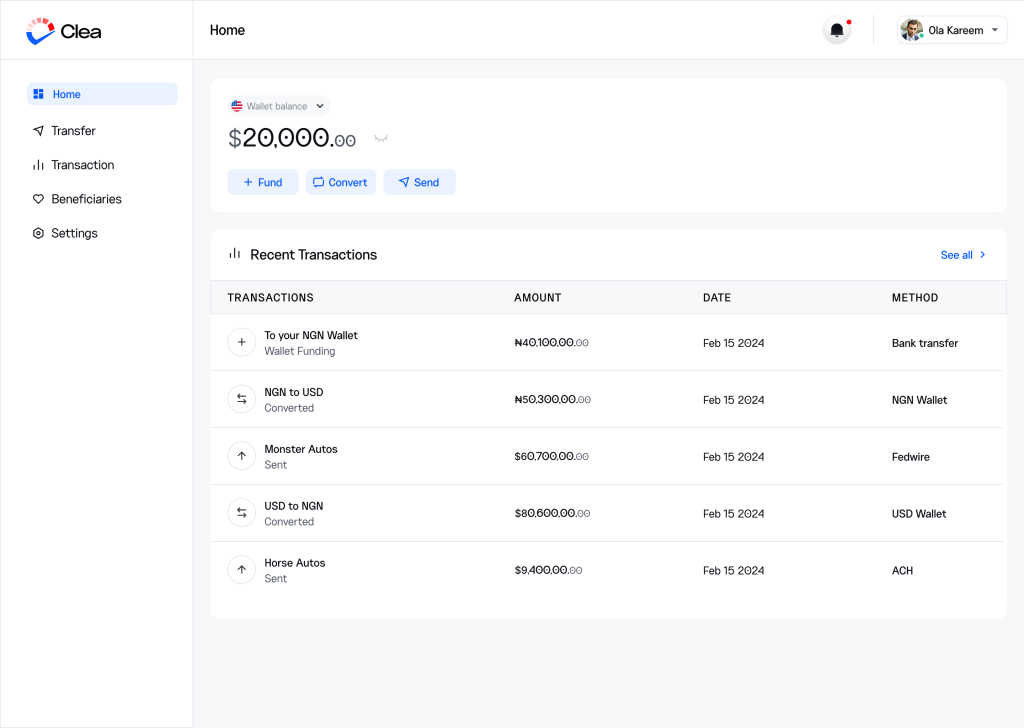
Clea’s Dashboard. Image: Clea
Clea operates through a wallet-based system and enables users to fund a wallet in Naira, convert to dollars using stablecoins, and then send money to foreign suppliers across multiple countries.
Through Clea’s partnership with Fincra, users are assigned virtual bank accounts and can make payments using multiple international rails. These rails include Fedwire, Automated Clearing House (ACH), and Real-Time Payments (RTP) in the US, and the Society for Worldwide Interbank Financial Telecommunication (SWIFT) for other countries.
Clea also allows users to fund their USD wallets directly with stablecoins, supporting BEP20 (BNB) and TRC20 (Tether) networks. Importers working with over-the-counter (OTC) crypto traders can also send USDT or USDC coins into their Clea wallets. For compliance purposes, Clea requires users to provide detailed beneficiary information, like relationship to the recipient, industry, and address, before payments are processed.
The startup generates revenue primarily from transfer fees, as it says it keeps FX margins low to protect importers’ profitability. Since its launch, the startup says it has onboarded 60 private pilot users and reports $68,000 in revenue during its pilot phase.
Why we’re watching: In 2024, the value of Nigeria’s remittance outflows reached $89.4 million, and Clea is targeting merchants in this segment. Its differentiation is its cross-border settlement through RTP, which settles payments faster than Fedwire and ACH. The startup says it is currently testing its new product, Clea Remit, which will allow inbound international transfers into Nigeria and convert received dollars into stablecoins instead of naira.
BookMolly wants to structure bookings for appointment-based businesses (SaaS, Nigeria)
BookMolly is an appointment booking and management platform for businesses that operate on scheduled services, like salons, spas, therapists, consultants, and wellness professionals.
Samuel Olabamiji, a senior software engineer, developed BookMolly in April 2025 after repeatedly calling service providers to ask when to come in, only to arrive and still wait or be turned back. Olabamiji then set out to build a system that allows customers to book a time slot in advance, pay upfront, and walk in exactly when expected.
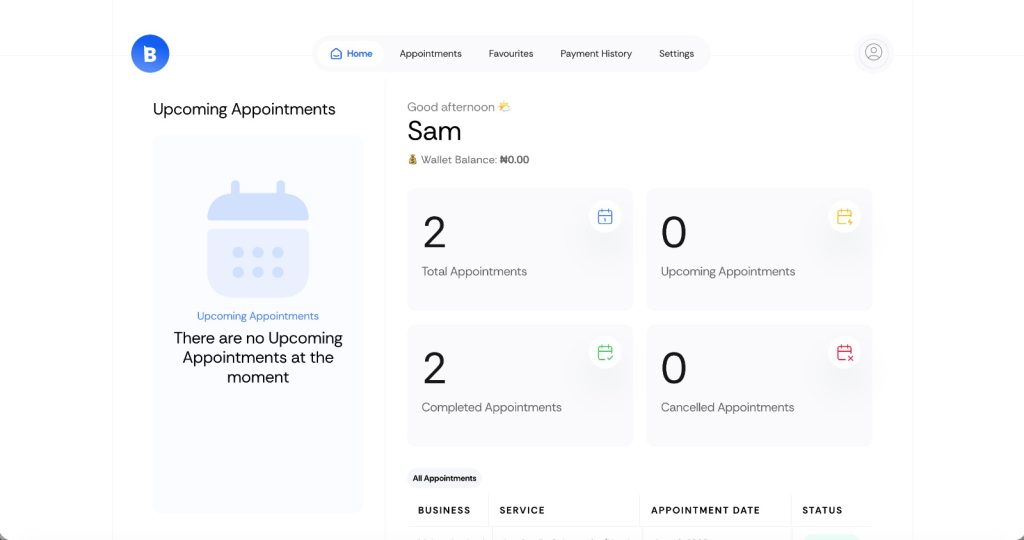
The webapp serves as a management dashboard for service providers and a marketplace for consumers. On the business side, service providers create accounts, set up their profiles, list services and prices, define opening hours, and manage availability through a calendar interface. Each business receives a unique booking link that can be shared directly with customers on channels like Instagram and WhatsApp.
BookMolly’s Dashboard: Image: BookMolly.
Businesses can also manage customers, payouts, team members, reviews, discounts, and reports showing appointments and performance trends. BookMolly integrates with Google Calendar and Google Meet, which allows virtual service providers like therapists to generate meeting links when bookings are made.
The platform also includes booking policies that require customers to pay a percentage of the service fee upfront, including rules for cancellations, rescheduling, and no-shows. Olabamiji says this feature addresses a problem where businesses lose revenue because clients fail to show up after blocking time slots.
On the customer side, BookMolly offers a marketplace where users can search for appointment-based businesses by category and location. Customers can view business profiles, select services, pick time slots, review booking policies, and pay deposits before confirming their appointment. At checkout, customers typically pay 70% upfront, depending on the business’s policy. Payments on the platform are processed through Paystack, which also provides business wallets.
BookMolly charges a 4.5% commission on bookings, capped at ₦30,000 ($21.95). Since its launch, the startup says it has onboarded over 400 registered businesses and is currently averaging at least 10 weekly appointments.
Why we’re watching: In Nigeria’s informal service economy, bookings are often handled through phone calls or WhatsApp messages that offer little structure or accountability. BookMolly is tackling this inefficiency with its booking software. The startup differentiates itself by combining a business management tool with a consumer-facing marketplace, a feature that competitors like KindlyBook do not currently offer.
The startup is building a WhatsApp-based AI booking agent to allow customers to search for services and book appointments without leaving WhatsApp. The startup also plans to include additional features such as payroll and white-label solutions.
Memcortex wants to provide a private memory layer for AI in highly regulated sectors (AI Infrastructure, Nigeria)
Founded in December 2025 by Bukola Sobowale, a Nigeria-based senior software engineer, Memcortex emerged from firsthand experience building AI systems in the US, a highly regulated healthcare environment, where data residency and patient privacy are non-negotiable. While building internal AI charting systems, he realised that existing large language model (LLM) platforms rely on external centralised layers that store and replay entire conversation histories, which is incompatible with healthcare and other compliance-heavy sectors.
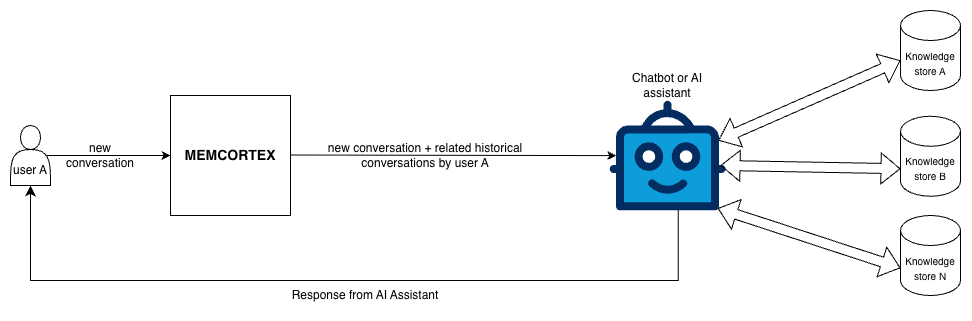
Memcortex is designed as a semantic memory layer that sits between an application and its underlying LLM. Instead of sending full conversation histories to a model, Memcortex stores past interactions between a patient and the organisation’s AI chatbot in a vector database.
Memcortex. Image: Bukola Sobowale
When a new prompt is issued, the system retrieves only contextually relevant historical data and passes that filtered context to the model. This approach ensures sensitive data never leaves the organisation’s environment. The tool is particularly useful for companies in healthcare, fintech, and internal enterprise AI tools, where personal data cannot be exposed to third-party platforms.
Memcortex is fully open source and available on GitHub, and can be deployed locally or on any cloud provider. Sobowale describes Memcortex as a foundational tool intended to help developers build compliant AI systems.
Why we’re watching: While big tech companies like OpenAI and Google maintain closed-source versions of this technology, Memcortex offers an alternative that smaller companies can use to build AI features without breaking the bank. By keeping data fully on an organisation’s own infrastructure, Memcortex says it addresses concerns that make AI platforms unsuitable for healthcare and other compliance-heavy sectors.
Get The Best African Tech Newsletters In Your Inbox
Select your country Nigeria Ghana Kenya South Africa Egypt Morocco Tunisia Algeria Libya Sudan Ethiopia Somalia Djibouti Eritrea Uganda Tanzania Rwanda Burundi Democratic Republic of the Congo Republic of the Congo Central African Republic Chad Cameroon Gabon Equatorial Guinea São Tomé and Príncipe Angola Zambia Zimbabwe Botswana Namibia Lesotho Eswatini Mozambique Madagascar Mauritius Seychelles Comoros Cape Verde Guinea-Bissau Senegal The Gambia Guinea Sierra Leone Liberia Côte d'Ivoire Burkina Faso Mali Niger Benin Togo Other
Select your gender Male Female Others
Subscribe
Tavestack wants to use its multilingual AI product to build an “intelligent brain” for African businesses (AI, Nigeria)
Tavestack, co-founded by Hafsah Garbati and Ahmad Sagir Koki, is an AI-powered productivity and workflow automation platform being built to help African businesses manage meetings better and centralise fragmented work tools into a single intelligent system.
The idea for Tavestack emerged from the team’s own struggles with remote work while operating across Kano, Kaduna, and Abuja. The founders relied heavily on online meetings and found gaps in existing tools for video calls and transcriptions. They saw that speech recognition tools failed to understand local pronunciations or mixed-language conversations. Meetings with strong local accents had poor transcription accuracy, and summaries failed to capture what was actually said. The team also realised that productivity tools priced in dollars consumed a significant share of operating budgets and required teams to juggle Zoom, Notion, reminders, and task managers without integration.
That led to the development of Tavestack, a productivity operating platform that sits on top of and integrates existing business tools. It allows users to automatically capture discussions during meetings, generate summaries, extract action items, and trigger follow-ups. The platform also extends into workflow orchestration, task automation, audit trails, and process intelligence, meaning the system is designed to understand how an organisation operates and automate interactions between tools.
Tavestack is also being built to function in low-resource environments by supporting offline or low-connectivity usage for physical meetings, which will be synced once connectivity is restored. Tavestack is developing its automatic speech recognition (ASR) engine tailored to African speech patterns, accents, and languages, to achieve accuratetranscriptions.
The company remains bootstrapped, has not yet launched publicly, but is targeting a public beta by Q3 2026. Its revenue model will be subscription-based, and its product will be targeted at B2B customers.
Why we’re watching: Tavestack is tackling the mismatch between global AI tools and real use cases in African organisations. By building its own automatic speech recognition (ASR) and enabling offline usage, the startup is addressing persistent issues around multilingual meetings in low-resource environments, which usually undermine the usefulness of existing transcription and productivity tools in such environments.
That’s all for today. Expect our next dispatch on February 13th. Know a startup we should feature next? Please nominate here.
Market Opportunity
CROSS Price(CROSS)
$0,10881
$0,10881$0,10881
-1,18%
USD
CROSS (CROSS) Live Price Chart
Disclaimer: The articles reposted on this site are sourced from public platforms and are provided for informational purposes only. They do not necessarily reflect the views of MEXC. All rights remain with the original authors. If you believe any content infringes on third-party rights, please contact service@support.mexc.com for removal. MEXC makes no guarantees regarding the accuracy, completeness, or timeliness of the content and is not responsible for any actions taken based on the information provided. The content does not constitute financial, legal, or other professional advice, nor should it be considered a recommendation or endorsement by MEXC.


 Yamify’s dashboard. Image: Yamify.
 Clea’s Dashboard. Image: Clea
 BookMolly’s Dashboard: Image: BookMolly.
 Memcortex. Image: Bukola Sobowale


