

FHE vs MPC vs ZK: Comparing Privacy-Preserving Cryptography
SPONSORED POST*
If you’ve been following the evolution of Web3 privacy technologies, you’ll have noticed that Fully Homomorphic Encryption (FHE) isn’t the only game in town. Multi-Party Computation (MPC) and Zero-Knowledge Proofs (ZKPs or simply ZK) are also widely used to protect sensitive data and enable secure computation.
Unfortunately, these technologies are often discussed interchangeably, even though they solve different problems. Admittedly, all three fall under the umbrella of privacy-preserving cryptography, meaning they allow sensitive information to be used or verified without revealing the underlying data. But the mechanisms they rely on – and the use cases they’re best suited for – vary significantly.
Understanding how these technologies differ will help you appreciate why each has found its own niche in the blockchain space as well as across traditional finance and cloud computing. There are some things that FHE does best. And others, as we’ll discover, that are best entrusted to MPC or ZKPs.
The Three Pillars of Privacy
Modern computing depends heavily on sharing data with third parties, whether it’s cloud providers running analytics on company datasets or blockchains validating transactions and smart contracts across decentralized networks. However, traditional encryption only protects data while it’s stored or transmitted. As soon as the system needs to use that data, it must be decrypted, which creates a potential exposure point.
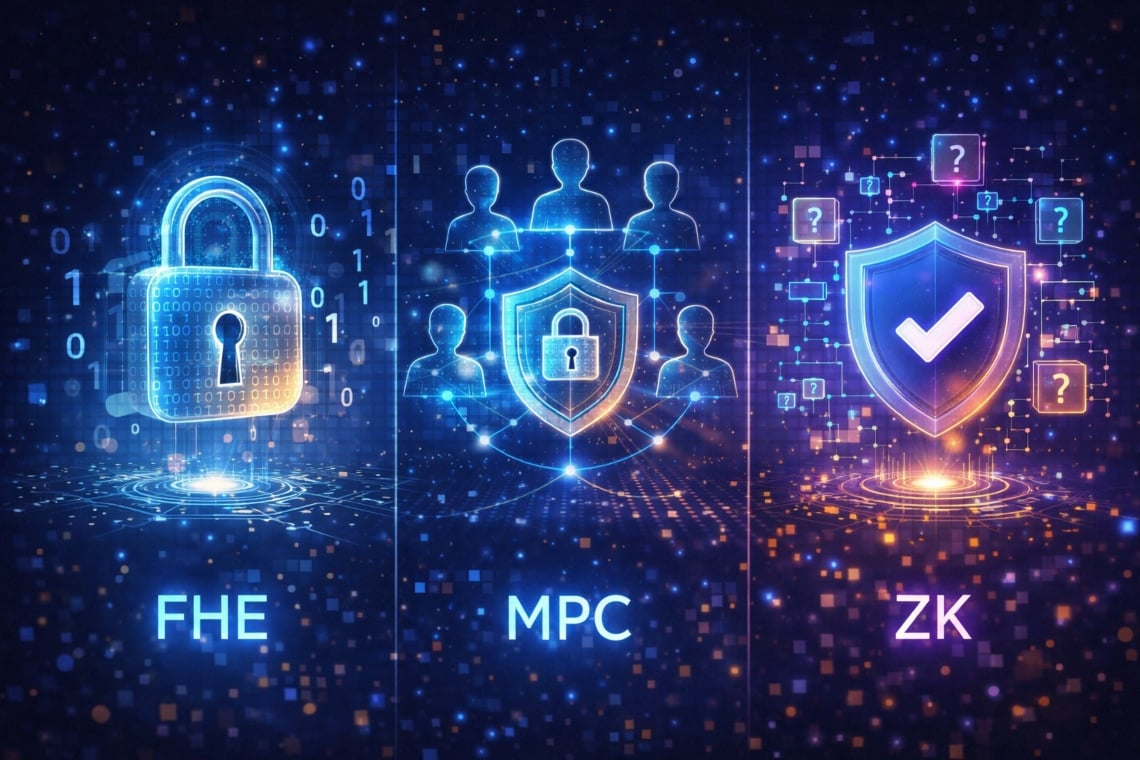
Privacy-preserving cryptography attempts to solve this by allowing information to be verified or computed without revealing the raw data itself. FHE, MPC, and ZKPs each approach that problem differently, but a high level, they work as follows:
- ZKPs: Zero-Knowledge Proofs allow one party (the prover) to convince another party (the verifier) that a statement is true without revealing any information beyond the validity of the statement itself. In the context of DeFi, a ZKP can prove that you are over 18 years old without revealing your birth date, or prove that you have enough collateral for a loan without revealing your total net worth.
ZKPs are excellent for validation, but they aren’t designed for joint computation on hidden data. You’re proving something you already know, rather than asking a server to calculate something for you.
- MPC: Multi-Party Computation allows a group of people to jointly compute a function over their inputs while keeping those inputs private from each other. No single party ever sees the whole data set. Instead, the data is split into “shares” distributed across multiple participants.
If there’s a drawback to MPC it’s that it requires a lot of communication between the participants. If one person goes offline or the network lags, the computation can stall.
- FHE: Fully Homomorphic Encryption allows a single untrusted party such as a cloud provider or a blockchain to perform calculations on encrypted data. Unlike MPC, it doesn’t require constant back-and-forth communication between multiple parties and unlike ZKP, it allows for the actual processing and transformation of data, not just the verification of it.
This capability makes FHE arguably the most powerful of the three cryptographic technologies profiled here. The only downside to FHE is that processing encrypted data is more computationally intensive and thus expensive – but as we’ll see, performance improvements have significantly reduced this.
Now let’s go a little deeper and examine how each of these privacy pillars works in turn.
Fully Homomorphic Encryption: Computing on Encrypted Data
FHE takes the most direct approach by allowing computations to be performed directly on encrypted data. Instead of decrypting information before running an algorithm, the system executes operations on ciphertext. When the result is eventually decrypted, it matches the result that would have been produced if the operations had been run on the original plaintext.
The most commonly cited use cases for this include letting a cloud server process financial data or training a machine learning model. But this capability is also extremely useful in Web3, where smart contracts can execute transactions without ever seeing the raw inputs. For example, in decentralized finance, FHE is being used to ensure that lending positions and collateral levels remain private while still enabling smart contracts to verify solvency and enforce liquidation logic.
The main advantage of FHE is that it allows arbitrary computation on encrypted data. In theory, any program can run in this environment, with the only trade-off – as we’ve already touched upon – being performance. Homomorphic operations remain computationally expensive, although advances in specialized hardware and improved algorithms are rapidly reducing that gap.
Multi-Party Computation: Sharing the Work
Multi-Party Computation solves the privacy problem from a different angle. Instead of allowing a single machine to compute on encrypted data, MPC distributes the computation across multiple participants. Each participant holds a fragment of the data and none of them individually possess enough information to reconstruct the full dataset.
In Web3, you’re likely to encounter MPC in the context of secure key management. Many institutional custody solutions, for instance, use MPC wallets where the private key is split across multiple devices or servers. Signing a transaction requires collaboration between those fragments, meaning no single party ever holds the full key.
The same capability is also used in consumer wallets, ensuring that if the owner loses access, they can get the wallet developer to use their “share” to restore access. Crucially, however, the developer can’t use their key share to unilaterally control the wallet and the funds it contains.
The advantage of MPC is that it avoids the heavy computational cost associated with other privacy-preserving technologies. The most obvious downside to MPC, however, is that it requires coordination between multiple actors. If enough participants collude or drop offline, the system can fail or lose its privacy guarantees.
Zero-Knowledge Proofs: Proving Without Revealing
Zero-Knowledge Proofs take yet another approach. Rather than enabling encrypted computation or distributed computation, ZKPs allow someone to prove that a statement is true without revealing the underlying data that makes it true. The classic example involves proving you know a password without actually disclosing the password itself.
A good way to think of ZKPs is as a mathematical certificate. Instead of showing the entire calculation, the system generates a cryptographic proof that the calculation was performed correctly. Anyone can verify the proof without needing to see the original inputs.
This makes ZKPs extremely powerful for verification, particularly in environments where transparency and trustlessness are required. However, the tech is less suited to complex general computation because generating proofs for large programs can be computationally expensive and often requires specialized circuit design.
Of the three privacy technologies, ZKPs are currently the most widely implemented within blockchain systems, where they allow users to demonstrate that a transaction is valid without exposing the full transaction details. This property is used extensively in privacy-focused networks and in scaling solutions known as ZK rollups.
.
The Future of Privacy-Preserving Computation
Rather than competing with each other, FHE, MPC, and ZKPs are broadly viewed as parts of the same toolkit, with each solving a different piece of the broader privacy puzzle.
FHE allows encrypted computation, MPC allows collaborative computation without centralized trust, and ZKPs allow verification without disclosure. Together, they form the foundation for a new model of computing in which sensitive data can remain private even while being processed and shared across distributed systems.
While ZKPs and MPC are already widely used in Web3 – ZKPs for scaling Ethereum and MPC for securing wallets – they both have limitations when it comes to shared state. FHE, on the other hand, allows for a global private state, allowing a blockchain to compute encrypted balances without seeing them.
As these tools mature, the distinction between them will matter less to end users. Just as most people use HTTPS without understanding the cryptography behind it, the next generation of applications may quietly rely on FHE, MPC, and ZKPs to keep their data private by default. When this occurs, the digital world will inherit the same level of privacy as we enjoy in the physical one.
*This article was paid for. Cryptonomist did not write the article or test the platform.
You May Also Like

Siren Token Sheds 70% as Analysts Question Supply Structure

One Of Frank Sinatra’s Most Famous Albums Is Back In The Spotlight

