WLFI price prints a bearish SFP after sweeping major liquidity at the swing high, signalling increased downside risk if price fails to reclaim key value area levels.WLFI price prints a bearish SFP after sweeping major liquidity at the swing high, signalling increased downside risk if price fails to reclaim key value area levels.

WLFI price rejects after liquidity grab, bearish SFP emerges

WLFI price prints a bearish SFP after sweeping major liquidity at the swing high, signalling increased downside risk if price fails to reclaim key value area levels.

Summary
  • WLFI’s recent rejection shows fading bullish strength after an aggressive liquidity sweep.
  • Current positioning below $0.16 keeps sellers in control of short-term direction.
  • A move into $0.12 would provide the next major reaction zone for traders.

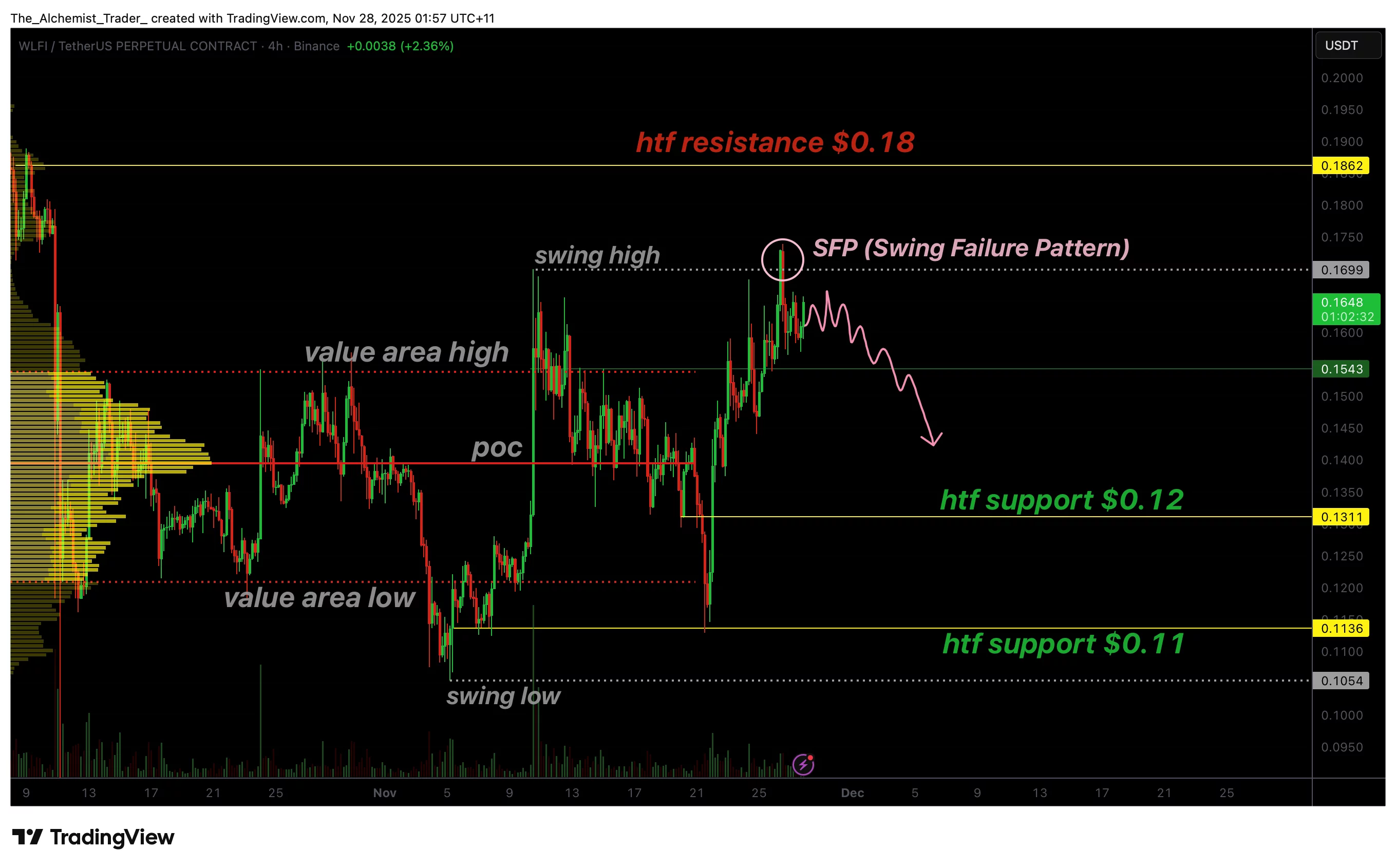
World Liberty Financial (WLFI), the Trump family’s crypto firm, has delivered a sharp rejection after sweeping liquidity above its recent swing high, forming a clear bearish Swing Failure Pattern. This development follows an impulsive rally from the predetermined $0.11 support, but momentum has now shifted as sellers step in aggressively. 

Crypto tensions are climbing in Washington, with senators now demanding a probe into World Liberty Financial, adding further uncertainty around the asset’s short-term trajectory. The evolving structure places the focus on value area levels that will determine whether WLFI extends lower or manages a reclaim to regain bullish footing.

WLFI price key technical points

  • Bearish SFP confirms a failed breakout, placing pressure on WLFI as trapped longs unwind.
  • Value area high at $0.16 acts as the decisive pivot, where a breakdown signals continuation to the downside.
  • High-time-frame support at $0.12 is the next major target, marking a key reaction zone if bearish momentum persists.
WLFI price rejects after liquidity grab, bearish SFP emerges - 1

WLFI’s recovery from $0.11 initiated a strong surge toward the previous swing high, but the move quickly showed signs of exhaustion. Once liquidity was taken above that high, price immediately reversed, forming a textbook Swing Failure Pattern, a signal that buyers failed to sustain the breakout and were likely absorbed by larger-time-frame sellers. This has shifted sentiment and structure toward a more cautious, bearish outlook.

The region around $0.16, representing the value area high, is now the defining level in the short term. As long as WLFI trades beneath this threshold, the SFP remains fully active and downside continuation remains the higher-probability scenario.

A reclaim would significantly weaken the bearish case, but order flow suggests buyers remain hesitant while sellers reclaim control of the chart. Volume during the rejection further supports the view that the SFP is not a minor deviation but a meaningful structural break.

If WLFI remains capped below the SFP zone and value area high, the next logical target becomes the high-time-frame support near $0.12. This region previously acted as a critical base for upward expansion and represents the strongest demand zone locally.

A move into this area would not be unexpected, especially considering the impulsive nature of the rejection and the broader market’s tendency to retest major supports following liquidity grabs.

What to expect in the coming price action

If WLFI cannot reclaim the $0.16 value area high, bearish continuation into $0.12 remains the most probable outcome. A strong reclaim of the SFP region would be required to invalidate this downside trajectory.

Market Opportunity
WLFI Logo
WLFI Price(WLFI)
$0.1426
$0.1426$0.1426
+5.39%
USD
WLFI (WLFI) Live Price Chart
Disclaimer: The articles reposted on this site are sourced from public platforms and are provided for informational purposes only. They do not necessarily reflect the views of MEXC. All rights remain with the original authors. If you believe any content infringes on third-party rights, please contact service@support.mexc.com for removal. MEXC makes no guarantees regarding the accuracy, completeness, or timeliness of the content and is not responsible for any actions taken based on the information provided. The content does not constitute financial, legal, or other professional advice, nor should it be considered a recommendation or endorsement by MEXC.

You May Also Like

Trust Wallet’s Decisive Move: Full Compensation for $7M Hack Victims

Trust Wallet’s Decisive Move: Full Compensation for $7M Hack Victims

BitcoinWorld Trust Wallet’s Decisive Move: Full Compensation for $7M Hack Victims In a significant move for cryptocurrency security, Trust Wallet has committed
Share
bitcoinworld2025/12/26 17:40
Cashing In On University Patents Means Giving Up On Our Innovation Future

Cashing In On University Patents Means Giving Up On Our Innovation Future

The post Cashing In On University Patents Means Giving Up On Our Innovation Future appeared on BitcoinEthereumNews.com. “It’s a raid on American innovation that would deliver pennies to the Treasury while kneecapping the very engine of our economic and medical progress,” writes Pipes. Getty Images Washington is addicted to taxing success. Now, Commerce Secretary Howard Lutnick is floating a plan to skim half the patent earnings from inventions developed at universities with federal funding. It’s being sold as a way to shore up programs like Social Security. In reality, it’s a raid on American innovation that would deliver pennies to the Treasury while kneecapping the very engine of our economic and medical progress. Yes, taxpayer dollars support early-stage research. But the real payoff comes later—in the jobs created, cures discovered, and industries launched when universities and private industry turn those discoveries into real products. By comparison, the sums at stake in patent licensing are trivial. Universities collectively earn only about $3.6 billion annually in patent income—less than the federal government spends on Social Security in a single day. Even confiscating half would barely register against a $6 trillion federal budget. And yet the damage from such a policy would be anything but trivial. The true return on taxpayer investment isn’t in licensing checks sent to Washington, but in the downstream economic activity that federally supported research unleashes. Thanks to the bipartisan Bayh-Dole Act of 1980, universities and private industry have powerful incentives to translate early-stage discoveries into real-world products. Before Bayh-Dole, the government hoarded patents from federally funded research, and fewer than 5% were ever licensed. Once universities could own and license their own inventions, innovation exploded. The result has been one of the best returns on investment in government history. Since 1996, university research has added nearly $2 trillion to U.S. industrial output, supported 6.5 million jobs, and launched more than 19,000 startups. Those companies pay…
Share
BitcoinEthereumNews2025/09/18 03:26
Trust Wallet Hack Hits $7M: CZ Hints at Possible Insider Role

Trust Wallet Hack Hits $7M: CZ Hints at Possible Insider Role

CZ hinted at possible insider involvement in the Trust Wallet incident while assuring users that their funds would be reimbursed.
Share
CryptoPotato2025/12/26 16:48