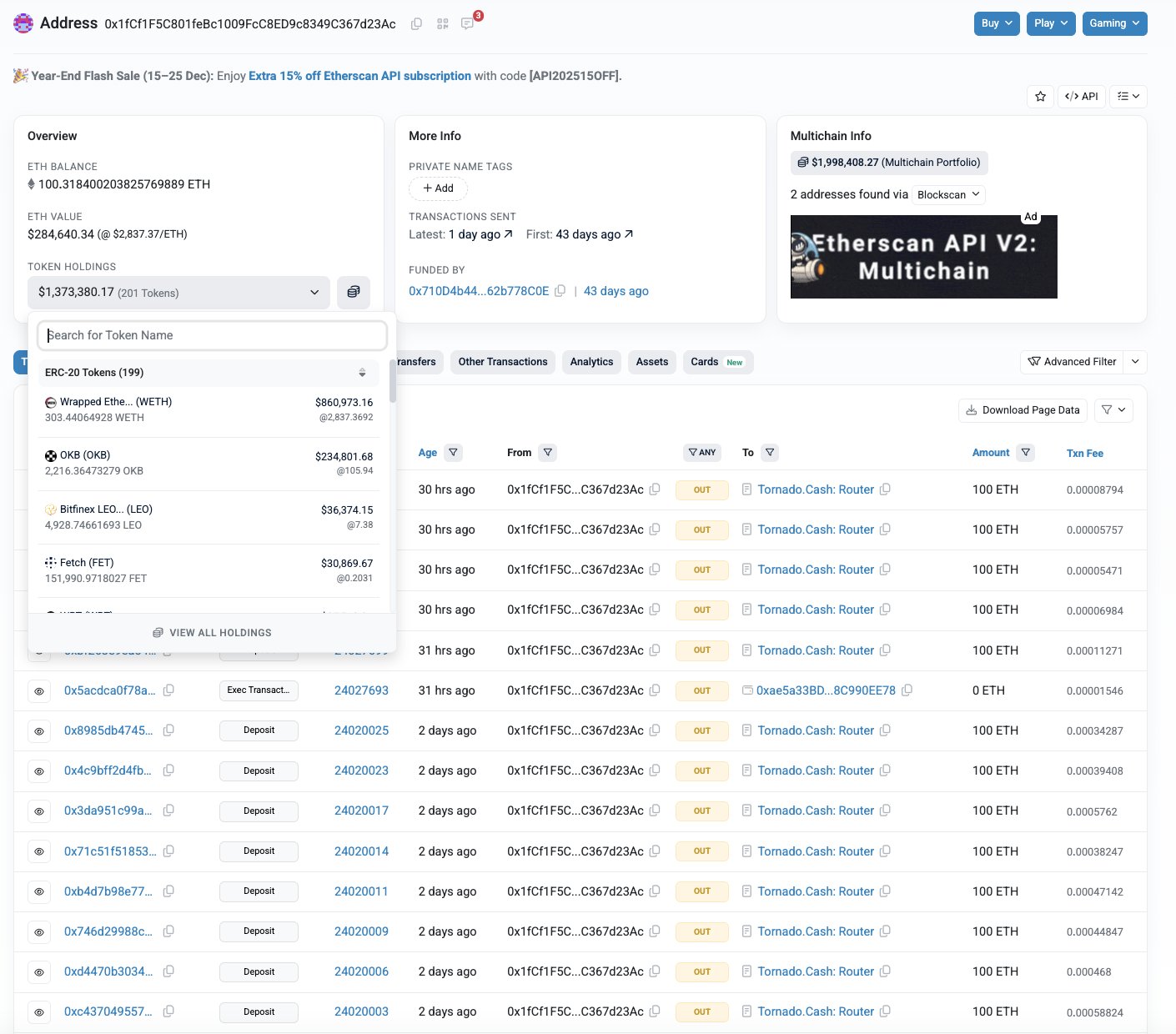
TLDR A private key hack caused a $27 million loss from an Ethereum whale’s wallet. Ethereum, WETH, OKB, and FET tokens were among those drained by the attacker.TLDR A private key hack caused a $27 million loss from an Ethereum whale’s wallet. Ethereum, WETH, OKB, and FET tokens were among those drained by the attacker.

Ethereum Whale’s Wallet Drained of $27 Million After Private Key Leak

TLDR

  • A private key hack caused a $27 million loss from an Ethereum whale’s wallet.
  • Ethereum, WETH, OKB, and FET tokens were among those drained by the attacker.
  • The compromised multisig wallet used a flawed “1-of-1” signature setup.
  • The attacker laundered funds through Tornado Cash in staggered transactions.

A recent hack has drained over $27 million from an Ethereum whale’s multisig wallet, caused by a private key compromise. The wallet’s private key was allegedly leaked or stolen, allowing the attacker to access and control the funds. The attacker has been able to launder some of the stolen assets using Tornado Cash, a tool known for anonymizing cryptocurrency transactions. This incident has raised concerns about the security of multisig wallets and private key management.

Multisig Wallet Compromised

The attack was first noticed by blockchain security firm PeckShield, which reported that the victim’s multisig wallet was compromised shortly after it was created. The hacker managed to take control of the wallet just six minutes after its creation on November 4, 2025. At this point, ownership of the wallet was transferred from the victim to the attacker.Image

The wallet, initially set up with multisig security, was later discovered to have been configured as a “1-of-1” wallet. This setup allowed a single signature to approve transactions, making it vulnerable to attack. Experts argue that this flaw essentially defeated the purpose of a multisig setup, which typically requires multiple signatures for transaction approval.

Funds Laundered Through Tornado Cash

Once the attacker gained control, they started moving the stolen funds in batches, using Tornado Cash to launder the assets. PeckShield reports that approximately $12.6 million, or around 4,100 ETH, was sent through Tornado Cash. This technique helps obfuscate the origin of the funds, making it more difficult for authorities or blockchain analysts to trace the stolen assets.

In addition to the 4,100 ETH, the attacker also held a portion of the funds in liquid assets, including $2 million in stablecoins and tokens. These tokens included ETH, WETH (Wrapped Ethereum), OKB, LEO, and FET, which were among the assets drained from the wallet. The total value of the stolen assets could be as high as $40 million, based on new findings from forensic experts.

Leveraged Position at Risk

At the time of the hack, the victim’s wallet had a significant leveraged position on the decentralized lending platform Aave. The victim had supplied about $25 million worth of Ethereum, borrowing roughly $12.3 million in DAI against it.

However, with the wallet compromised, the attacker could potentially liquidate these assets if the Ethereum price drops significantly. The current health factor of the leveraged position is around 1.68, meaning it is close to being liquidated if Ethereum’s price declines further.

This situation poses a risk not only to the victim but also to the broader market, as forced liquidations could create selling pressure on Ethereum and other assets involved in the attack.

Security Vulnerabilities in Multisig Setup

Experts have pointed to several potential vulnerabilities in the way the victim handled their multisig wallet. Malware or phishing attacks targeting the victim’s device or poor security practices might have led to the private key compromise. To prevent such attacks, security professionals recommend using isolated, offline signing devices and verifying transactions beyond the user interface.

Furthermore, the fact that the wallet was configured as a “1-of-1” raises questions about the victim’s operational security. A multisig wallet ideally requires multiple signatures from different participants, reducing the risk of a single point of failure.

The post Ethereum Whale’s Wallet Drained of $27 Million After Private Key Leak appeared first on CoinCentral.

Market Opportunity
Ambire Wallet Logo
Ambire Wallet Price(WALLET)
$0.01917
$0.01917$0.01917
-0.10%
USD
Ambire Wallet (WALLET) Live Price Chart
Disclaimer: The articles reposted on this site are sourced from public platforms and are provided for informational purposes only. They do not necessarily reflect the views of MEXC. All rights remain with the original authors. If you believe any content infringes on third-party rights, please contact service@support.mexc.com for removal. MEXC makes no guarantees regarding the accuracy, completeness, or timeliness of the content and is not responsible for any actions taken based on the information provided. The content does not constitute financial, legal, or other professional advice, nor should it be considered a recommendation or endorsement by MEXC.

You May Also Like

China Blocks Nvidia’s RTX Pro 6000D as Local Chips Rise

China Blocks Nvidia’s RTX Pro 6000D as Local Chips Rise

The post China Blocks Nvidia’s RTX Pro 6000D as Local Chips Rise appeared on BitcoinEthereumNews.com. China Blocks Nvidia’s RTX Pro 6000D as Local Chips Rise China’s internet regulator has ordered the country’s biggest technology firms, including Alibaba and ByteDance, to stop purchasing Nvidia’s RTX Pro 6000D GPUs. According to the Financial Times, the move shuts down the last major channel for mass supplies of American chips to the Chinese market. Why Beijing Halted Nvidia Purchases Chinese companies had planned to buy tens of thousands of RTX Pro 6000D accelerators and had already begun testing them in servers. But regulators intervened, halting the purchases and signaling stricter controls than earlier measures placed on Nvidia’s H20 chip. Image: Nvidia An audit compared Huawei and Cambricon processors, along with chips developed by Alibaba and Baidu, against Nvidia’s export-approved products. Regulators concluded that Chinese chips had reached performance levels comparable to the restricted U.S. models. This assessment pushed authorities to advise firms to rely more heavily on domestic processors, further tightening Nvidia’s already limited position in China. China’s Drive Toward Tech Independence The decision highlights Beijing’s focus on import substitution — developing self-sufficient chip production to reduce reliance on U.S. supplies. “The signal is now clear: all attention is focused on building a domestic ecosystem,” said a representative of a leading Chinese tech company. Nvidia had unveiled the RTX Pro 6000D in July 2025 during CEO Jensen Huang’s visit to Beijing, in an attempt to keep a foothold in China after Washington restricted exports of its most advanced chips. But momentum is shifting. Industry sources told the Financial Times that Chinese manufacturers plan to triple AI chip production next year to meet growing demand. They believe “domestic supply will now be sufficient without Nvidia.” What It Means for the Future With Huawei, Cambricon, Alibaba, and Baidu stepping up, China is positioning itself for long-term technological independence. Nvidia, meanwhile, faces…
Share
BitcoinEthereumNews2025/09/18 01:37
Ripple-Backed Evernorth Faces $220M Loss on XRP Holdings Amid Market Slump

Ripple-Backed Evernorth Faces $220M Loss on XRP Holdings Amid Market Slump

TLDR Evernorth invested $947M in XRP, now valued at $724M, a loss of over $220M. XRP’s price dropped 16% in the last 30 days, leading to Evernorth’s paper losses
Share
Coincentral2025/12/26 03:56
New Trump appointee Miran calls for half-point cut in only dissent as rest of Fed bands together

New Trump appointee Miran calls for half-point cut in only dissent as rest of Fed bands together

The post New Trump appointee Miran calls for half-point cut in only dissent as rest of Fed bands together appeared on BitcoinEthereumNews.com. Stephen Miran, chairman of the Council of Economic Advisers and US Federal Reserve governor nominee for US President Donald Trump, arrives for a Senate Banking, Housing, and Urban Affairs Committee confirmation hearing in Washington, DC, US, on Thursday, Sept. 4, 2025. The Senate Banking Committee’s examination of Stephen Miran’s appointment will provide the first extended look at how prominent Republican senators balance their long-standing support of an independent central bank against loyalty to their party leader. Photographer: Daniel Heuer/Bloomberg via Getty Images Daniel Heuer | Bloomberg | Getty Images Newly-confirmed Federal Reserve Governor Stephen Miran dissented from the central bank’s decision to lower the federal funds rate by a quarter percentage point on Wednesday, choosing instead to call for a half-point cut. Miran, who was confirmed by the Senate to the Fed Board of Governors on Monday, was the sole dissenter in the Federal Open Market Committee’s statement. Governors Michelle Bowman and Christopher Waller, who had dissented at the Fed’s prior meeting in favor of a quarter-point move, were aligned with Fed Chair Jerome Powell and the others besides Miran this time. Miran was selected by Trump back in August to fill the seat that was vacated by former Governor Adriana Kugler after she suddenly announced her resignation without stating a reason for doing so. He has said that he will take an unpaid leave of absence as chair of the White House’s Council of Economic Advisors rather than fully resign from the position. Miran’s place on the board, which will last until Jan. 31, 2026 when Kugler’s term was due to end, has been viewed by critics as a threat from Trump to the Fed’s independence, as the president has nominated three of the seven members. Trump also said in August that he had fired Federal Reserve Board Governor…
Share
BitcoinEthereumNews2025/09/18 02:26