The fallout from Trust Wallet’s Chrome extension incident intensified on December 26 after Changpeng Zhao (CZ), weighed in publicly, suggesting the breach may haveThe fallout from Trust Wallet’s Chrome extension incident intensified on December 26 after Changpeng Zhao (CZ), weighed in publicly, suggesting the breach may have

Trust Wallet Incident Deepens as CZ Suggests Possible Insider Role

The fallout from Trust Wallet’s Chrome extension incident intensified on December 26 after Changpeng Zhao (CZ), weighed in publicly, suggesting the breach may have involved an insider. 

The comment came as Trust Wallet confirmed that roughly $7 million in user funds have been affected so far.

Insider Access as Key Line of Investigation

CZ said Trust Wallet will fully reimburse impacted users and stressed that customer funds remain safe. 

However, he added that investigators are still examining how a compromised browser extension update was able to pass through distribution controls, calling an insider role “most likely.” 

The statement amplified concerns around internal access and update governance, rather than an external exploit alone.

Trust Wallet later confirmed that the incident affected Browser Extension version 2.68 only, reiterating that mobile users and other versions were not impacted. 

The company said it is finalizing reimbursement procedures and will issue clear instructions to affected users. 

Meanwhile, users should remain cautious against phishing attempts posing as official support.

The insider angle has drawn particular attention within the crypto security community. Browser extensions require signing keys, developer credentials, and approval workflows to publish updates. 

For a malicious or compromised build to be distributed through the official Chrome Web Store, investigators typically look at either credential compromise or direct internal access. 

Both scenarios point to weaknesses in operational security rather than a traditional software vulnerability.

Such risks are not theoretical. Over the past year, several high-profile browser extension incidents have stemmed from hijacked developer accounts or compromised release pipelines.

TWT Token Briefly Dips Before Rebounding

Market reaction reflected the uncertainty. Trust Wallet’s native token, TWT, saw a sharp sell-off following the initial reports on December 25. 

However, prices stabilized and rebounded on December 26 after confirmation that losses were limited and refunds would be issued. 
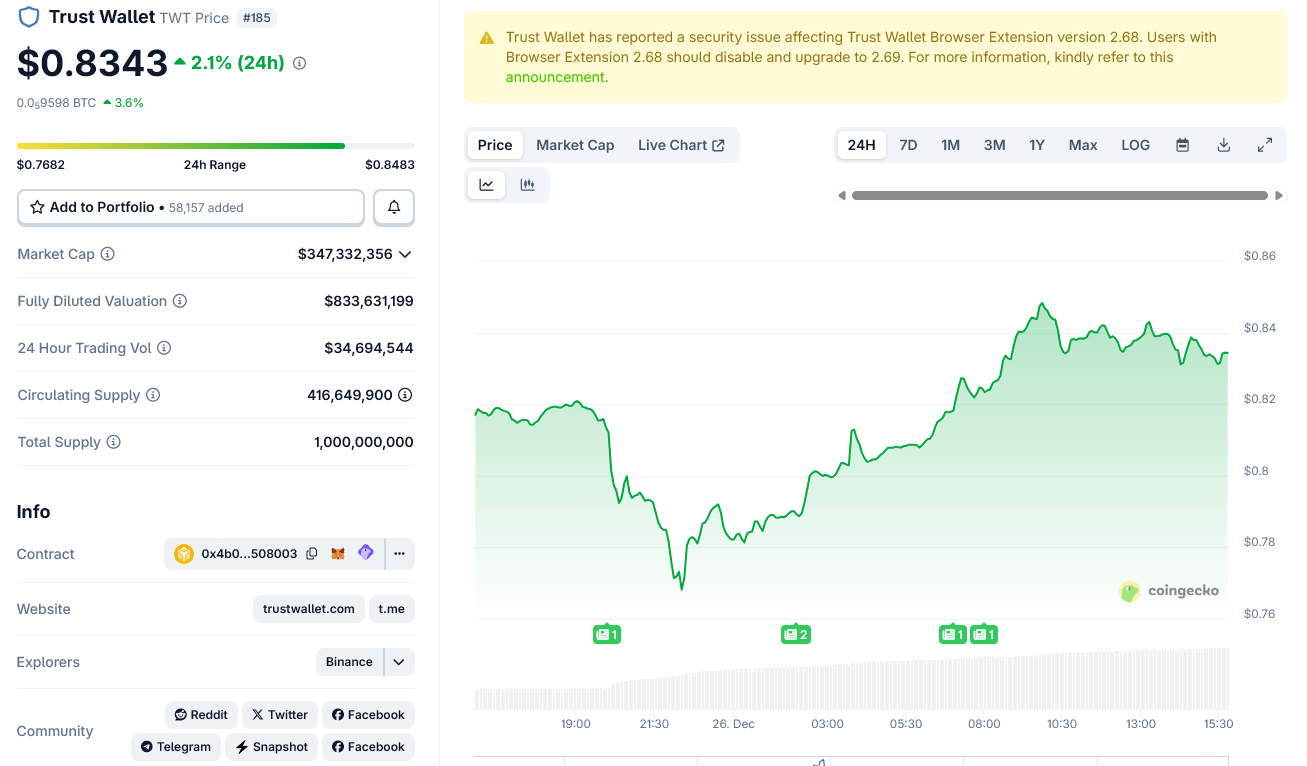
TWT Token Price Chart. Source: CoinGecko

While Trust Wallet has moved quickly to contain the incident, the episode reflects a broader industry challenge. 

As crypto wallets increasingly rely on browser extensions, update security and insider risk management are emerging as critical attack surfaces, not secondary concerns.

Market Opportunity
Intuition Logo
Intuition Price(TRUST)
$0.1095
$0.1095$0.1095
+0.55%
USD
Intuition (TRUST) Live Price Chart
Disclaimer: The articles reposted on this site are sourced from public platforms and are provided for informational purposes only. They do not necessarily reflect the views of MEXC. All rights remain with the original authors. If you believe any content infringes on third-party rights, please contact service@support.mexc.com for removal. MEXC makes no guarantees regarding the accuracy, completeness, or timeliness of the content and is not responsible for any actions taken based on the information provided. The content does not constitute financial, legal, or other professional advice, nor should it be considered a recommendation or endorsement by MEXC.

You May Also Like

Coinbase Data Breach Fallout: Former Employee Arrest in India Over Customer Data Case Raises Bitcoin Security Concerns

Coinbase Data Breach Fallout: Former Employee Arrest in India Over Customer Data Case Raises Bitcoin Security Concerns

The post Coinbase Data Breach Fallout: Former Employee Arrest in India Over Customer Data Case Raises Bitcoin Security Concerns appeared on BitcoinEthereumNews.
Share
BitcoinEthereumNews2025/12/27 10:36
Burmese war amputees get free 3D-printed prostheses, thanks to Thailand-based group

Burmese war amputees get free 3D-printed prostheses, thanks to Thailand-based group

PROSTHETIC FEET. Silicon foot covers fitted with metal rods found in the prosthetic production unit in Mae Tao Clinic. A good prosthetic foot must absorb impact
Share
Rappler2025/12/27 10:00
China Blocks Nvidia’s RTX Pro 6000D as Local Chips Rise

China Blocks Nvidia’s RTX Pro 6000D as Local Chips Rise

The post China Blocks Nvidia’s RTX Pro 6000D as Local Chips Rise appeared on BitcoinEthereumNews.com. China Blocks Nvidia’s RTX Pro 6000D as Local Chips Rise China’s internet regulator has ordered the country’s biggest technology firms, including Alibaba and ByteDance, to stop purchasing Nvidia’s RTX Pro 6000D GPUs. According to the Financial Times, the move shuts down the last major channel for mass supplies of American chips to the Chinese market. Why Beijing Halted Nvidia Purchases Chinese companies had planned to buy tens of thousands of RTX Pro 6000D accelerators and had already begun testing them in servers. But regulators intervened, halting the purchases and signaling stricter controls than earlier measures placed on Nvidia’s H20 chip. Image: Nvidia An audit compared Huawei and Cambricon processors, along with chips developed by Alibaba and Baidu, against Nvidia’s export-approved products. Regulators concluded that Chinese chips had reached performance levels comparable to the restricted U.S. models. This assessment pushed authorities to advise firms to rely more heavily on domestic processors, further tightening Nvidia’s already limited position in China. China’s Drive Toward Tech Independence The decision highlights Beijing’s focus on import substitution — developing self-sufficient chip production to reduce reliance on U.S. supplies. “The signal is now clear: all attention is focused on building a domestic ecosystem,” said a representative of a leading Chinese tech company. Nvidia had unveiled the RTX Pro 6000D in July 2025 during CEO Jensen Huang’s visit to Beijing, in an attempt to keep a foothold in China after Washington restricted exports of its most advanced chips. But momentum is shifting. Industry sources told the Financial Times that Chinese manufacturers plan to triple AI chip production next year to meet growing demand. They believe “domestic supply will now be sufficient without Nvidia.” What It Means for the Future With Huawei, Cambricon, Alibaba, and Baidu stepping up, China is positioning itself for long-term technological independence. Nvidia, meanwhile, faces…
Share
BitcoinEthereumNews2025/09/18 01:37