

Is Bitunix Legit? A Transparent Look at Its Security, Licensing, and User Protections
Before you put money on any platform, you want one thing: confidence that you can deposit, trade, and withdraw without drama. This crypto exchange has grown fast, so it’s normal to pause and ask questions. If you searched for Bitunix legit, you’re doing the right kind of homework.
This guide focuses on practical checks: what the platform says it does for security, what it shares about compliance, and what you can do on your side to reduce risk.
Bitunix Legit: What People Usually Mean By It
Most people don’t mean one single thing when they say legit. They’re usually trying to
reduce a few specific risks.
First, they want to know if the platform is real and operational. That means it consistently processes deposits and withdrawals and provides clear rules for how trading and accounts work.
Second, they want to know if there are serious safety measures behind the scenes. Think custody partners, internal controls, and transparency around reserves.
Third, they want to know if the exchange takes compliance seriously. Even if you don’t love KYC, rules like identity checks and anti-fraud controls reduce the odds of sudden restrictions or account issues later.
Security Signals You Can Actually Check
A good starting point is how the platform handles custody and operational security. Bitunix highlights an integration with Fireblocks and describes protections around asset security and operations.
Another check is whether the exchange publishes reserve transparency. Bitunix provides a Proof of Reserves page and states it maintains reserves for user assets.
Finally, look for clear, written policies that explain how accounts are handled, how suspicious activity is addressed, and what users are expected to do. Policies won’t stop every problem, but vague or missing policies are a red flag.
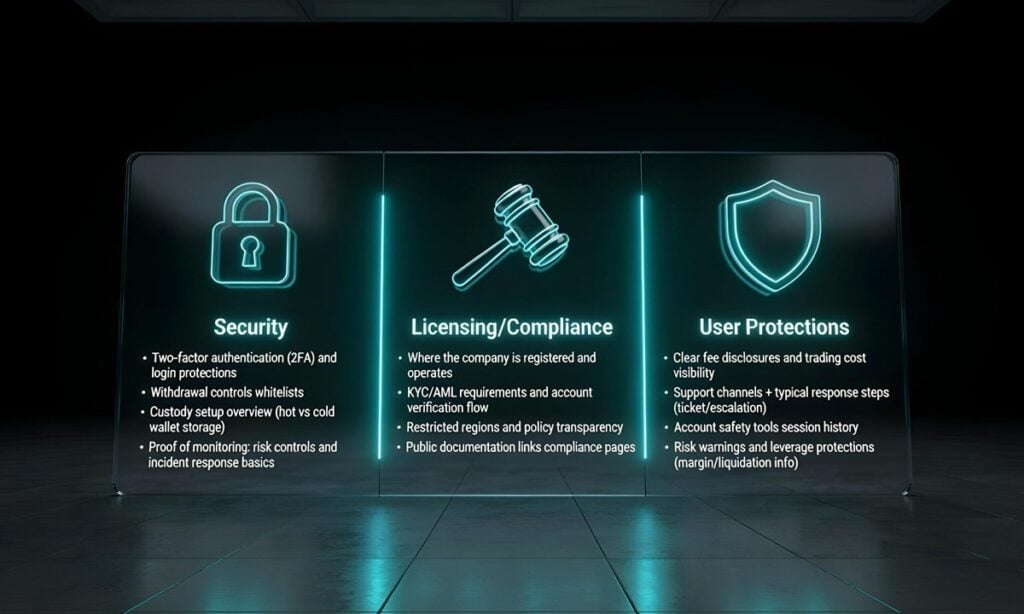
Security, licensing,compliance, and user protections—three things to check before trusting an exchange
Licensing and Compliance: What Bitunix Shares Publicly
Bitunix lists two concrete compliance milestones you can verify. First, it states it obtained a U.S. Money Services Business registration through FinCEN, dated April 23, 2025, which is the registration commonly used for money-services compliance in the U.S.
Second, it says a group entity completed AUSTRAC registration in Australia on December 17, 2025, which matters if you want a regulated foothold in that market. On the policy side, Bitunix describes a risk-based AML program that includes customer due diligence, monitoring for suspicious activity, screening related to sanctions/PEP risk, and reporting where required.
On the user side, Bitunix publishes KYC guidance and makes it clear that some products and features require identity verification.
User Protections That Matter In Day-to-Day Use
In real life, protections are less about big claims and more about what happens when something goes wrong.
One example is clarity around who can use the platform. Bitunix publishes restricted-region and compliance guidance so users can check access rules before they deposit. Another is having written standards for suspicious activity and account controls.
On the protection side, Bitunix says it upgraded its custody and security infrastructure and backed it with insurance coverage up to $42.5 million, plus an added $5 million insurance protection layer tied to the upgrade announcement.
It also describes using multi-party computation custody and named integrations/partners used for custody and risk controls (including Fireblocks and Elliptic) to reduce key-management risk and monitor suspicious activity patterns. For transparency, Bitunix provides an asset verification feature that lets users verify holdings using a Merkle Tree method, which is a common approach for proof-of-reserves style checks.
A Quick Checklist Before You Deposit
Do this once, and you’ll save yourself a lot of stress later. None of these steps is complicated. They’re just the boring stuff that works.
- Confirm you’re on the real domain and not a clone site.
- Read the restricted-region and verification rules before funding your account.
- Start with a small test deposit, then do a small test withdrawal.
- Use strong account security settings and store backup codes safely.
- Check the Proof of Reserves page and understand what it does and does not prove.
- Keep screenshots of transaction IDs and support tickets for anything important.
- Avoid moving your entire stack at once. Increase size only after you’ve tested the basics.
Bottom line
So, is Btunix legit for your needs? A practical answer looks like this: treat it like any other crypto exchange and verify.
First, check what it publishes about security and reserves, and whether you can independently confirm the claims. Look for a clear proof-of-reserves method and a way to validate your own snapshot.
Next, look at compliance. Is the licensing or registration information easy to find, specific, and tied to an identifiable legal entity? And do the features you plan to use match what’s allowed in your region?
Finally, protect yourself with small tests before you scale up. Deposit a small amount, do one spot trade, withdraw to your own wallet, and confirm fees, processing times, and 2FA behavior match what the platform says.
You May Also Like

Ripple’s Hidden Road acquisition could ‘supercharge XRP’s utility’

S&P 500 Slides as Gas Prices Rise
