Key takeaways:
-
Institutional adoption of the Ethereum network accelerates despite Ether disappointing price action. Ethereum and its layer-2s hold 65% of TVL market share.
-
Vitalik Buterin is shifting focus toward base layer scalability and ZK-EVM to ensure long-term onchain efficiency and security.
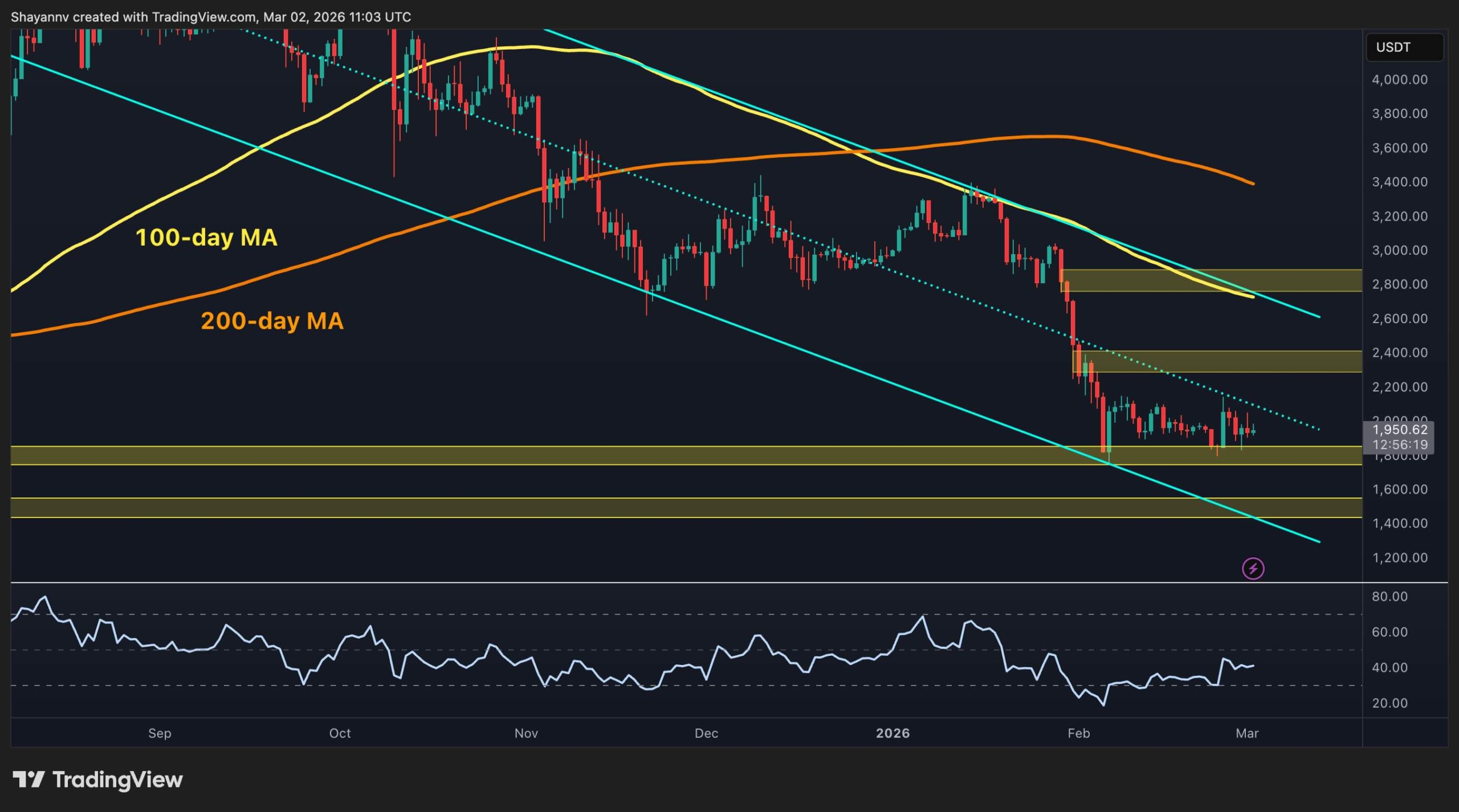
Ether (ETH) has declined 36% in 2026, sparking frustration as the $3,000 level feels increasingly out of reach. Despite a retreat toward $1,900, Ethereum fundamentals appear resilient. Development continues at a rapid pace, specifically targeting base layer scalability, privacy, and quantum resistance.
Critics claiming Ether is poorly positioned may be surprised if the market sentiment shifts back toward cryptocurrencies.
ETH/USD (orange) vs total crypto capitalization (blue). Source: TradingViewEther has underperformed the broader crypto market by 9% during the first two months of 2026, challenging the theory that external factors are the sole drivers of this correction. Decentralized exchange (DEX) volumes on the Ethereum network fell 55% over the past six months, while competitor Solana saw a more modest 21% decline during that same timeframe.
Ethereum 30-day DEX volumes (left) & DApp revenue, USD (right). Source: DefiLlamaEthereum DEX volumes dropped to $56.5 billion in February 2026, down significantly from a peak of $128.5 billion in August 2025. During the same period, monthly Solana volumes reached $95.5 billion, down from $120.6 billion in August. This contraction in activity has weighed on network fees and decentralized application (DApp) revenue, effectively reducing the immediate incentives for holding Ether.
Institutions choose Ethereum over other blockchains
The narrow focus on volume ignores the fact that Ethereum maintains a 57% market share in total value locked (TVL), totaling $52.4 billion. When including layer-2 solutions such as Base, Arbitrum, Polygon, and Optimism, Ethereum’s dominance rises to 65%. For comparison, Solana’s TVL sits at $6.4 billion, while BNB Chain holds an aggregate $5.5 billion locked in smart contracts.
Major institutions, including JPMorgan Asset Management, Citi, Deutsche Bank, and BlackRock, have recently launched onchain projects using Ethereum. From tokenized funds to dedicated layer-2 rollups and bank-issued stablecoins, Ethereum remains the primary venue for decentralized finance (DeFi) innovation, commanding a 68% market share in Real World Assets (RWA).
Real World Assets active market capitalization, USD. Source: DefiLlamaEthereum’s strategic decision to prioritize layer-2 scalability via rollups has been partially labeled a failure, as competing chains like Tron and Solana currently lead in network fees. Regardless of how critics judge the decision to subsidize rollup costs, no “Ethereum killer” has managed to match its monetary value. Even the highly successful Hyperliquid maintains a relatively modest $1.5 billion in TVL.
Blockchains ranked by Total Value Locked, USD. Source: DefiLlamaVitalik Buterin, Ethereum’s co-founder and lead architect, recently expressed intentions to reduce dependence on rollups by targeting base layer scalability. According to Buterin, the proposed changes include parallel block verification, aligning gas costs with actual execution time, and the implementation of a zero-knowledge Ethereum Virtual Machine (ZK-EVM).
These updates will be implemented gradually. Buterin recommends that a minority of the network participate initially before moving toward mandatory block confirmation systems that rely on ZK-EVM. Additionally, Ethereum maintains a clear roadmap to navigate the quantum computing era, which includes consensus-layer signatures based on privacy-focused proof systems.
Related: Why institutions still prefer Ethereum despite faster blockchains
Buterin has admitted that quantum-resistant signatures are significantly larger and more difficult to verify, noting that lattice-based solutions are currently inefficient. Consequently, the proposed solution involves fixing protocol-layer recursive signature and proof aggregation while developing vectorized math precompiles to reduce gas costs. While the Ethereum network is not yet perfect, a viable path for scalability exists.
Before dismissing ETH as a failure, it is necessary to analyze what has made the network successful relative to competing DApp-focused blockchains. Decentralization and trust require years, if not decades, to establish. ETH maintains a significant first-mover advantage and appears well-positioned to capture a future surge in demand for institutional-grade onchain activity.
This article does not contain investment advice or recommendations. Every investment and trading move involves risk, and readers should conduct their own research when making a decision. While we strive to provide accurate and timely information, Cointelegraph does not guarantee the accuracy, completeness, or reliability of any information in this article. This article may contain forward-looking statements that are subject to risks and uncertainties. Cointelegraph will not be liable for any loss or damage arising from your reliance on this information.
Source: https://cointelegraph.com/news/ether-60percent-down-from-its-2025-high-but-tradfi-keeps-betting-on-eth-here-s-why?utm_source=rss_feed&utm_medium=feed&utm_campaign=rss_partner_inbound