Cardano’s on-chain governance entered uncharted territory this weekend after the meme-mascot account HOSKY declared that the network’s Constitutional Committee (CC) was “dropping below the required seven members,” calling it “our first official government shutdown.” The post followed a formal retirement notice from the Cardano Atlantic Council, a seated CC member, which said it will “retire […]Cardano’s on-chain governance entered uncharted territory this weekend after the meme-mascot account HOSKY declared that the network’s Constitutional Committee (CC) was “dropping below the required seven members,” calling it “our first official government shutdown.” The post followed a formal retirement notice from the Cardano Atlantic Council, a seated CC member, which said it will “retire […]

Cardano Faces First ‘Governance Shutdown’ — Hoskinson Responds

Cardano’s on-chain governance entered uncharted territory this weekend after the meme-mascot account HOSKY declared that the network’s Constitutional Committee (CC) was “dropping below the required seven members,” calling it “our first official government shutdown.” The post followed a formal retirement notice from the Cardano Atlantic Council, a seated CC member, which said it will “retire our CC keys on November 25th, following the epoch transition, to allow active proposals to ratify or expire.”

What The Cardano ‘Governance Shutdown’ Means

The proximate cause is political as much as procedural: a compensation proposal for CC members appears headed for defeat. In its thread announcing the decision, Cardano Atlantic said the “current CC Compensation governance proposal is unlikely to pass, based on the vote tally and rationales,” adding that “it appears the DRep community lacks appetite to compensate CC members… our decision is not a negotiation tactic or plea for Yes votes; it simply reflects a misalignment of expectations.” It also noted a 100% voting participation record during its term and said it “will not participate in any further proposals.”

Charles Hoskinson, Cardano’s founder, downplayed the disruption, arguing that a rotating committee is a design feature, not a flaw. “The system works. Cardano is designed to be self-reflective and self-healing. People retire and others take their place,” he wrote in response to HOSKY on November 9.

At issue is how the Cardano governance stack behaves when the CC slips beneath its configured minimum size. Under CIP-1694—the blueprint for Cardano’s Voltaire-era governance—there is an explicit protocol parameter, committeeMinSize, representing the minimal number of non-expired committee members. When membership falls below that floor, “the constitutional committee will be unable to ratify governance actions,” meaning actions requiring CC assent cannot be enacted until the committee is replenished.

That matters immediately for categories such as treasury withdrawals and protocol-parameter changes, which require concurrent majorities from DReps and the CC. In normal operation, these actions are ratified by “at least two of these three governance bodies” (DReps, SPOs, CC), with the policy specifying exactly which bodies must co-approve each action type.

Cardano’s developer documentation confirms that treasury withdrawals and parameter updates need both DRep and CC majorities; with an under-sized CC, these classes of actions stall regardless of DRep or SPO sentiment. This is the practical sense in which a “governance shutdown” occurs, even if the chain itself continues producing blocks and non-CC-dependent votes can proceed.

Ecosystem reaction has been pragmatic, if tense. Jaromír Tesař, a prominent DRep operating as Cardano YOD₳ (Manda Pool), argued that the governance framework anticipated this scenario and predicted that “within a month, it will be possible to approve withdrawals again,” but he also warned of fatigue among DReps and friction over CC pay: “5 out of 7 CC members believe that their work is demanding and are asking for compensation, while DReps are strongly against their proposal… DReps are exhausted. Voting activity is decreasing every epoch.”

From the DRep side, the theme of compensation—or lack of consensus about it—has become a flashpoint. Dori, a Cardano DRep, called for “more discussion around compensation,” attributing many “no” votes to “the community’s lack of prior discussion or failure to effectively communicate the reasoning behind CC rewards,” and reminding that “everyone has their own livelihood to consider.”

Viewed through the lens of governance mechanics rather than social drama, what happens next is scripted by CIP-1694: the community can seat new CC members via the UpdateCommittee governance action and/or adjust thresholds; until then, actions that depend on an affirmative CC cannot be ratified.

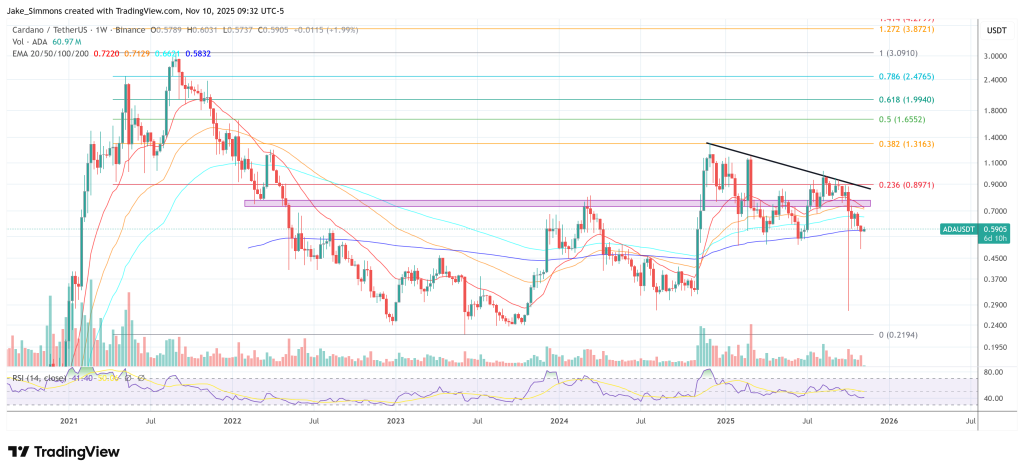
At press time, ADA traded at $0.59.
Cardano price
Market Opportunity
Memecoin Logo
Memecoin Price(MEME)
$0.0009293
$0.0009293$0.0009293
-1.87%
USD
Memecoin (MEME) Live Price Chart
Disclaimer: The articles reposted on this site are sourced from public platforms and are provided for informational purposes only. They do not necessarily reflect the views of MEXC. All rights remain with the original authors. If you believe any content infringes on third-party rights, please contact service@support.mexc.com for removal. MEXC makes no guarantees regarding the accuracy, completeness, or timeliness of the content and is not responsible for any actions taken based on the information provided. The content does not constitute financial, legal, or other professional advice, nor should it be considered a recommendation or endorsement by MEXC.

You May Also Like

What is the 80 20 rule for Airbnb? A practical guide for hosts

What is the 80 20 rule for Airbnb? A practical guide for hosts

This article explains the 80 20 idea as a practical heuristic for Airbnb hosts and shows how it links to realistic, low-cash ways people gain control of short-term
Share
Coinstats2026/01/31 08:42
Tokenized Assets Shift From Wrappers to Building Blocks in DeFi

Tokenized Assets Shift From Wrappers to Building Blocks in DeFi

The post Tokenized Assets Shift From Wrappers to Building Blocks in DeFi appeared on BitcoinEthereumNews.com. RWAs are rapidly moving on-chain, unlocking new opportunities for investors and DeFi protocols, according to a new report from Dune and RWAxyz. Tokenized real-world assets (RWAs) are moving beyond digital versions of traditional securities to become key building blocks of decentralized finance (DeFi), according to the 2025 RWA Report from Dune and RWAxyz. The report notes that Treasuries, bonds, credit, and equities are now being used in DeFi as collateral, trading instruments, and yield products. This marks tokenization’s “real breakthrough” – composability, or the ability to combine and reuse assets across different protocols. Projects are already showing how this works in practice. Asset manager Maple Finance’s syrupUSDC, for example, has grown to $2.5 billion, with more than 30% placed in DeFi apps like Spark ($570 million). Centrifuge’s new deJAAA token, a wrapper for Janus Henderson’s AAA CLO fund, is already trading on Aerodrome, Coinbase and other exchanges, with Stellar planned next. Meanwhile, Aave’s Horizon RWA Market now lets institutional users post tokenized Treasuries and CLOs as collateral. This trend underscores a bigger shift: RWAs are no longer just copies of traditional assets; instead, they are becoming core parts of on-chain finance, powering lending, liquidity, and yield, and helping to close the gap between traditional finance (TradFi) and DeFi. “RWAs have crossed the chasm from experimentation to execution,” Sid Powell, CEO of Maple Finance, says in the report. “Our growth to $3.5B AUM reflects a broader shift: traditional financial services are adopting crypto assets while institutions seek exposure to on-chain markets.” Investor demand for higher returns and more diversified options is mainly driving this growth. Tokenized Treasuries proved there is strong demand, with $7.3 billion issued by September 2025 – up 85% year-to-date. The growth was led by BlackRock, WisdomTree, Ondo, and Centrifuge’s JTRSY (Janus Henderson Anemoy Treasury Fund). Spark’s $1…
Share
BitcoinEthereumNews2025/09/18 06:10
Why ZKP Ranks Among the Best New Cryptos to Buy With Fair Design and Private Compute

Why ZKP Ranks Among the Best New Cryptos to Buy With Fair Design and Private Compute

While many investors focus on the latest trending tokens, ZKP has been steadily building a foundation with lasting value. By combining real hardware, verifiable
Share
Techbullion2026/01/31 09:00
