Michael Saylor Vows ‘We Buy Real Bitcoin,’ No Rehypothecation
Michael Saylor’s Strategy has reignited a long-running Bitcoin custody debate after co-founder and CTO of Casa Jameson Lopp challenged whether the firm can know its holdings aren’t being rehypothecated by third parties. Saylor’s blunt response — “We buy real bitcoin. We don’t rehypothecate.” — quickly turned into a broader argument about what “proof” looks like for a public company warehousing BTC at institutional custodians.
The exchange landed as Strategy’s accumulation narrative is accelerating in early 2026. On Jan. 26, Saylor posted that Strategy bought 2,932 BTC for roughly $264.1 million at an average price near $90,061 per bitcoin. He added that, as of Jan. 25, the company held 712,647 BTC acquired for about $54.19 billion at an average cost of roughly $76,037 per coin.
That disclosure sparked commentary from Jesse Myers, who framed Strategy’s pace as structurally supply-tightening. Myers said the company has acquired 40,150 BTC so far in 2026, against 11,700 BTC mined year-to-date. “Eventually, the BTC price must go higher. Much higher,” he wrote, leaning on a simple imbalance: one large buyer absorbing more than new issuance.
No Paper Bitcoin?
Lopp pushed back on the implicit assumption that all of those purchases translate into unencumbered, uniquely owned UTXOs. “Your thesis is sensible… under the assumption that he’s buying real bitcoin,” Lopp wrote. “Does Strategy actually verify that their bitcoin only belongs to them and isn’t rehypothecated? I’m skeptical.”
Saylor responded with a short, definitive denial: “We buy real bitcoin. We don’t rehypothecate.” But Lopp widened the aperture from Strategy’s own behavior to the incentives and opacity of intermediaries. “But how do you know your custodians don’t? Presumably they put your BTC in segregated addresses you can monitor,” he wrote. “People ask for proof of reserves since they don’t even know what monitoring / assurances you put in place. Multiple layers of trusted black boxes make folks nervous.”
As the thread grew, some users demanded Strategy publish addresses. One account wrote, “Prove it then. Show us the addresses.” Others argued that transparency cuts both ways. “Ever considered that TradFi could be extremely frightened if Strategy were to do this, given that it opens up multiple attack Vectors?”
Defenders leaned on the mechanics of public-company controls rather than on-chain visibility. Attorney Jesse Kobernick from Miller Nash LLP argued that Strategy’s filings describe steps auditors take to verify balances and control, and that multiple third parties touch the process, including the separation between BTC purchases and the equity sales and cash proceeds that fund them. Lopp rejected that comfort. “Trusted third parties are security holes…” he replied.
Bitcoin OG Adam Back, meanwhile, pointed to mainstream custodianship norms as a reason to discount “paper bitcoin” fears. “Think about it. Their custodians are I think Fidelity and Coinbase,” Back wrote, adding that large auditors take verification and key-control standards seriously.
Lopp remained unconvinced that outside observers can know what, exactly, is being verified. “Are these auditors spinning up nodes, verifying balances at addresses, ensuring that no clients hold claims to the same BTC?” he wrote. “I’m skeptical, but ultimately we just don’t know – it’s a black box.”
Later on Jan. 28, Saylor reposted the message more broadly, escalating from denial to prescription: “We buy real bitcoin. We audit our custodians. We don’t rehypothecate.” He added: “You shouldn’t either.”
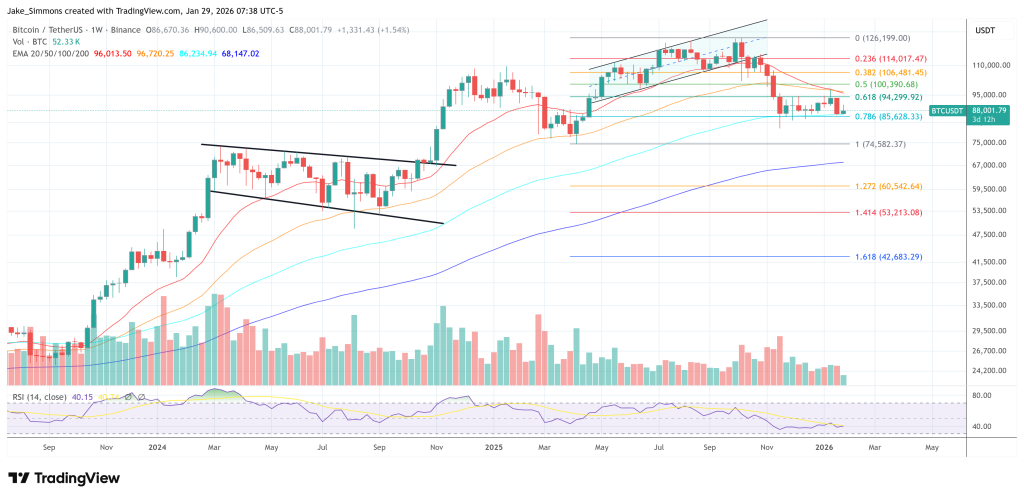
At press time, Bitcoin traded at $88,001.
You May Also Like

qLabs Fires First Shot in Quantum Crypto Race — Can Coinbase Catch Up?

Slate Milk Raises $23 Million Series B Round To Bolster Protein Drink’s Rapid Growth