The post Market Meltdown: Gold, Silver, Stocks & Crypto Crash Altogether—What’s Next for Bitcoin Price? appeared first on Coinpedia Fintech News Gold and silverThe post Market Meltdown: Gold, Silver, Stocks & Crypto Crash Altogether—What’s Next for Bitcoin Price? appeared first on Coinpedia Fintech News Gold and silver

Market Meltdown: Gold, Silver, Stocks & Crypto Crash Altogether—What’s Next for Bitcoin Price?

Stream Finance Halts Operations

The post Market Meltdown: Gold, Silver, Stocks & Crypto Crash Altogether—What’s Next for Bitcoin Price? appeared first on Coinpedia Fintech News

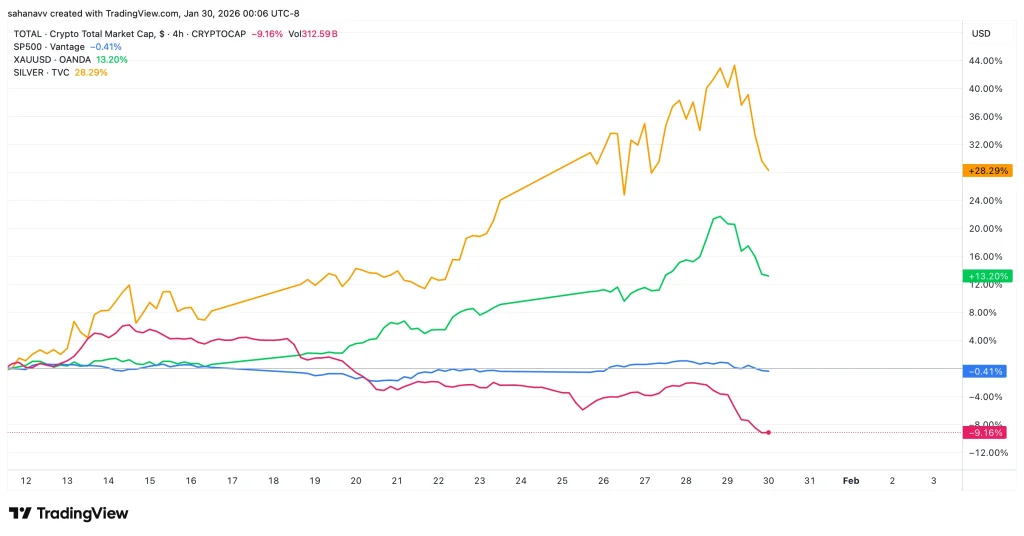
Gold and silver prices retreated after scaling record highs as traders moved to lock in profits following an extended rally. The weakness spilled into equities, with the S&P 500, Nasdaq, and technology stocks sliding sharply. Market sentiment turned cautious after earnings from Microsoft raised concerns around slowing AI-related spending.
total market cap

Crypto markets mirrored the broader risk-off move. Bitcoin price slipped close to the $81,000 level, while major altcoins extended losses. Forced selling and liquidations in leveraged positions accelerated the decline, amplifying downside pressure across digital assets.

Stronger Dollar Emerges as a Key Factor

The simultaneous drop across precious metals, stocks, and crypto raised a key question: was this driven by a single negative headline or a combination of profit-taking, stretched valuations, and tightening financial conditions?

Unlike typical market cycles, where gold rises as stocks and crypto fall, this move reflected a broader liquidity-driven reset rather than asset-specific weakness. After weeks of strong gains, multiple markets appeared overbought, leaving prices vulnerable once risk appetite faded.
dxy index

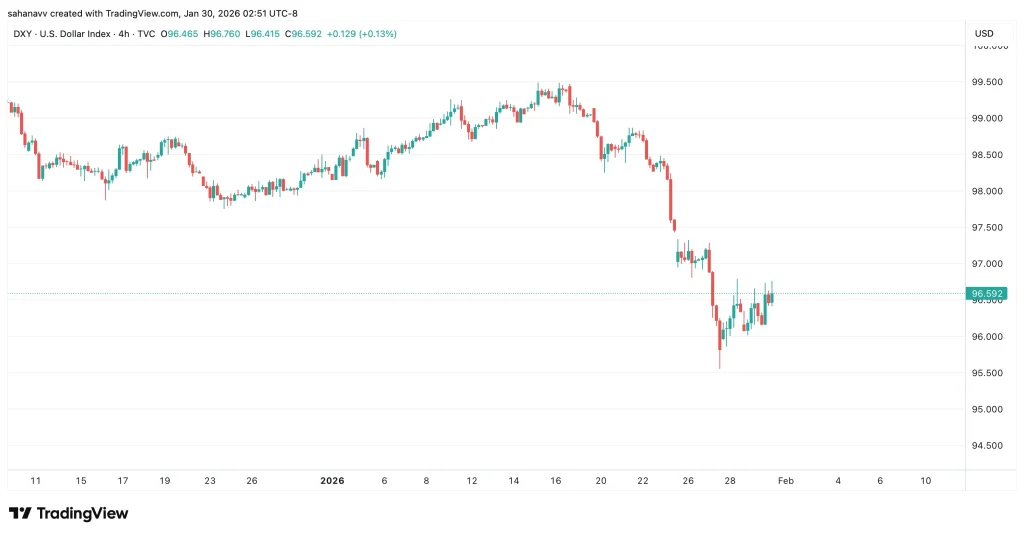
One of the main macro drivers behind the sell-off has been renewed strength in the US dollar. The DXY Index, which tracks the dollar against a basket of major currencies, reversed its recent downtrend after falling more than 3% since mid-January. The rebound signals renewed demand for the greenback as investors rotate toward safety and liquidity.

The momentum gained further support after the latest FOMC decision kept interest rates unchanged. Adding to the shift in sentiment, reports around a potential new Federal Reserve Chair also influenced expectations, strengthening the dollar and pressuring risk assets priced in USD.

What Next for Bitcoin (BTC) Price—Will it Hold the $80,000 Support?

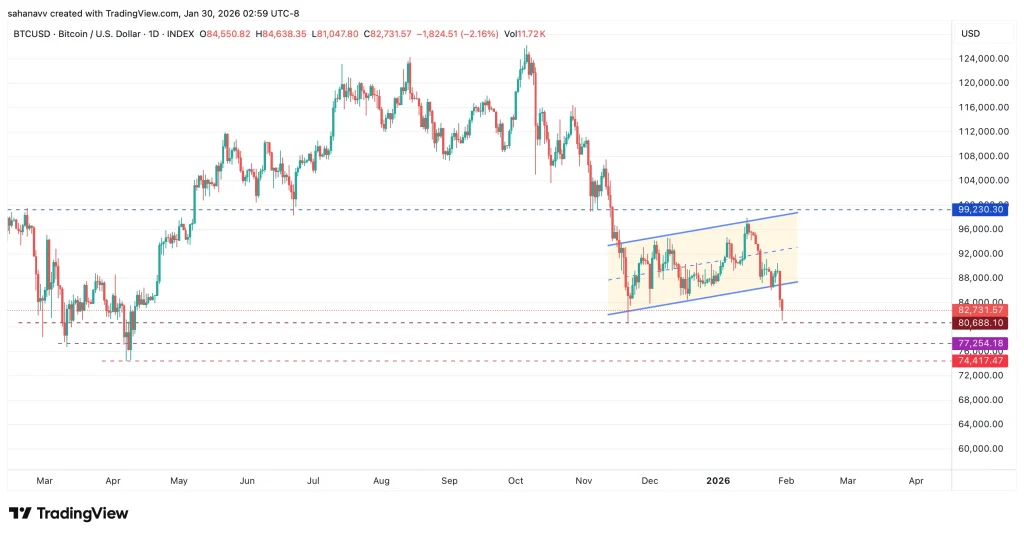
Bitcoin’s price action suggests the market is entering a decisive phase after breaking below the ascending channel that previously guided its recovery. This breakdown indicates fading bullish momentum and increases the probability of further downside in the near term. If BTC fails to reclaim the $88,000–$90,000 resistance zone, sellers may continue to dominate, dragging the price toward the $80,600 support level. 
btc price

A deeper pullback into the $77,000–$74,000 demand zone cannot be ruled out if selling pressure intensifies. However, this region remains crucial for the broader structure, as a strong reaction here could signal stabilization and renewed accumulation. Overall, Bitcoin is likely to remain volatile, with price direction hinging on how it reacts to these key support levels.

Disclaimer: The articles reposted on this site are sourced from public platforms and are provided for informational purposes only. They do not necessarily reflect the views of MEXC. All rights remain with the original authors. If you believe any content infringes on third-party rights, please contact service@support.mexc.com for removal. MEXC makes no guarantees regarding the accuracy, completeness, or timeliness of the content and is not responsible for any actions taken based on the information provided. The content does not constitute financial, legal, or other professional advice, nor should it be considered a recommendation or endorsement by MEXC.

You May Also Like

qLabs Fires First Shot in Quantum Crypto Race — Can Coinbase Catch Up?

qLabs Fires First Shot in Quantum Crypto Race — Can Coinbase Catch Up?

The rapid progress of quantum computing is forcing the cryptocurrency industry to confront the problem that has long been treated as theoretical. Blockchains th
Share
CryptoNews2026/01/30 22:53
The Anatomy of a Self-Made Billionaire’s Mindset: How Gurhan Kiziloz Reached a $1.7B Net Worth

The Anatomy of a Self-Made Billionaire’s Mindset: How Gurhan Kiziloz Reached a $1.7B Net Worth

There are many paths to wealth in the modern economy, but the one Gurhan Kiziloz took stands out for a simple reason: he built everything himself. By 2026, the
Share
Coinstats2026/01/30 23:07
Aave DAO to Shut Down 50% of L2s While Doubling Down on GHO

Aave DAO to Shut Down 50% of L2s While Doubling Down on GHO

The post Aave DAO to Shut Down 50% of L2s While Doubling Down on GHO appeared on BitcoinEthereumNews.com. Aave DAO is gearing up for a significant overhaul by shutting down over 50% of underperforming L2 instances. It is also restructuring its governance framework and deploying over $100 million to boost GHO. This could be a pivotal moment that propels Aave back to the forefront of on-chain lending or sparks unprecedented controversy within the DeFi community. Sponsored Sponsored ACI Proposes Shutting Down 50% of L2s The “State of the Union” report by the Aave Chan Initiative (ACI) paints a candid picture. After a turbulent period in the DeFi market and internal challenges, Aave (AAVE) now leads in key metrics: TVL, revenue, market share, and borrowing volume. Aave’s annual revenue of $130 million surpasses the combined cash reserves of its competitors. Tokenomics improvements and the AAVE token buyback program have also contributed to the ecosystem’s growth. Aave global metrics. Source: Aave However, the ACI’s report also highlights several pain points. First, regarding the Layer-2 (L2) strategy. While Aave’s L2 strategy was once a key driver of success, it is no longer fit for purpose. Over half of Aave’s instances on L2s and alt-L1s are not economically viable. Based on year-to-date data, over 86.6% of Aave’s revenue comes from the mainnet, indicating that everything else is a side quest. On this basis, ACI proposes closing underperforming networks. The DAO should invest in key networks with significant differentiators. Second, ACI is pushing for a complete overhaul of the “friendly fork” framework, as most have been unimpressive regarding TVL and revenue. In some cases, attackers have exploited them to Aave’s detriment, as seen with Spark. Sponsored Sponsored “The friendly fork model had a good intention but bad execution where the DAO was too friendly towards these forks, allowing the DAO only little upside,” the report states. Third, the instance model, once a smart…
Share
BitcoinEthereumNews2025/09/18 02:28