The post BNB Price Slides 6% as $900 Rejection Triggers Liquidation-Led Selloff appeared first on Coinpedia Fintech News Binance Coin (BNB) price extended its declineThe post BNB Price Slides 6% as $900 Rejection Triggers Liquidation-Led Selloff appeared first on Coinpedia Fintech News Binance Coin (BNB) price extended its decline

BNB Price Slides 6% as $900 Rejection Triggers Liquidation-Led Selloff

CMB International BNB Chain

The post BNB Price Slides 6% as $900 Rejection Triggers Liquidation-Led Selloff appeared first on Coinpedia Fintech News

Binance Coin (BNB) price extended its decline on Friday as the broader crypto market slid into a risk-off phase. BNB price fell more than 6% intraday, extending losses after failing to reclaim the psychologically important $900 level. The move comes amid a wider selloff across Bitcoin and major altcoins, where rising liquidations and tightening macro conditions are accelerating downside momentum. As price slipped below key support zones, derivatives data shows the decline was not driven by spot selling alone. Instead, the move unfolded as a liquidation-led breakdown, exposing structural weakness built up during the prior consolidation.

BNB Price Breaks Down After $900 Rejection

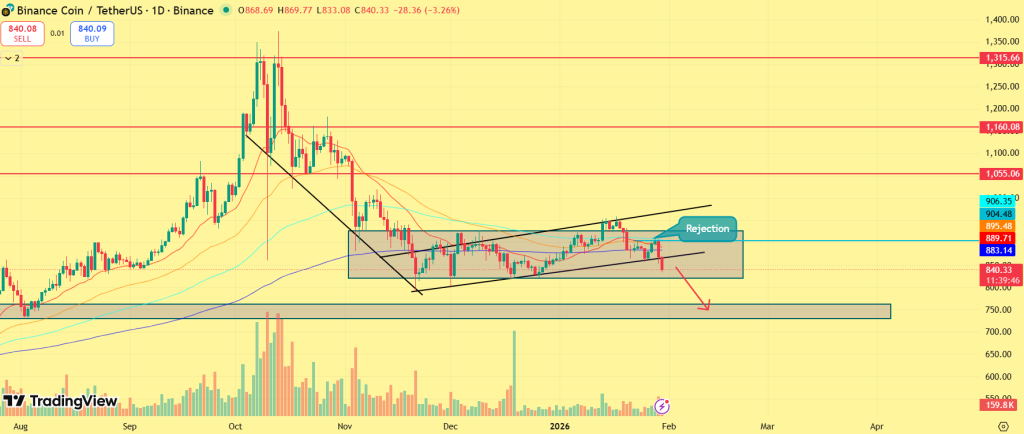
BNB price chart shows clear signs of breakdown. The rejection at $900 marked a failure at a key supply zone that has capped upside attempts multiple times. Once BNB price lost the $880 support, selling pressure intensified, breaking the short-term higher-low structure and confirming a shift toward lower-highs and lower lows. The current selloff has pushed BNB below the $850 mark, with $880 now acting as resistance rather than support. 
BNB price

If downside pressure persists, the $800-$830 emerges as the next major demand zone, aligned with prior liquidity absorption. A deeper move could expose the $800 psychological level, especially if broader market weakness continues. On the upside, any rebound toward $860-880 is likely to face selling interest unless BNB can reclaim $900 with strong volume, a scenario that currently appears unlikely given the derivatives backdrop.

Liquidations and Funding Rates Confirm Deleveraging Phase

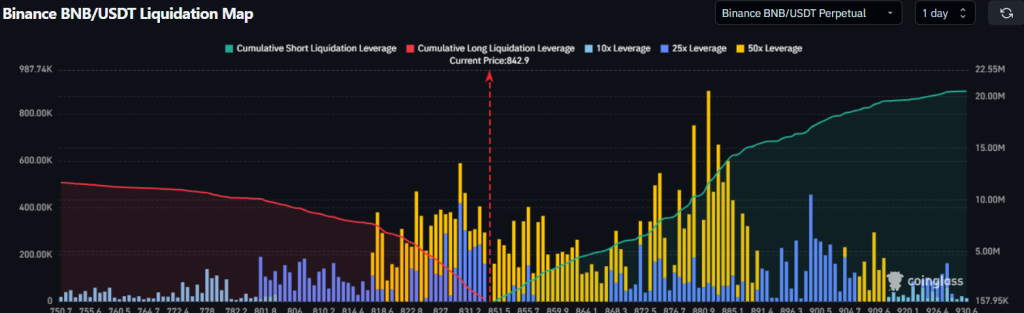
The sharp downside move in BNB was fueled by aggressive liquidation activity across derivatives markets. Liquidation heatmap data reveals dense long-position clusters stacked between $880 and $850, where leverage had accumulated over recent sessions. 
BNB liquidation map

Once BNB was rejected at $900, price quickly moved into this liquidity pocket, triggering a cascade of forced closures. During the selloff, BNB-related liquidations exceeded $100 million, with long positions accounting for the bulk of the wipeout. This confirms that bullish positioning had become overcrowded near resistance, leaving the market vulnerable to a rapid flush once support gave way.
BNB funding rate

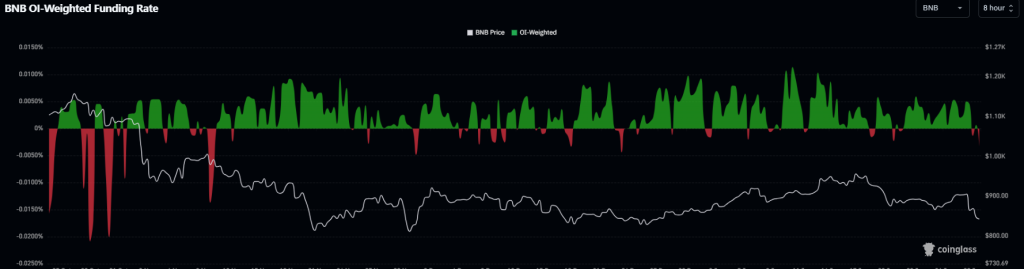
Funding rates across major perpetual contracts flipped decisively negative, sliding into the -0.01% to -0.02% range, signalling traders paying a premium to stay short. At the same time, open interest dropped by roughly 8–10%, showing that leverage was being forcibly removed rather than rotated into new positions. Together, negative funding, falling open interest, and clustered liquidations point to a structural leverage reset, not a one-off panic move.

Final Thoughts

BNB’s price rejection at $900 has shifted the short-term trend firmly bearish, with liquidation-driven selling exposing fragile market structure. Until leverage resets and price stabilizes above key resistance, downside risks remain dominant. For now, traders are watching whether demand can re-emerge near support, or if further deleveraging extends the decline.

Disclaimer: The articles reposted on this site are sourced from public platforms and are provided for informational purposes only. They do not necessarily reflect the views of MEXC. All rights remain with the original authors. If you believe any content infringes on third-party rights, please contact service@support.mexc.com for removal. MEXC makes no guarantees regarding the accuracy, completeness, or timeliness of the content and is not responsible for any actions taken based on the information provided. The content does not constitute financial, legal, or other professional advice, nor should it be considered a recommendation or endorsement by MEXC.

You May Also Like

qLabs Fires First Shot in Quantum Crypto Race — Can Coinbase Catch Up?

qLabs Fires First Shot in Quantum Crypto Race — Can Coinbase Catch Up?

The rapid progress of quantum computing is forcing the cryptocurrency industry to confront the problem that has long been treated as theoretical. Blockchains th
Share
CryptoNews2026/01/30 22:53
The Anatomy of a Self-Made Billionaire’s Mindset: How Gurhan Kiziloz Reached a $1.7B Net Worth

The Anatomy of a Self-Made Billionaire’s Mindset: How Gurhan Kiziloz Reached a $1.7B Net Worth

There are many paths to wealth in the modern economy, but the one Gurhan Kiziloz took stands out for a simple reason: he built everything himself. By 2026, the
Share
Coinstats2026/01/30 23:07
Aave DAO to Shut Down 50% of L2s While Doubling Down on GHO

Aave DAO to Shut Down 50% of L2s While Doubling Down on GHO

The post Aave DAO to Shut Down 50% of L2s While Doubling Down on GHO appeared on BitcoinEthereumNews.com. Aave DAO is gearing up for a significant overhaul by shutting down over 50% of underperforming L2 instances. It is also restructuring its governance framework and deploying over $100 million to boost GHO. This could be a pivotal moment that propels Aave back to the forefront of on-chain lending or sparks unprecedented controversy within the DeFi community. Sponsored Sponsored ACI Proposes Shutting Down 50% of L2s The “State of the Union” report by the Aave Chan Initiative (ACI) paints a candid picture. After a turbulent period in the DeFi market and internal challenges, Aave (AAVE) now leads in key metrics: TVL, revenue, market share, and borrowing volume. Aave’s annual revenue of $130 million surpasses the combined cash reserves of its competitors. Tokenomics improvements and the AAVE token buyback program have also contributed to the ecosystem’s growth. Aave global metrics. Source: Aave However, the ACI’s report also highlights several pain points. First, regarding the Layer-2 (L2) strategy. While Aave’s L2 strategy was once a key driver of success, it is no longer fit for purpose. Over half of Aave’s instances on L2s and alt-L1s are not economically viable. Based on year-to-date data, over 86.6% of Aave’s revenue comes from the mainnet, indicating that everything else is a side quest. On this basis, ACI proposes closing underperforming networks. The DAO should invest in key networks with significant differentiators. Second, ACI is pushing for a complete overhaul of the “friendly fork” framework, as most have been unimpressive regarding TVL and revenue. In some cases, attackers have exploited them to Aave’s detriment, as seen with Spark. Sponsored Sponsored “The friendly fork model had a good intention but bad execution where the DAO was too friendly towards these forks, allowing the DAO only little upside,” the report states. Third, the instance model, once a smart…
Share
BitcoinEthereumNews2025/09/18 02:28