

Trumps’ World Liberty Financial teases AI agent tech for USD1 as stablecoins near $315bn

The Trump family’s crypto startup is rewiring how machines pay.
Zak Folkman, a co-founder of World Liberty Financial, teased on Wednesday that the stablecoin issuer is preparing a major push into agentic artificial intelligence payments.
This would position its USD1 stablecoin for a future where autonomous software agents transact at machine speed.
“We’ve been building in the background,” Folkman said.
“Some very exciting updates coming that will completely change how people think about AI agents making autonomous payments,” he said.
Other developers at the project confirmed that World Liberty Financial is “already developing AI Agents capable of making autonomous payments.”
World Liberty Financial’s new push into the crossover between AI and cryptocurrency comes amid a broader rush to build infrastructure for AI-driven online commerce using stablecoins.
US President Donald Trump, who is a co-founder emeritus of World Liberty Financial, has repeatedly championed stablecoin innovation as part of his vision to make the US the “crypto capital of the world.”
Stablecoins swell
The stablecoin market has swelled to nearly $315 billion, according to DefiLlama data. That’s double the market’s size in 2022. USD1 is the fifth largest stablecoin out there.
In November, US Treasury Secretary Scott Bessent raised his forecast for global stablecoin adoption to $3 trillion by 2030, lifting his previous $2 trillion estimate by roughly 50%.
Analysts at Citi are even more bullish, projecting the stablecoin market could expand to $4 trillion by the end of the decade.
Agent revolution?
World Liberty Financial’s agentic payments push signals an attempt to anchor USD1 at the centre of what industry pioneers increasingly describe as the next growth engine for digital dollars: machine-to-machine transactions.
While the analysts behind the highly circulated Citrini Research report warn that agentic payments could lead to the downfall of the world economy, industry champions are steaming ahead to make the tech a reality.
On a recent earnings call, Circle CEO Jeremy Allaire framed stablecoins as the native currency of machine commerce.
“We’re building a new internet financial system,” he said, arguing that the real opportunity lies not in agents buying consumer goods, but in agents consuming services from one another.
Circle has rolled out new blockchain infrastructure and nanopayment capabilities designed to let agents hold balances and transact for fractions of a penny. Stripe, meanwhile, is developing Tempo, a purpose-built blockchain for stablecoin payments, alongside crypto partners.
E-commercy platform Shopify has integrated stablecoin payments with cashback incentives. Crypto exchange Coinbase incubated x402, an open standard aimed squarely at agentic payments. Venture funding is pouring into agent-driven platforms.
Yet adoption remains embryonic. x402 reports just tens of thousands of users and modest monthly volume against a global e-commerce market measured in trillions.
AI Momentum
Still, tech giants continue their relentless quest for AI platforms.
On Tuesday, Meta acquired Moltbook, a viral social network built specifically for AI agents, bringing its founders into the company’s Superintelligence Labs, Axios reported.
Moltbook created a verified registry for agents tethered to human owners, enabling them to coordinate and transact on behalf of users.
Meanwhile, OpenAI has hired the creator of OpenClaw, an autonomous agent framework.
The ecosystem is converging around identity, coordination and programmable payments — the rails required for software to act economically.
In this model, an AI legal agent charges another agent for research. A logistics agent pays a data provider for real-time shipping updates. An analytics bot purchases compute cycles by the minute. These flows are frequent, low-value and automated. They favour programmable money embedded directly into workflows.
Lance Datskoluo is DL News’ Europe-based markets correspondent. Got a tip? Email him at lance@dlnews.com.
You May Also Like

Tether Backs Ark Labs’ $5.2 Million Bet on Bitcoin’s Stablecoin Revival
MySQL Single Leader Replication with Node.js and Docker
command: --server-id=1 --log-bin=ON The --server-id option gives each MySQL server in your replication setup its own name tag. Each one has to be unique and without it, replication won’t work at all. Another cool option not included here is binlog_format=ROW. This tells MySQL how to keep track of changes before passing them along to the replicas. By default, MySQL already uses row-based replication, but you can explicitly set it to ROW to be sure or switch it to STATEMENT if you’d rather log the actual SQL statements instead of row-by-row changes. \ Run our containers on docker Now, in the terminal, we can run the following command to spin up our database containers: docker-compose up -d \ Setting Up Our Master (Primary) Server To configure our master server, we would have to first access the running instance on docker using the following command docker exec -it mysql-master bash This command opens an interactive Bash shell inside the running Docker container named mysql-master, allowing us to run commands directly inside that container. \ Now that we’re inside the container, we can access the MySQL server and start running commands. type: mysql -uroot -p This will log you into MySQL as the root user. You’ll be prompted to enter the password you set in your docker-compose.yml file. \ Next, we need to create a special user that our replicas will use to connect to the master server and pull data. Inside the MySQL prompt, run the following commands: \ CREATE USER 'repl_user'@'%' IDENTIFIED BY 'replication_pass'; GRANT REPLICATION SLAVE ON . TO 'repl_user'@'%'; FLUSH PRIVILEGES; Here’s what’s happening: CREATE USER makes a new MySQL user called repl_user with the password replication_pass. GRANT REPLICATION SLAVE gives this user permission to act as a replication client. FLUSH PRIVILEGES tells MySQL to reload the user permissions so they take effect immediately. \ Time to Configure the Replica (Secondary) Servers a. First, let’s access the replica containers the same way we did with the master. Run this command in your terminal for each of the replica containers: \ docker exec -it <replica_container_name> bash mysql -uroot -p <replica_container_name> should be replace with the name of the replica container you are trying to setup b. Now it’s time to tell our replica where to get its data from. While inside the replica’s MySQL shell, run the following command to configure replication using the master’s details: CHANGE REPLICATION SOURCE TO SOURCE_HOST='mysql-master', SOURCE_USER='repl_user', SOURCE_PASSWORD='replication_pass', GET_SOURCE_PUBLIC_KEY=1; With the replication settings in place, let’s fire up the replica and get it syncing with the master. Still inside the MySQL shell on the replica, run: START REPLICA; This starts the replication process. To make sure everything is working, check the replica’s status with:
SHOW REPLICA STATUS\G; Look for Replica_IO_Running and Replica_SQL_Running — if both say Yes, congratulations! 🎉 Your replica is now successfully connected to the master and replicating data in real time.
Testing Our Replication Setup from the Node.js App Now that our replication is successfully set up, we can configure our Node.js server to observe the real-time effect of data being replicated from the master server to the replica server whenever we write to it. We start by installing the following dependencies:
npm i express mysql2 sequelize \ Now create a folder called src in the root directory and add the following files inside that folder connection.js, index.js and model.js. Our current directory should look like this We can now set up our connections to our master and replica server in the connection.js file as shown below
const Sequelize = require("sequelize"); const sequelize = new Sequelize({ dialect: "mysql", replication: { write: { host: "127.0.0.1", username: "root", password: "master", database: "replicaDb", }, read: [ { host: "127.0.0.1", username: "root", password: "slave", database: "replicaDb", port: 3307 }, { host: "127.0.0.1", username: "root", password: "slave", database: "replicaDb", port: 3308 }, { host: "127.0.0.1", username: "root", password: "slave", database: "replicaDb", port: 3309 }, ], }, }); async function connectdb() { try { await sequelize.authenticate(); } catch (error) { console.error("❌ unable to connect to the follower database", error); } } connectdb(); module.exports = { sequelize, }; \ We can now create a User table in the model.js file
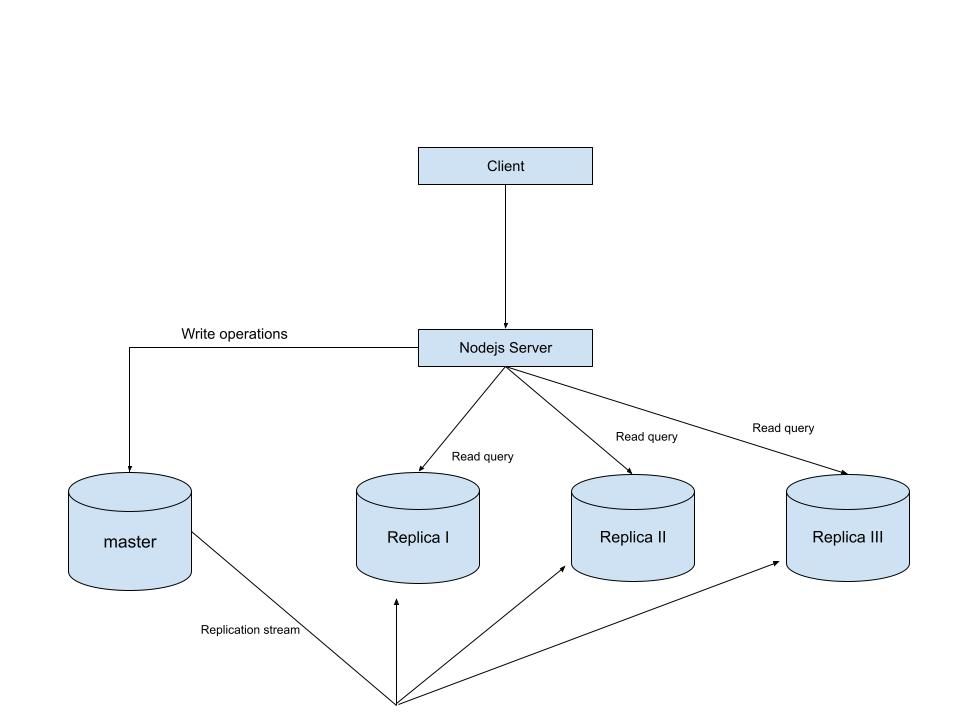
const {DataTypes} = require("sequelize"); const { sequelize } = require("./connection"); const User = sequelize.define("User", { name: { type: DataTypes.STRING, allowNull: false, }, email: { type: DataTypes.STRING, unique: true, allowNull: false, }, }); module.exports = User \ and finally in our index.js file we can start our server and listen for connections on port 3000. from the code sample below, all inserts or updates will be routed by sequelize to the master server. while all read queries will be routed to the read replicas.
const express = require("express"); const { sequelize } = require("./connection"); const User = require("./model"); const app = express(); app.use(express.json()); async function main() { await sequelize.sync({ alter: true }); app.get("/", (req, res) => { res.status(200).json({ message: "first step to setting server up", }); }); app.post("/user", async (req, res) => { const { email, name } = req.body; let newUser = await User.build({ name, email, }); // This INSERT will go to the write (master) connection newUser = newUser.save({ returning: false }); res.status(201).json({ message: "User successfully created", }); }); app.get("/user", async (req, res) => { // This SELECT query will go to one of the read replicas const users = await User.findAll(); res.status(200).json(users); }); app.listen(3000, () => { console.log("server has connected"); }); } main(); When you make a POST request to the /users endpoint, take a moment to check both the master and replica servers to observe how data is replicated in real time. Right now, we are relying on Sequelize to automatically route requests, which works for development but isn’t robust enough for a production environment. In particular, if the master node goes down, Sequelize cannot automatically redirect requests to a newly elected leader. In the next part of this series, we’ll explore strategies to handle these challenges
