US Corporate Bond Industry Statistics 2026: Hidden Trends Now
Imagine a financial landscape shaped by stability, growth, and the intricate balance of risk and reward. This scene aptly describes the US corporate bond market, a crucial pillar of the country’s financial system. In recent years, the corporate bond industry has experienced significant fluctuations driven by economic shifts, interest rate changes, and the rising influence of environmental, social, and governance (ESG) factors. The bond market is adapting, with fresh opportunities and notable challenges reshaping the industry.
This article delves into the latest statistics and trends shaping the US corporate bond market, covering everything from issuance dynamics to technological advancements in bond trading. By understanding these changes, investors, policymakers, and finance professionals can better navigate and anticipate what lies ahead in this vital sector.
Editor’s Choice
- YTD issuance reached $484.9 billion through February, rising 12.4% year over year amid strong refinancing and M&A demand.
- Investment-grade gross issuance is forecast to reach about $2.25 trillion this year, with net supply near $1.0 trillion.
- US high-grade bond sales topped $208.4 billion in January alone, about 12% above the prior year’s January record.
- Average daily US corporate bond trading volume hit roughly $70.4 billion through February, up 19.3% year over year.
- January trading saw more than $61 billion in US corporate bonds changing hands per day, about 11% higher than a year earlier.
- North America’s corporate bond market is valued at around $16.66 trillion in 2026, led by the US as the largest national market.
- Global high-yield bond default rates are expected to be around 2% this year, well below the long-term average of 4.5%.
Recent Developments
- US corporate bond issuance reached $484.9 billion through February, up 12.4% year over year.
- Investment-grade gross issuance projected at $2.25 trillion for the year, with net issuance at $1.0 trillion.
- Sales of US investment-grade corporate bonds topped $208.4 billion in January alone, up 12% from the prior year.
- Convertible bond issuance hit $13.6 billion through mid-February by 18 companies, up 556% versus the 2025 period.
- Average daily trading volume reached $70.4 billion through February, rising 19.3% year over year.
- M&A activity up 51% in Q4 2025 and 35% for the full year, driving higher bond issuance for deals.
- US Bank regulatory changes to SLR are expected to cut LTD issuance needs by over $150 billion.
- Green bond issuance forecast to hit record $370 billion globally, led by SSAs up 8%.
- 2026 Fed stress tests feature corporate bond spreads widening to 5.7 percentage points.
Expected Bond Supply Trends
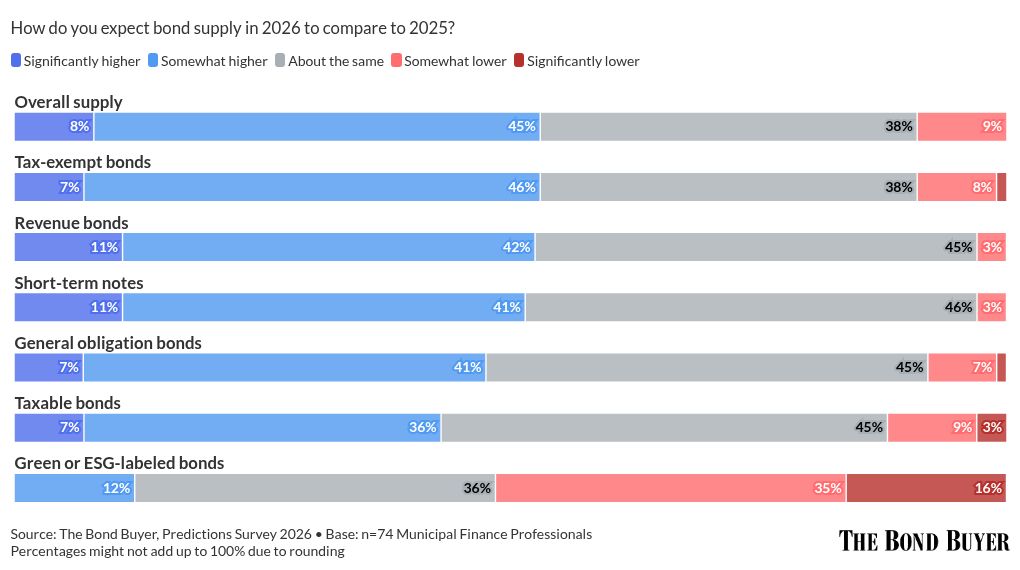
- 53% of respondents expect overall bond supply to increase, including 8% significantly higher and 45% somewhat higher, while only 9% anticipate a decline.
- 53% expect higher issuance of tax-exempt bonds, with just 9% predicting lower supply.
- 53% foresee increases in revenue bonds, while 45% expect supply to stay the same.
- 52% expect growth in short-term notes, with 46% indicating no change.
- 48% predict higher issuance of general obligation bonds, while 45% expect no significant change.
- 43% expect growth in taxable bonds, 45% anticipate stability, and 12% forecast a decline.
- 51% expect a lower supply of green and ESG-labeled bonds, including 16% significantly lower, compared to just 12% expecting growth.
- Between 36% and 46% of respondents indicate supply will stay about the same across most bond categories.
- Growth expectations outweigh declines in traditional bond segments, particularly where increases range from 48% to 53%.
- ESG bond expectations diverge, with declines reaching 51%, signaling a potential slowdown heading into 2026.
 (Reference: Fortune)
Issuance Statistics and Trends
- Total US corporate bond issuance hit $484.9 billion through February, up 12.4% year over year.
- Investment-grade gross issuance projected to exceed $2 trillion for the full year.
- High-grade bond sales surpassed $200 billion in January, smashing the prior monthly record.
- Gross corporate bond issuance reached $197.9 billion in February alone, up 14% year over year.
- Financial institutions captured 49.50% market share in corporate bond issuance.
- Large corporations held 68.73% share of the overall corporate bond market.
- Global green bond issuance expected to reach $700 billion, with US corporates at $50 billion.
- High-yield bond issuance reached $124 billion in H1, representing 9.4% of total issuance.
- Convertible bond issuance surged to $13.6 billion through mid-February, up 556%.
Investment Grade vs. High Yield Analysis
- Investment-grade issuance is projected to exceed $2 trillion gross for the year.
- High-yield returns forecasted at a median 6.2%, ranging 5-8.5%.
- High-yield default rates are expected to be 1.5-3%, below the long-term 4.5% average.
- US high-yield option-adjusted spread narrowed to 3.27% as of mid-March.
- High-yield index yield stood at 6.6% end-2025, supporting strong carry.
- Investment-grade corporate index yield around 4.8-5.0% entering the year.
- High-yield spread duration at 2.8 years, limiting impact from widening.
- New high-yield coupon averages 7.2%, easing refinancing from prior 8-9%.
Major Players and Market Share
- BofA Securities led US corporate bond underwriting with 9.96% market share in 1H 2026.
- JP Morgan ranked second at 8.72% market share in US corporate bond underwriting in 1H 2026.
- Citigroup held 8.19% market share in US corporate bond underwriting through mid-2026.
- Wells Fargo captured 6.59% market share in corporate bond underwriting in 1H 2026.
- Goldman Sachs accounted for 6.28% of the US corporate bond underwriting market share in mid-2026.
- Morgan Stanley contributed 5.63% market share in US corporate bond underwriting in 1H 2026.
- Barclays secured 3.93% market share in corporate bond underwriting through mid-2026.
Corporate Bond Trading Volume
- Average daily trading volume reached $70.4 billion through February, up 19.3% year over year.
- Total trading volume hit $1,687.1 billion through February across fixed income securities.
- More than $61 billion traded per day on average in January, up 11% from the prior year.
- Average daily notional volume rose 22% year over year to $61 billion early in the year.
- Electronic trading ADV for high-grade credit averaged $7.8 billion in recent quarters.
- Trumid reported record electronic ADV of $10.2 billion in February, up 37.8% year over year.
- Tradeweb US credit electronic ADV hit $9.8 billion in February, up 13% year over year.
- Portfolio trading rose to 18% of total electronic volume in institutional credit markets.
Interest Rate Impact on Corporate Bond Issuance
- Investment-grade issuance projected to top $2 trillion gross amid stable rate environment.
- High-yield spreads narrowed to 327 bps as of March 16 amid Fed rate cuts.
- IG corporate bond yields at 5.11% with 93 bps spread over Treasuries as of March 13.
- Corporate spreads tight at 78 bps OAS for IG index end-2025, 2nd percentile historically.
- Fed cut rates three times by the end of 2025 to 3.50-3.75%, with one more cut expected.
- 10-year Treasury yield to trade 4.0-4.5% amid moderate growth and one rate cut.
- Bank SLR changes cut LTD issuance needs by over $150 billion.
- YTD issuance $484.9 billion through February, up 12.4% Y/Y despite rates.
Bond Market Sector Breakdown
- The banking sector holds 17.69% of the corporate bond portfolio allocation.
- Consumer non-cyclical accounts for 15.91% in corporate bonds.
- Consumer cyclical represents 13.02% of the sector allocation.
- REITs comprise 9.44% of corporate bond holdings.
- The technology sector weighs 9.42% in the bond market.
- Finance companies contribute 6.27% to corporate bonds.
- Energy sector allocation stands at 5.60%.
- Electric utilities hold 4.98% market share.
Investment Review and Outlook
- Corporate bond yields averaged 5.11% for IG with a 93 bps spread as of March 13.
- High-yield index effective yield reached 6.6% end-2025, yielding strong carry.
- High-yield spreads narrowed to 327 bps OAS as of March 16.
- High-yield returns forecasted at median 6.2%, range 5-8.5%.
- IG credit outlook favors modest positive returns amid tight spreads.
- Fixed-income experts predict 4.5-5.5% annualized returns for core bonds.
- High-yield default rates are low at 1.5-3%, below 4.5% historical average.
- New high-yield coupons average 7.2%, down from prior 8-9% peaks.
- IG spreads at 78 bps OAS end-2025, 2nd tightest in 20 years.
Role of ESG and Green Bonds
- Global sustainable bond issuance forecast at $800-900 billion, signaling consolidation rather than rapid growth.
- Green bonds expected to reach about $530 billion, around 60% of total sustainable issuance.
- Social bond issuance projected near $115 billion, broadly flat versus last year.
- Sustainability bonds seen around $190 billion in new issuance.
- Sustainability-linked bonds forecast at roughly $25 billion, a small but persistent slice.
- Transition bond issuance expected to jump to about $40 billion, nearly double 2024’s level.
- Green bonds and loans together project around $955 billion ($700 billion in bonds, $255 billion in loans).
- US dollar sustainable corporate bond issuance expected to hover near $50 billion, constrained by higher rates.
Bond Market Composition by Instrument
- Treasuries represent 46% of the Bloomberg US Aggregate Index by market value.
- Corporate bonds account for 24% of the Bloomberg US Aggregate Index.
- Mortgage-backed securities comprise 28% of the Bloomberg US Aggregate Index.
- Municipal securities represent roughly 9% of total US fixed income outstanding.
- Total Treasuries outstanding reached $29.7 trillion, the largest asset class.
- Corporate bonds outstanding totaled $11.5 trillion, the second-largest class.
- Commercial paper outstanding stood at $1.3 trillion, about 3% of fixed income.
Valuations
- The average US investment-grade corporate bond yield is 5.11% with a 0.93% spread over Treasuries as of March 13.
- Moody’s seasoned Aaa corporate bond yield is 5.30% as of February.
- BBB US corporate index effective yield stands at 5.26% as of March 16.
- Corporate (Aaa/AAA) bond yields around 3.79% at 10 years on major retail platforms.
- Corporate (Baa/BBB) bond yields reach 6.51% at 10-year maturities.
- Aaa effective yield in secondary markets is approximately 4.9% in mid-March.
- 30-year US Treasury bond yield is about 4.85%, anchoring long-duration valuations.
- IRS 24-month average segment rates for December 2025 are 4.75%, 5.25%, and 5.70% for the first, second, and third segments.
Technological Innovations in Bond Trading and Analysis
- Nearly 85% of firms plan to increase AI use in corporate bond trading, up from 57% in 2024.
- The global AI-powered trading platform market is valued at around $4.56 billion, projected to reach $14.44 billion by 2035 at 15% CAGR.
- Electronification usage among bond traders rose to 79% of suitable orders, up from 70% last year.
- Portfolio trading ADV on MarketAxess hit $1.5 billion, with market share in US credit portfolios at 20.6%.
- High-grade electronic ADV on MarketAxess reached about $7.0 billion, with high-yield ADV near $1.7 billion.
- AI-driven issuance from hyperscaler firms is expected to exceed $140 billion in new bonds.
Challenges in the Corporate Bond Market
- About 85% of maturing US corporate debt through 2027 will need refinancing at higher rates, raising rollover risk.
- Roughly 25% of bonds maturing face interest costs more than 2 percentage points higher upon refinancing.
- US non-financial firms have about $930 billion of bonds maturing in 2026 and $860 billion in 2027.
- Fitch projects US high-yield bond default rates of 2.5-3.0% and leveraged loan defaults of 4.5-5.0% this year.
- Nearly 50% of surveyed investors expect the 10-year Treasury to end the year between 4.0-4.5%, implying persistent yield volatility.
- Corporate spreads remain near historical tight, with IG spreads roughly 80-90 bps, limiting compensation for risk.
- Global debt markets face sustained pressure from rising interest costs and large fiscal deficits, elevating systemic risk.
- US corporate bond defaults and distressed exchanges are expected to remain above pre-2020 norms, signaling ongoing credit stress.
Frequently Asked Questions (FAQs)
The US corporate bond market outstanding is about $11.5 trillion, up 2.2% year over year as of 3Q 2025.
US corporate bond issuance totals $484.9 billion through February, an increase of 12.4% year over year.
Gross investment-grade corporate bond issuance is projected to exceed $2 trillion.
A broad US investment-grade corporate bond index yields 5.11% with a 0.93% spread over Treasuries as of March 13.
Conclusion
The US corporate bond market is both a stabilizing force in the economy and a dynamic, evolving sector. It plays a crucial role in corporate finance and offers diverse opportunities for investors. Today, key trends such as interest rate impacts, increased ESG participation, and technological innovations in trading continue to shape the landscape.
While challenges like rate volatility, regulatory changes, and liquidity constraints remain, the bond market’s resilience and adaptability keep it robust. As companies and investors alike navigate these changes, the corporate bond market will likely see further growth and innovation, marking its continued significance in the financial world.
The post US Corporate Bond Industry Statistics 2026: Hidden Trends Now appeared first on CoinLaw.
You May Also Like
US Spot Crypto ETFs Pull in $361 Million in a Single Day as Institutional Appetite Grows

Vitalik Buterin Says Ethereum Is About to Get a Lot Faster, But There’s a Catch