Curve Finance has put forward a revenue-sharing protocol to give CRV holders sustainable income beyond emissions and fees. Curve aims to mint $60 million in crvUSD and channel it into three Bitcoin pools, and create yield opportunities. On August 18, a contributor known as michwill put forward an idea called “Create a crvUSD credit line [...]]]>Curve Finance has put forward a revenue-sharing protocol to give CRV holders sustainable income beyond emissions and fees. Curve aims to mint $60 million in crvUSD and channel it into three Bitcoin pools, and create yield opportunities. On August 18, a contributor known as michwill put forward an idea called “Create a crvUSD credit line [...]]]>

CRV Holders Poised for Direct Yield Under New Curve Finance Proposal

  • Curve Finance has put forward a revenue-sharing protocol to give CRV holders sustainable income beyond emissions and fees.
  • Curve aims to mint $60 million in crvUSD and channel it into three Bitcoin pools, and create yield opportunities.

On August 18, a contributor known as michwill put forward an idea called “Create a crvUSD credit line to Yield Basis.” People are already referring to it as Yield Basis for short, and the core idea is to provide CRV holders who lock into veCRV with a more direct and steady stream of income from the protocol.

Currently, most veCRV rewards originate from emissions and indirect incentives; however, this proposal would redirect real protocol revenue to stakers through a crvUSD-powered mechanism. If the community signs off, it could mark one of the biggest overhauls of Curve’s tokenomics in years.

The crvUSD credit line is designed to act like fuel for Curve’s liquidity engine, funding pools in much the same way as crvUSD mint markets and PegKeepers. The Yield Basis proposal lays out a system where 35%–65% of the value generated flows directly back to veCRV holders, while still ensuring liquidity providers benefit from fees and incentives.

In practice, the plan would bootstrap three “Bitcoin wrapper” pools, WBTC, cbBTC, and tBTC, each initially capped at $10 million. Pre-minted crvUSD would be loaned into these pools to strengthen liquidity while reducing long-term risks like impermanent loss.

Revenue Flow and Distribution

The revenue model is structured with multiple layers: LPs borrowing crvUSD pay rates that stay within the system to rebalance pools, while trading fees from stablecoin-to-BTC wrapper pairs are split, half covering operations and half shared between veYB holders and LPs.

With multipliers and emissions factored in, the design ensures that veYB holders capture a significant portion of the upside, aligning governance with recurring, protocol-backed rewards.

Another topic in the Yield Basis debate is how many YB tokens, the governance and incentive layer of the system, should flow back to Curve DAO itself. The working plan is that around 20% of YB token inflation would go directly to the DAO, with the potential for more if the program scales successfully. This would give the wider Curve ecosystem both skin in the game and resources to manage ongoing oversight.

However, not everyone is sold on going all-in right away. Some in the community are pushing for a phased rollout instead of dropping the entire $60 million credit line on day one. The suggestion: start smaller, maybe $10M–$20M, watch how the pools perform, and adjust based on results.

Others are focused on guardrails, audits, contract safety, crvUSD’s peg stability, and clear plans for what happens if markets swing against the system. In the first quarter of 2025, Curve Finance processed close to $35 billion in transactions, a reminder of just how central the protocol remains in DeFi.

Right now, Curve’s total value locked stands at about $39 million. On the market side, CRV has seen a big pickup in activity, with trading volume jumping 37.5% to around $230 million. The token’s market cap is sitting at roughly $1.7 billion, and CRV is currently changing hands at $0.7724. Traders are already eyeing the next key resistance level up near $0.80.

]]>
Market Opportunity
Curve Logo
Curve Price(CRV)
$0.3812
$0.3812$0.3812
-2.20%
USD
Curve (CRV) Live Price Chart
Disclaimer: The articles reposted on this site are sourced from public platforms and are provided for informational purposes only. They do not necessarily reflect the views of MEXC. All rights remain with the original authors. If you believe any content infringes on third-party rights, please contact service@support.mexc.com for removal. MEXC makes no guarantees regarding the accuracy, completeness, or timeliness of the content and is not responsible for any actions taken based on the information provided. The content does not constitute financial, legal, or other professional advice, nor should it be considered a recommendation or endorsement by MEXC.

You May Also Like

The Channel Factories We’ve Been Waiting For

The Channel Factories We’ve Been Waiting For

The post The Channel Factories We’ve Been Waiting For appeared on BitcoinEthereumNews.com. Visions of future technology are often prescient about the broad strokes while flubbing the details. The tablets in “2001: A Space Odyssey” do indeed look like iPads, but you never see the astronauts paying for subscriptions or wasting hours on Candy Crush.  Channel factories are one vision that arose early in the history of the Lightning Network to address some challenges that Lightning has faced from the beginning. Despite having grown to become Bitcoin’s most successful layer-2 scaling solution, with instant and low-fee payments, Lightning’s scale is limited by its reliance on payment channels. Although Lightning shifts most transactions off-chain, each payment channel still requires an on-chain transaction to open and (usually) another to close. As adoption grows, pressure on the blockchain grows with it. The need for a more scalable approach to managing channels is clear. Channel factories were supposed to meet this need, but where are they? In 2025, subnetworks are emerging that revive the impetus of channel factories with some new details that vastly increase their potential. They are natively interoperable with Lightning and achieve greater scale by allowing a group of participants to open a shared multisig UTXO and create multiple bilateral channels, which reduces the number of on-chain transactions and improves capital efficiency. Achieving greater scale by reducing complexity, Ark and Spark perform the same function as traditional channel factories with new designs and additional capabilities based on shared UTXOs.  Channel Factories 101 Channel factories have been around since the inception of Lightning. A factory is a multiparty contract where multiple users (not just two, as in a Dryja-Poon channel) cooperatively lock funds in a single multisig UTXO. They can open, close and update channels off-chain without updating the blockchain for each operation. Only when participants leave or the factory dissolves is an on-chain transaction…
Share
BitcoinEthereumNews2025/09/18 00:09
Franklin Templeton CEO Dismisses 50bps Rate Cut Ahead FOMC
Franklin Templeton CEO Dismisses 50bps Rate Cut Ahead FOMC

The post Franklin Templeton CEO Dismisses 50bps Rate Cut Ahead FOMC appeared on BitcoinEthereumNews.com. Franklin Templeton CEO Jenny Johnson has weighed in on whether the Federal Reserve should make a 25 basis points (bps) Fed rate cut or 50 bps cut. This comes ahead of the Fed decision today at today’s FOMC meeting, with the market pricing in a 25 bps cut. Bitcoin and the broader crypto market are currently trading flat ahead of the rate cut decision. Franklin Templeton CEO Weighs In On Potential FOMC Decision In a CNBC interview, Jenny Johnson said that she expects the Fed to make a 25 bps cut today instead of a 50 bps cut. She acknowledged the jobs data, which suggested that the labor market is weakening. However, she noted that this data is backward-looking, indicating that it doesn’t show the current state of the economy. She alluded to the wage growth, which she remarked is an indication of a robust labor market. She added that retail sales are up and that consumers are still spending, despite inflation being sticky at 3%, which makes a case for why the FOMC should opt against a 50-basis-point Fed rate cut. In line with this, the Franklin Templeton CEO said that she would go with a 25 bps rate cut if she were Jerome Powell. She remarked that the Fed still has the October and December FOMC meetings to make further cuts if the incoming data warrants it. Johnson also asserted that the data show a robust economy. However, she noted that there can’t be an argument for no Fed rate cut since Powell already signaled at Jackson Hole that they were likely to lower interest rates at this meeting due to concerns over a weakening labor market. Notably, her comment comes as experts argue for both sides on why the Fed should make a 25 bps cut or…
Share
BitcoinEthereumNews2025/09/18 00:36
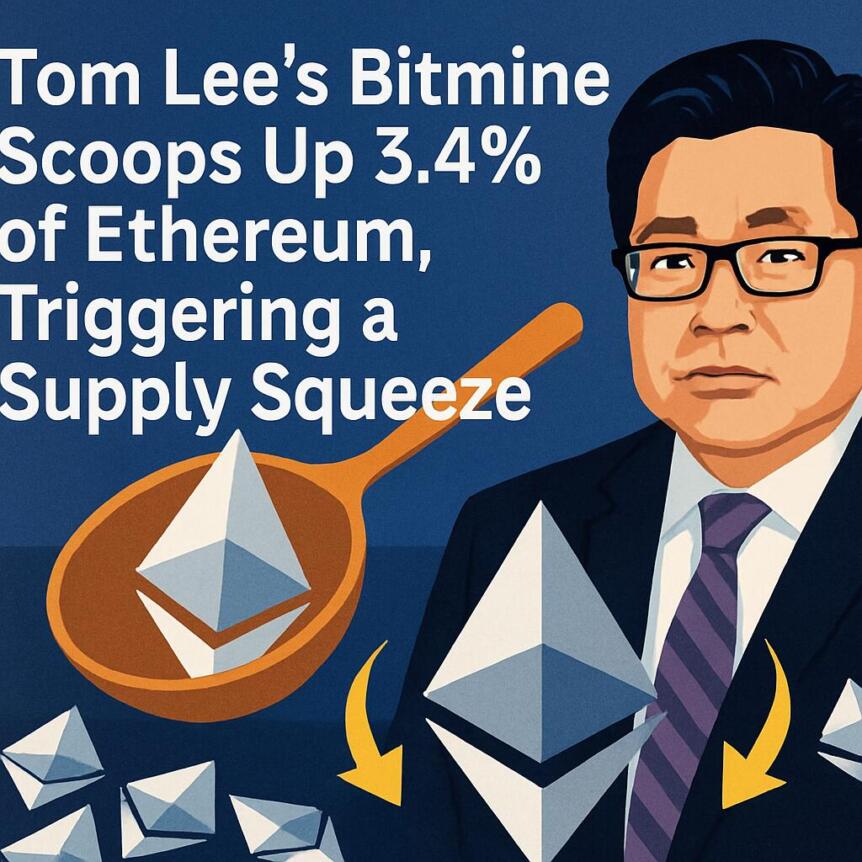
Tom Lee’s Bitmine Scoops Up 3.4% of Ethereum, Triggering a Supply Squeeze

Tom Lee’s Bitmine Scoops Up 3.4% of Ethereum, Triggering a Supply Squeeze

Bitmine Immersion now controls 3.4% of Ethereum amid shrinking exchange supply and rising institutional accumulation.
Share
Crypto Breaking News2026/01/20 16:27