Mt. Gox-linked bitcoin tied to Aleksey Bilyuchenko is continuing to filter onto exchanges, extending a slow, closely watched stream of legacy supply that on-chainMt. Gox-linked bitcoin tied to Aleksey Bilyuchenko is continuing to filter onto exchanges, extending a slow, closely watched stream of legacy supply that on-chain

Mt. Gox Hacker Unloads 1,300 Bitcoin As $360 Million Still Remains

Mt. Gox-linked bitcoin tied to Aleksey Bilyuchenko is continuing to filter onto exchanges, extending a slow, closely watched stream of legacy supply that on-chain analysts have been flagging since the fall.

Mt. Gox Hacker Unloads More Bitcoin

Arkham analyst Emmett Gallic said entities related to Aleksey Bilyuchenko deposited another 1,300 BTC, about $114 million, into unknown exchanges over the past seven days. The wallets still hold roughly 4,100 BTC (around $360 million), and have sold a total of 2,300 BTC.

Gallic wrote via X on Dec. 23: “The entity related to Aleksey Bilyuchenko has deposited another 1.3K BTC ($114M) to the unknown exchanges in the past 7 days. They still hold 4.1K BTC ($360M). They have sold a total of 2.3K BTC.”
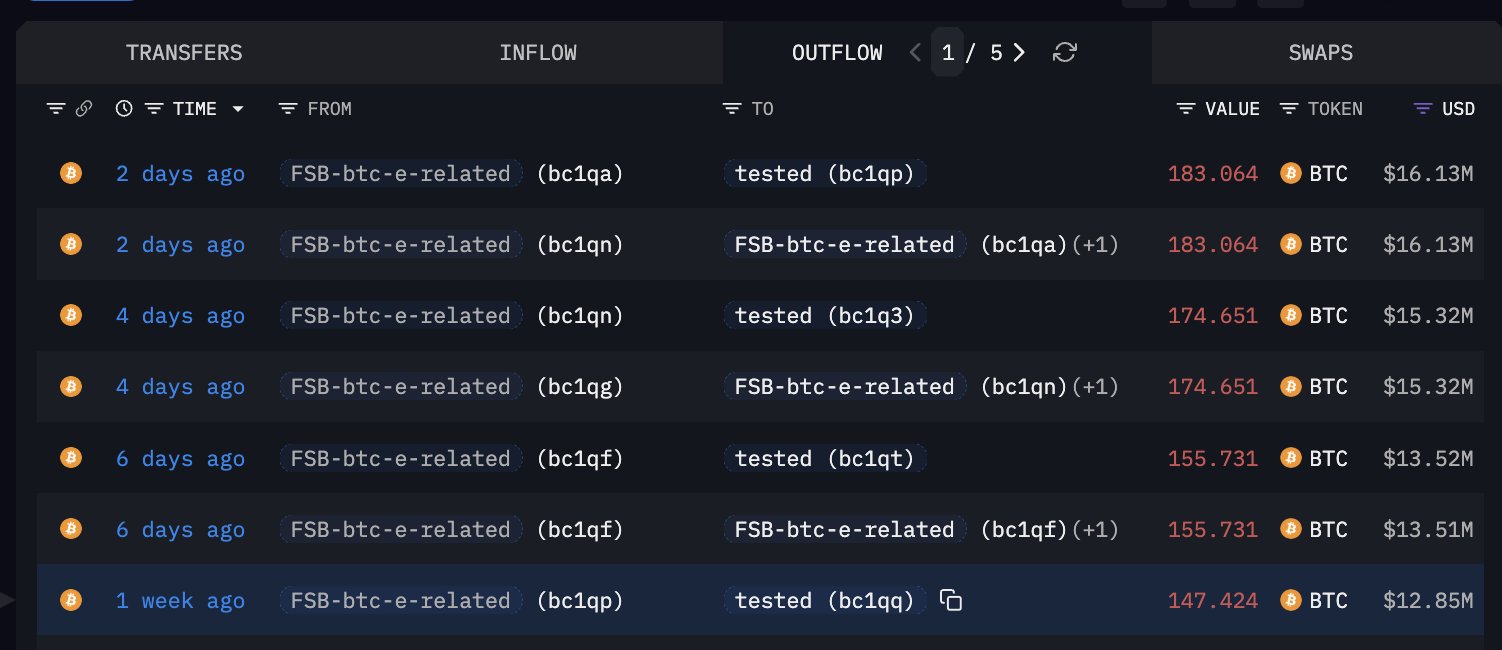
Aleksey Bilyuchenko on Arkham

Bilyuchenko has been charged by the US Department of Justice in connection with the Mt. Gox hack.

The Dec. 23 deposits build on earlier posts in which Gallic described a methodical unwind rather than a one-off dump. On Nov. 9, he said bitcoins “once belonging to BTC-E cofounder Aleksey Bilyuchenko are slowly being sold off through unknown exchanges,” citing 110 BTC deposited over two days.

That Nov. 9 note also emphasized uncertainty around who is actually controlling the funds. “Unclear if he’s still jailed in Russia or in control of these funds, but Moscow courts have seized most of his other assets,” Gallic wrote.

The repeated use of “unknown exchanges” suggests the destination clusters are not cleanly attributable to major, labeled venues in the datasets Gallic is using. For market participants, that makes the flow harder to handicap: deposits can signal intent to sell, but the execution path is less transparent than transfers into well-known exchange wallets.

In an Oct. 17 post, Gallic went further, alleging that “almost 8K BTC … related to the WEX/BTCE case are controlled by Russian authorities,” including “the 6.5K BTC that moved earlier today.” He attributed that control to a specific unit—“3rd department of the 2nd service of the CSS of the FSB”—and linked to a Russian-language investigative article.

Who Is Bilyuchenko?

In Russia, Bilyuchenko has faced a separate WEX-related criminal case that has already produced a conviction. On March 18, 2024, the Moscow City Court upheld an earlier guilty verdict against Alexey Bilyuchenko, described in local reporting as a system administrator of the WEX exchange.

Bilyuchenko was accused of embezzling 3.1 billion rubles in WEX assets; the Meshchansky District Court sentenced him in September 2023 to 3.5 years in prison and a 500,000-ruble fine, and the appeal court left that decision in place, bringing the verdict into legal force.

In the United States, the posture is different: prosecutors have unsealed charges. The case is still ongoing. In June 2023, the Department of Justice announced the unsealing of charges against Bilyuchenko and Aleksandr Verner in the Southern District of New York, accusing them of conspiring to launder approximately 647,000 bitcoin tied to the 2011 Mt. Gox hack. The SDNY indictment charges both men with conspiracy to commit money laundering, carrying a maximum potential penalty of 20 years in prison.

Separately, Bilyuchenko is charged in the Northern District of California with conspiracy to commit money laundering and operating an unlicensed money services business, tied to allegations that he worked with Alexander Vinnik and others to operate BTC-e from 2011 until it was shut down in July 2017. DOJ listed a maximum potential penalty of 25 years on those NDCA charges.

At press time, BTC traded at $87,756.
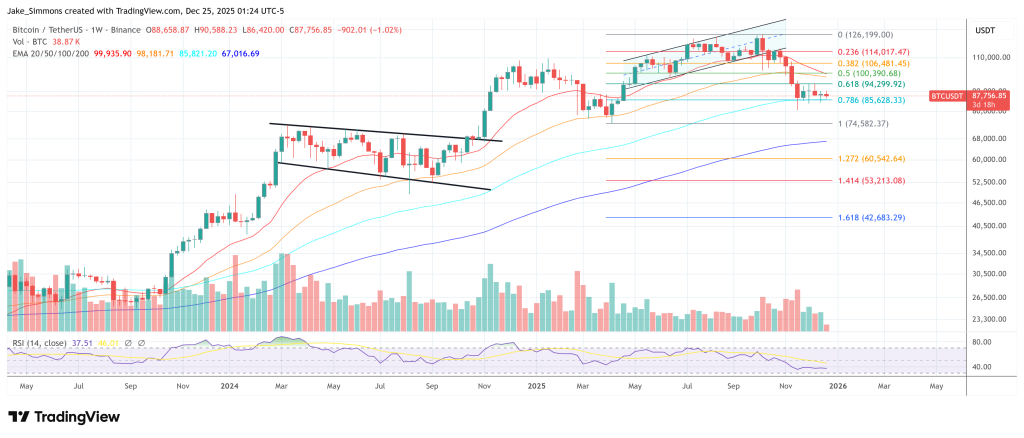
Bitcoin price chart
Market Opportunity
1 Logo
1 Price(1)
$0.00769
$0.00769$0.00769
+1.26%
USD
1 (1) Live Price Chart
Disclaimer: The articles reposted on this site are sourced from public platforms and are provided for informational purposes only. They do not necessarily reflect the views of MEXC. All rights remain with the original authors. If you believe any content infringes on third-party rights, please contact service@support.mexc.com for removal. MEXC makes no guarantees regarding the accuracy, completeness, or timeliness of the content and is not responsible for any actions taken based on the information provided. The content does not constitute financial, legal, or other professional advice, nor should it be considered a recommendation or endorsement by MEXC.

You May Also Like

Social engineering kost crypto miljarden in 2025

Social engineering kost crypto miljarden in 2025

De grootste dreiging voor crypto zit niet altijd in bugs of fouten in de code. Vaak gaat het fout bij mensen zelf. Nieuwe cijfers over 2025 laten zien hoe misleiding
Share
Coinstats2025/12/26 03:01
Christmas Stocking Stuffers? Don't Ignore These Bitcoin Mining Stocks That Gave Impressive Returns In 2025

Christmas Stocking Stuffers? Don't Ignore These Bitcoin Mining Stocks That Gave Impressive Returns In 2025

Christmas brings cheer, cakes and cozy vibes, but it can also be a perfect time for kicking off investments you may not have considered before.read more
Share
Coinstats2025/12/26 03:01
China Blocks Nvidia’s RTX Pro 6000D as Local Chips Rise

China Blocks Nvidia’s RTX Pro 6000D as Local Chips Rise

The post China Blocks Nvidia’s RTX Pro 6000D as Local Chips Rise appeared on BitcoinEthereumNews.com. China Blocks Nvidia’s RTX Pro 6000D as Local Chips Rise China’s internet regulator has ordered the country’s biggest technology firms, including Alibaba and ByteDance, to stop purchasing Nvidia’s RTX Pro 6000D GPUs. According to the Financial Times, the move shuts down the last major channel for mass supplies of American chips to the Chinese market. Why Beijing Halted Nvidia Purchases Chinese companies had planned to buy tens of thousands of RTX Pro 6000D accelerators and had already begun testing them in servers. But regulators intervened, halting the purchases and signaling stricter controls than earlier measures placed on Nvidia’s H20 chip. Image: Nvidia An audit compared Huawei and Cambricon processors, along with chips developed by Alibaba and Baidu, against Nvidia’s export-approved products. Regulators concluded that Chinese chips had reached performance levels comparable to the restricted U.S. models. This assessment pushed authorities to advise firms to rely more heavily on domestic processors, further tightening Nvidia’s already limited position in China. China’s Drive Toward Tech Independence The decision highlights Beijing’s focus on import substitution — developing self-sufficient chip production to reduce reliance on U.S. supplies. “The signal is now clear: all attention is focused on building a domestic ecosystem,” said a representative of a leading Chinese tech company. Nvidia had unveiled the RTX Pro 6000D in July 2025 during CEO Jensen Huang’s visit to Beijing, in an attempt to keep a foothold in China after Washington restricted exports of its most advanced chips. But momentum is shifting. Industry sources told the Financial Times that Chinese manufacturers plan to triple AI chip production next year to meet growing demand. They believe “domestic supply will now be sufficient without Nvidia.” What It Means for the Future With Huawei, Cambricon, Alibaba, and Baidu stepping up, China is positioning itself for long-term technological independence. Nvidia, meanwhile, faces…
Share
BitcoinEthereumNews2025/09/18 01:37