JPMorgan Freezes Accounts Linked to Stablecoin Startups Over Sanctions Risks JPMorgan Chase has recently frozen accounts associated with two venture-backed stablecoinJPMorgan Freezes Accounts Linked to Stablecoin Startups Over Sanctions Risks JPMorgan Chase has recently frozen accounts associated with two venture-backed stablecoin

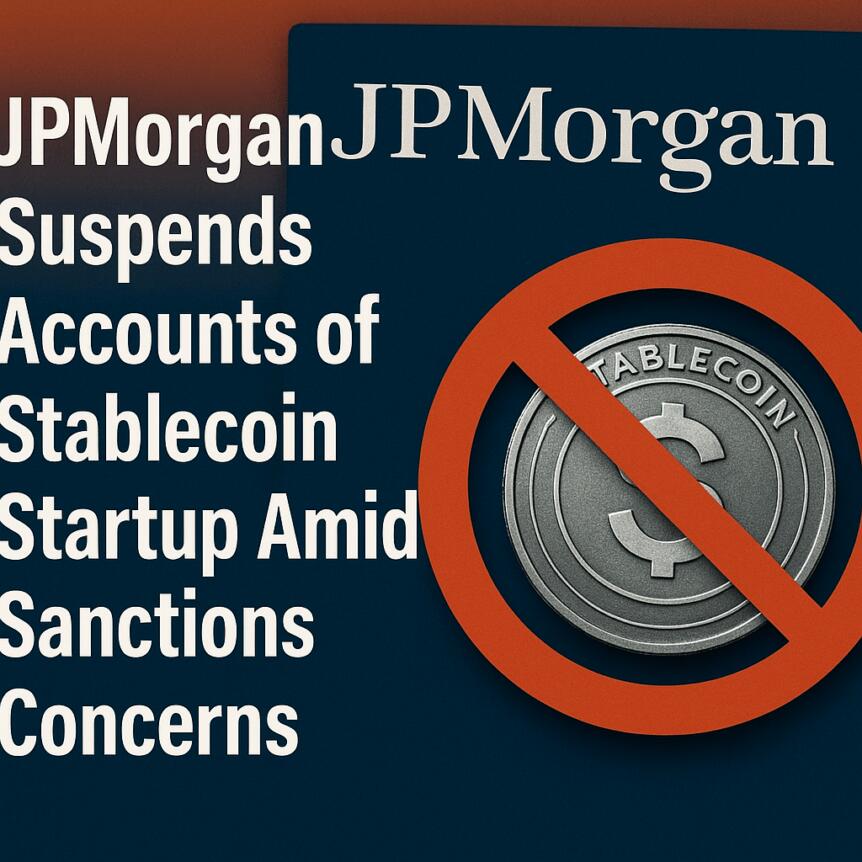
JPMorgan Suspends Accounts of Stablecoin Startup Amid Sanctions Concerns
Jpmorgan Suspends Accounts Of Stablecoin Startup Amid Sanctions Concerns

JPMorgan Freezes Accounts Linked to Stablecoin Startups Over Sanctions Risks

JPMorgan Chase has recently frozen accounts associated with two venture-backed stablecoin companies, BlindPay and Kontigo, amid concerns over exposure to sanctioned regions, particularly Venezuela. The move highlights ongoing challenges in the regulatory landscape surrounding digital assets and cross-border financial transactions.

The accounts belonged to these Y Combinator-backed startups, which primarily operate across Latin America. Both firms accessed JPMorgan’s banking infrastructure via Checkbook, a digital payments platform partnering with major financial institutions. The account freezes occurred after JPMorgan flagged business activities linked to high-risk jurisdictions subject to US sanctions, notably Venezuela.

A JPMorgan spokesperson clarified that the decision was not directly related to the stablecoins themselves. “This has nothing to do with stablecoin companies,” they stated. “We bank both stablecoin issuers and stablecoin-related businesses, and we recently took a stablecoin issuer public.” This indicates that the bank’s oversight focuses on compliance issues rather than the digital assets’ technology or market potential.

Chargeback Risks and Risk Management Strategies

According to Checkbook CEO PJ Gupta, the account closures were partly driven by a surge in chargebacks linked to the rapid onboarding of customers over the internet. Gupta explained, “They opened the floodgates and a bunch of people came in,” implying that the spike in chargebacks raised red flags for JPMorgan’s risk management teams.

The partnership between JPMorgan and Checkbook has deepened, with the firms announcing in November 2024 that Checkbook would join the J.P. Morgan Payments Partner Network. This integration allows corporate clients to send digital checks, streamlining B2B transactions across sectors like legal services, government, and banking. Earlier in 2024, Checkbook expanded its B2B offerings to further establish its presence in the digital payments ecosystem.

Amid a broader movement towards cryptocurrency adoption, especially in regions like Venezuela where citizens increasingly turn to digital assets to hedge against inflation and strict government controls, JPMorgan’s cautious stance signals ongoing regulatory tension in the space. Cointelegraph reached out to JPMorgan for comment but had not received a response at press time.

Previously, Gemini co-founder Tyler Winklevoss accused JPMorgan Chase of retaliation, asserting that the bank paused Gemini’s re-onboarding process following his criticism of JPMorgan’s data policies. This incident underscores the tensions between traditional banking giants and innovative crypto platforms, amid growing regulatory oversight.

Meanwhile, JPMorgan is reportedly exploring crypto-based financial products, including trading for institutional clients—a move reflecting increasing institutional interest and a more supportive regulatory environment for digital assets in the United States.

This article was originally published as JPMorgan Suspends Accounts of Stablecoin Startup Amid Sanctions Concerns on Crypto Breaking News – your trusted source for crypto news, Bitcoin news, and blockchain updates.

Market Opportunity
Startup Logo
Startup Price(STARTUP)
$0.0003987
$0.0003987$0.0003987
+14.33%
USD
Startup (STARTUP) Live Price Chart
Disclaimer: The articles reposted on this site are sourced from public platforms and are provided for informational purposes only. They do not necessarily reflect the views of MEXC. All rights remain with the original authors. If you believe any content infringes on third-party rights, please contact service@support.mexc.com for removal. MEXC makes no guarantees regarding the accuracy, completeness, or timeliness of the content and is not responsible for any actions taken based on the information provided. The content does not constitute financial, legal, or other professional advice, nor should it be considered a recommendation or endorsement by MEXC.

You May Also Like

Momentum Check: Can XDC Network Charge Back to Its Recent Highs, or Is a Pullback in Play?

Momentum Check: Can XDC Network Charge Back to Its Recent Highs, or Is a Pullback in Play?

The crypto market’s prolonged bearish fear is gaining more traction day by day, which has pulled down the total market cap toward $2.95 trillion. Meanwhile, most
Share
Thenewscrypto2025/12/27 15:21
Ondo Plans Tokenized U.S. Stocks and ETFs on Solana in 2026 After Low-Slippage Tests

Ondo Plans Tokenized U.S. Stocks and ETFs on Solana in 2026 After Low-Slippage Tests

The post Ondo Plans Tokenized U.S. Stocks and ETFs on Solana in 2026 After Low-Slippage Tests appeared on BitcoinEthereumNews.com. Ondo Finance plans to launch
Share
BitcoinEthereumNews2025/12/27 19:39
Vitalik Buterin Reveals Ethereum’s Bold Plan to Stay Quantum-Secure and Simple!

Vitalik Buterin Reveals Ethereum’s Bold Plan to Stay Quantum-Secure and Simple!

Buterin unveils Ethereum’s strategy to tackle quantum security challenges ahead. Ethereum focuses on simplifying architecture while boosting security for users. Ethereum’s market stability grows as Buterin’s roadmap gains investor confidence. Ethereum founder Vitalik Buterin has unveiled his long-term vision for the blockchain, focusing on making Ethereum quantum-secure while maintaining its simplicity for users. Buterin presented his roadmap at the Japanese Developer Conference, and splits the future of Ethereum into three phases: short-term, mid-term, and long-term. Buterin’s most ambitious goal for Ethereum is to safeguard the blockchain against the threats posed by quantum computing.  The danger of such future developments is that the future may call into question the cryptographic security of most blockchain systems, and Ethereum will be able to remain ahead thanks to more sophisticated mathematical techniques to ensure the safety and integrity of its protocols. Buterin is committed to ensuring that Ethereum evolves in a way that not only meets today’s security challenges but also prepares for the unknowns of tomorrow. Also Read: Ethereum Giant The Ether Machine Takes Major Step Toward Going Public! However, in spite of such high ambitions, Buterin insisted that Ethereum also needed to simplify its architecture. An important aspect of this vision is to remove unnecessary complexity and make Ethereum more accessible and maintainable without losing its strong security capabilities. Security and simplicity form the core of Buterin’s strategy, as they guarantee that the users of Ethereum experience both security and smooth processes. Focus on Speed and Efficiency in the Short-Term In the short term, Buterin aims to enhance Ethereum’s transaction efficiency, a crucial step toward improving scalability and reducing transaction costs. These advantages are attributed to the fact that, within the mid-term, Ethereum is planning to enhance the speed of transactions in layer-2 networks. According to Butterin, this is part of Ethereum’s expansion, particularly because there is still more need to use blockchain technology to date. The other important aspect of Ethereum’s development is the layer-2 solutions. Buterin supports an approach in which the layer-2 networks are dependent on layer-1 to perform some essential tasks like data security, proof, and censorship resistance. This will enable the layer-2 systems of Ethereum to be concerned with verifying and sequencing transactions, which will improve the overall speed and efficiency of the network. Ethereum’s Market Stability Reflects Confidence in Long-Term Strategy Ethereum’s market performance has remained solid, with the cryptocurrency holding steady above $4,000. Currently priced at $4,492.15, Ethereum has experienced a slight 0.93% increase over the last 24 hours, while its trading volume surged by 8.72%, reaching $34.14 billion. These figures point to growing investor confidence in Ethereum’s long-term vision. The crypto community remains optimistic about Ethereum’s future, with many predicting the price could rise to $5,500 by mid-October. Buterin’s clear, forward-thinking strategy continues to build trust in Ethereum as one of the most secure and scalable blockchain platforms in the market. Also Read: Whales Dump 200 Million XRP in Just 2 Weeks – Is XRP’s Price on the Verge of Collapse? The post Vitalik Buterin Reveals Ethereum’s Bold Plan to Stay Quantum-Secure and Simple! appeared first on 36Crypto.
Share
Coinstats2025/09/18 01:22