Traditional lending depends on banks, paperwork, and trust in centralized institutions. To borrow money, you need a credit history, you fill in endless forms, and you wait for approval. Depositors rely on banks to manage risk, set interest rates, and decide who gets access to liquidity. The system is slow, opaque, and full of middlemen who take their cut. DeFi lending flips this model. Instead of banks, protocols set the rules. Instead of clerks, smart contracts execute them automatically. Instead of credit scores, collateral (usually in crypto) secures the loan. And instead of waiting days or weeks, users can borrow or deposit in minutes, directly from their wallets. Oracles feed real-time market prices into the contracts, ensuring that loans remain properly collateralized. For borrowers, this means instant liquidity without selling long-term crypto holdings. For depositors, it means earning yield on idle assets without relying on a bank’s decision. The trade-off? Risk is managed differently. If collateral value drops, liquidation happens automatically. Transparency is high, but responsibility shifts onto the user: you control your funds, but you also carry the risks. DeFi lending is still young and volatile, but it shows what finance looks like when code replaces clerks. It removes friction and opens access globally, yet it also demands awareness and caution. In short: fewer middlemen, more control, faster access — and new risks you need to understand before diving in.Traditional lending depends on banks, paperwork, and trust in centralized institutions. To borrow money, you need a credit history, you fill in endless forms, and you wait for approval. Depositors rely on banks to manage risk, set interest rates, and decide who gets access to liquidity. The system is slow, opaque, and full of middlemen who take their cut. DeFi lending flips this model. Instead of banks, protocols set the rules. Instead of clerks, smart contracts execute them automatically. Instead of credit scores, collateral (usually in crypto) secures the loan. And instead of waiting days or weeks, users can borrow or deposit in minutes, directly from their wallets. Oracles feed real-time market prices into the contracts, ensuring that loans remain properly collateralized. For borrowers, this means instant liquidity without selling long-term crypto holdings. For depositors, it means earning yield on idle assets without relying on a bank’s decision. The trade-off? Risk is managed differently. If collateral value drops, liquidation happens automatically. Transparency is high, but responsibility shifts onto the user: you control your funds, but you also carry the risks. DeFi lending is still young and volatile, but it shows what finance looks like when code replaces clerks. It removes friction and opens access globally, yet it also demands awareness and caution. In short: fewer middlemen, more control, faster access — and new risks you need to understand before diving in.

I Unlocked Cash Without Selling Bitcoin: My OnLock Story

2025/09/22 13:13
4 min read

At some point, I needed extra funds, but selling bitcoin was not an option — that would mean locking in a loss.

I was looking for a way to keep my position while still getting access to liquidity. The solution was right there in my EMCD account.

There is a service called OnLock: you use BTC as collateral and receive USDT for temporary use. The whole process took about 15 minutes. Here’s how it worked for me.

Why Liquidity Services Are Trending

At the 0xConnect festival, there was a lot of discussion about platforms where crypto can be used as collateral. The idea is simple: you don’t sell bitcoin or ether; you leave them as collateral and receive USDT.

==Your assets remain with you, while the stablecoins can be used right away — withdrawn, used in services, or circulated.== Unlike traditional financial solutions, there’s no paperwork, credit history checks, or long waiting periods.

That’s exactly why I wanted to test OnLock in practice with EMCD.
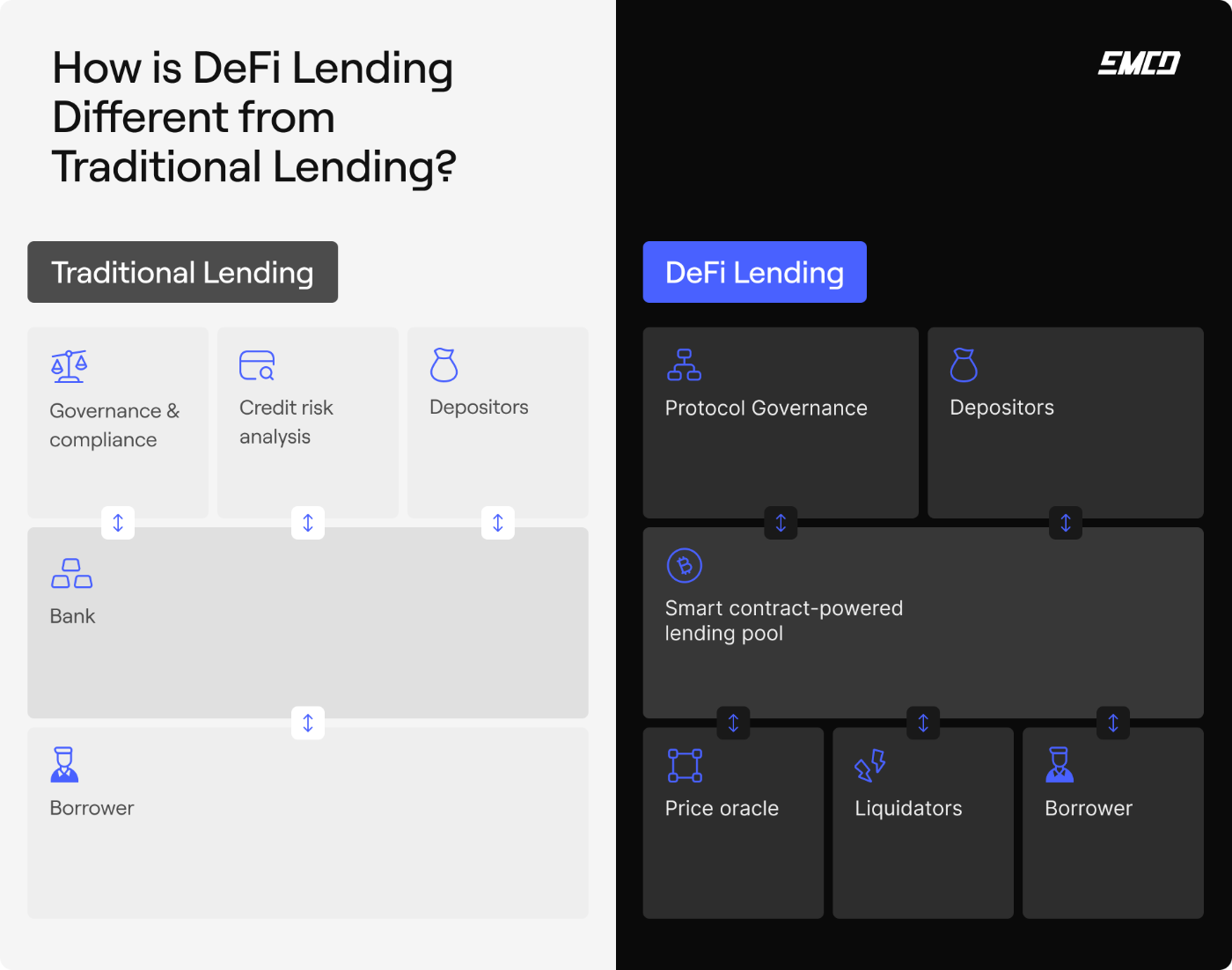
How DeFi lending works vs. traditional banks

Step One: Choosing the Terms

Everything is straightforward in the personal account. I could see my collateral in BTC, the available amount in USDT, and term options: 7, 14, 30, or 60 days.

The system displayed a fixed fee — in my case, equal to 17% annually — plus the daily calculation and the total amount for the selected term.

After adding BTC as collateral and setting the parameters, a “Receive” button appeared, and ==within 15 minutes== the USDT was in my balance.
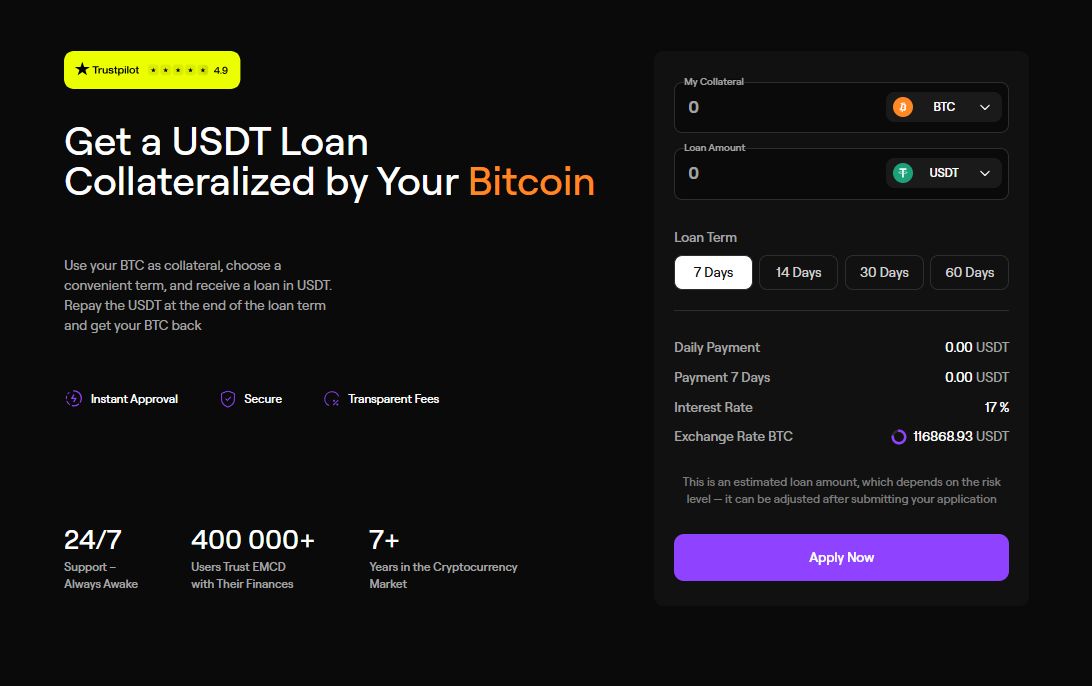
Choosing the terms

Step Two: Understanding LTV and Risk

One of the key parameters in OnLock is LTV (Loan-to-Value). It shows what portion of your BTC value you can access in USDT.

The lower the LTV, the lower the risk of liquidation. If BTC falls in price, LTV rises, and vice versa. That’s why it’s safer to keep some buffer.

Liquidation happens if the LTV exceeds 95%. In that case, the system uses part of the collateral to close the position.

The advantage with EMCD is that you get notifications and a 5-day grace period. This gives time to add more collateral or return part of the funds in advance. In other words, you stay in control of the risk instead of just watching the price move.
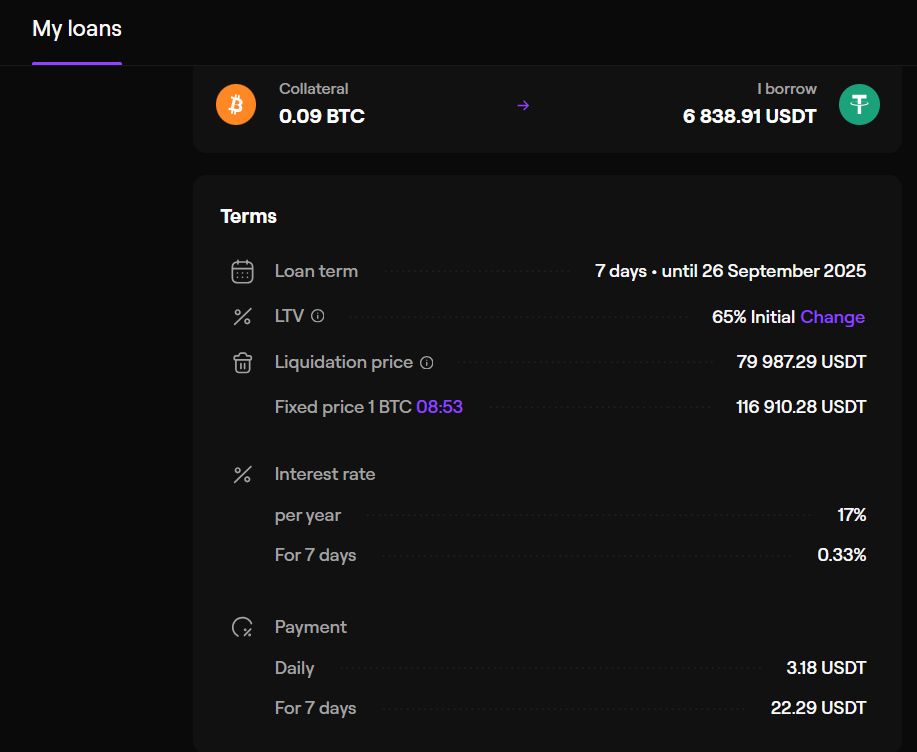
Understanding LTV and risk

Step Three: Returning USDT and Unlocking BTC

You can close the position at any time. It’s enough to return the USDT plus the platform fee — and your BTC is released immediately.

Usually, this takes less than an hour since assets are stored in cold wallets. If there are no funds available, the system closes the position automatically at the market rate, but only after the term and the 5-day grace period expire.

Step Four: How to Use USDT

Once liquidity access is arranged, ==USDT can be used right away==. EMCD offers several options: move funds into Coinhold, EMCD’s reward service, with reward levels of up to 14% annually (depending on market conditions), or withdraw through P2P.

Final Thoughts: My OnLock Experience

OnLock by EMCD is a practical way to access funds without selling core assets. It works as a collateral-based liquidity model but stands out with simple terms, transparent fees, and timely notifications.

I received USDT in 15 minutes, kept my BTC, and could manage my risks flexibly.

For comparison: Arch, YouHodler, and Compound offer similar services, but their Trustpilot ratings are noticeably lower — Compound 3.2, YouHodler 3.8, Arch 4.8.

Complaints often mention delays and hidden fees. EMCD holds a ==4.9 rating==, and my experience confirms this: everything worked quickly, clearly, and without hidden conditions.

Of course, the main drawback remains — volatility risk. If bitcoin drops sharply, the position may be liquidated. But that’s true for the entire sector, not just EMCD.

In every other aspect, the tool proved genuinely convenient: it helps preserve your portfolio while giving you liquidity here and now.

Liked this story? Don’t miss the next one. Smash that Subscribe button and stay tuned for more hands-on crypto insights!

\ \ \n

\

Market Opportunity
RealLink Logo
RealLink Price(REAL)
$0.05422
$0.05422$0.05422
-0.05%
USD
RealLink (REAL) Live Price Chart
Disclaimer: The articles reposted on this site are sourced from public platforms and are provided for informational purposes only. They do not necessarily reflect the views of MEXC. All rights remain with the original authors. If you believe any content infringes on third-party rights, please contact service@support.mexc.com for removal. MEXC makes no guarantees regarding the accuracy, completeness, or timeliness of the content and is not responsible for any actions taken based on the information provided. The content does not constitute financial, legal, or other professional advice, nor should it be considered a recommendation or endorsement by MEXC.

You May Also Like

CEO Sandeep Nailwal Shared Highlights About RWA on Polygon

CEO Sandeep Nailwal Shared Highlights About RWA on Polygon

The post CEO Sandeep Nailwal Shared Highlights About RWA on Polygon appeared on BitcoinEthereumNews.com. Polygon CEO Sandeep Nailwal highlighted Polygon’s lead in global bonds, Spiko US T-Bill, and Spiko Euro T-Bill. Polygon published an X post to share that its roadmap to GigaGas was still scaling. Sentiments around POL price were last seen to be bearish. Polygon CEO Sandeep Nailwal shared key pointers from the Dune and RWA.xyz report. These pertain to highlights about RWA on Polygon. Simultaneously, Polygon underlined its roadmap towards GigaGas. Sentiments around POL price were last seen fumbling under bearish emotions. Polygon CEO Sandeep Nailwal on Polygon RWA CEO Sandeep Nailwal highlighted three key points from the Dune and RWA.xyz report. The Chief Executive of Polygon maintained that Polygon PoS was hosting RWA TVL worth $1.13 billion across 269 assets plus 2,900 holders. Nailwal confirmed from the report that RWA was happening on Polygon. The Dune and https://t.co/W6WSFlHoQF report on RWA is out and it shows that RWA is happening on Polygon. Here are a few highlights: – Leading in Global Bonds: Polygon holds 62% share of tokenized global bonds (driven by Spiko’s euro MMF and Cashlink euro issues) – Spiko U.S.… — Sandeep | CEO, Polygon Foundation (※,※) (@sandeepnailwal) September 17, 2025 The X post published by Polygon CEO Sandeep Nailwal underlined that the ecosystem was leading in global bonds by holding a 62% share of tokenized global bonds. He further highlighted that Polygon was leading with Spiko US T-Bill at approximately 29% share of TVL along with Ethereum, adding that the ecosystem had more than 50% share in the number of holders. Finally, Sandeep highlighted from the report that there was a strong adoption for Spiko Euro T-Bill with 38% share of TVL. He added that 68% of returns were on Polygon across all the chains. Polygon Roadmap to GigaGas In a different update from Polygon, the community…
Share
BitcoinEthereumNews2025/09/18 01:10
SHIB Price Analysis for February 8

SHIB Price Analysis for February 8

The post SHIB Price Analysis for February 8 appeared on BitcoinEthereumNews.com. Original U.Today article Can traders expect SHIB to test the $0.0000070 range soon
Share
BitcoinEthereumNews2026/02/09 00:26
Solana’s Long-Term Upside Tied to Upgrades, Short-Term Structure Still Weak

Solana’s Long-Term Upside Tied to Upgrades, Short-Term Structure Still Weak

Solana remains caught between strong long-term fundamentals and a fragile short-term technical structure. While the network’s upgrade roadmap points to meaningful
Share
Coinstats2026/02/09 00:28