Not long ago, Web3 felt like chaos: thousands of tokens, hype, and little substance. In 2025, that picture shifted. Only projects with real utility, revenue, and adoption remain — creating new opportunities for investors. The main frontiers are three: DePIN (Decentralized Physical Infrastructure): networks like Helium, WeatherXM, and io.net that build telecom, weather, and GPU-sharing systems powered by tokens. AI × Crypto: projects at the intersection of decentralized AI and blockchain, from training networks (Bittensor) to data marketplaces (Ocean Protocol) and compute markets (Gensyn). RWA (Real World Assets): tokenization of U.S. Treasuries (Ondo), corporate bonds (Superstate), and even real estate (EMCD), bridging traditional finance with Web3. In this guide, I share a step-by-step view of how to approach these areas, what actually works in 2025, and what’s already proven not to.Not long ago, Web3 felt like chaos: thousands of tokens, hype, and little substance. In 2025, that picture shifted. Only projects with real utility, revenue, and adoption remain — creating new opportunities for investors. The main frontiers are three: DePIN (Decentralized Physical Infrastructure): networks like Helium, WeatherXM, and io.net that build telecom, weather, and GPU-sharing systems powered by tokens. AI × Crypto: projects at the intersection of decentralized AI and blockchain, from training networks (Bittensor) to data marketplaces (Ocean Protocol) and compute markets (Gensyn). RWA (Real World Assets): tokenization of U.S. Treasuries (Ondo), corporate bonds (Superstate), and even real estate (EMCD), bridging traditional finance with Web3. In this guide, I share a step-by-step view of how to approach these areas, what actually works in 2025, and what’s already proven not to.

What to Invest in Within Web3 in 2025: From DePIN to Tokenized Assets

5 min read

DePIN: Decentralized Infrastructure

DePIN (Decentralized Physical Infrastructure Networks) has become one of the major stories of recent years. Instead of giant corporations spending billions to build telecom networks, maps or weather stations, thousands of individuals install the hardware themselves and earn tokens in return. This model enables infrastructure to roll out faster, more flexibly and at lower cost.

Today DePIN runs on more than 13 mln active devices, and the sector’s market cap is estimated at about $50 bln. By 2028 it is projected to reach $3.5 trln. Helium 5G shows how users build mobile networks where carriers find it uneconomical.

Hivemapper turns dashcams into a decentralized alternative to Google Maps. WeatherXM makes weather station owners data providers for farmers, insurers, and logistics firms. And io.net connects idle GPUs from miners and gamers into a global computing market for AI.

How to Invest in DePIN

  1. **Choose a project \ Research DePIN ecosystems and their tokens. Look at the team, the idea and the network’s growth potential. Buy tokens of the chosen project through an exchange or wallet.

  2. **Plug in resources \ Join the network by providing what is needed: compute power, storage or bandwidth. The more resources you contribute, the larger your share of rewards.

  3. **Earn rewards \ The network automatically issues tokens for participation. This is passive income tied to your resources and user activity inside the ecosystem.

  4. **Boost yield \ Stake your earned tokens and use reward models. This way your income comes not only from base rewards but also from staking bonuses.

  5. **Act on time \ At early stages, returns are higher: competition is lower and the network is growing fast. The earlier you join and stay active, the greater the upside.

    \
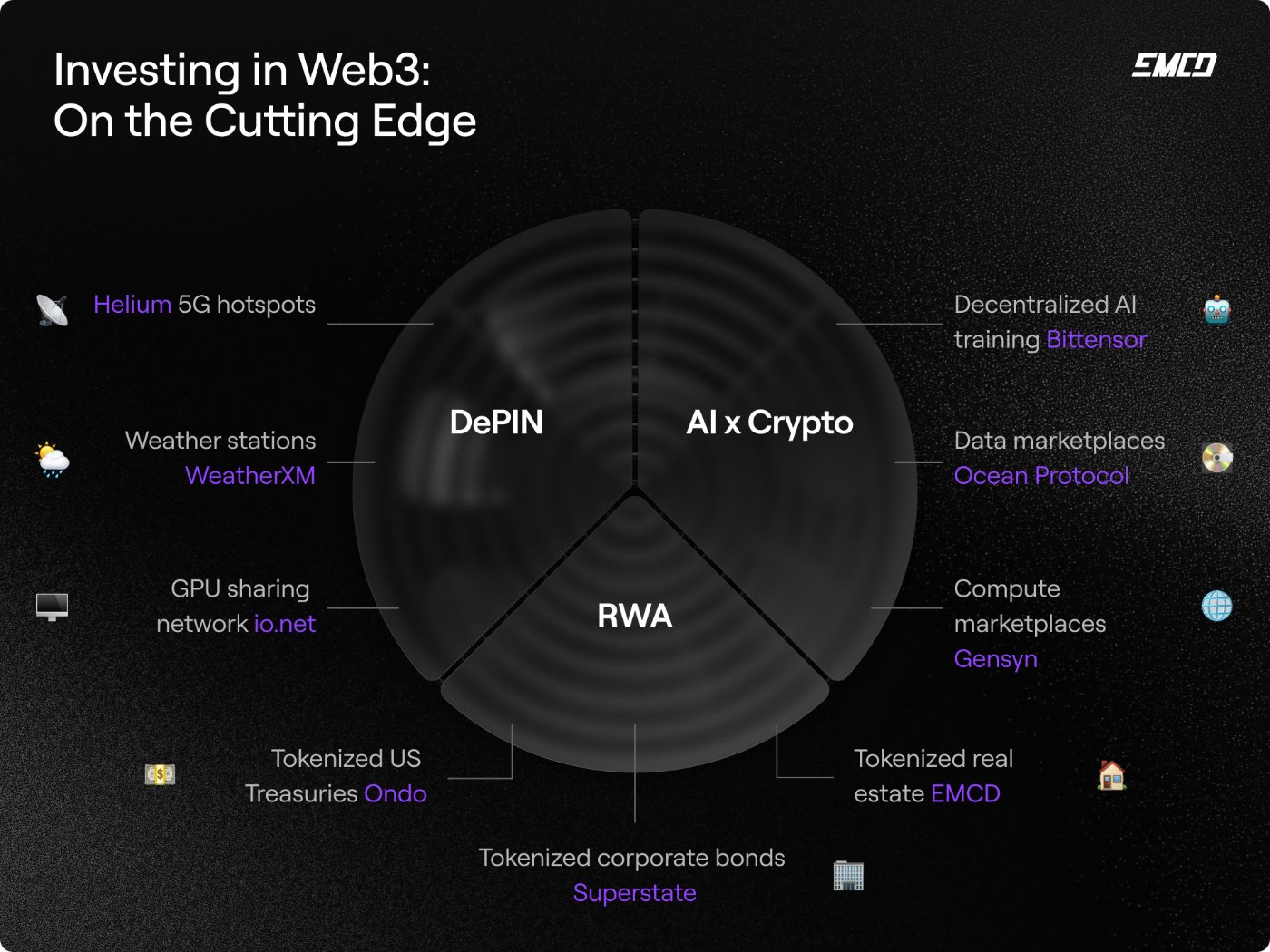
    Web3 investing today: DePIN, AI, RWA

AI + Crypto: An Ecosystem with Real Cash Flows

After the hype wave, it became clear: AI and blockchain deliver value only together.

Bittensor (TAO) builds a market where developers get paid for useful models. Ocean Protocol lets companies monetize data while keeping it private. Gensyn matches ML workloads with GPU owners, and Ritual makes neural networks transparent and verifiable.

How to Invest in AI + Crypto

  1. **Choose a project \ Look into ecosystems like Bittensor, Ocean Protocol, Gensyn or Ritual. Understand the problems they solve and buy their tokens via exchange or wallet.

  2. **Track usage \ Here token value grows not on speculation but on real demand. The more requests for compute and data, the higher the yield for holders.

  3. **Join the community \ Even without coding skills, you can engage through DAOs, voting, and initiatives. This helps networks grow and increases the value of your investment.

  4. Boost yield

    Use staking and reward programs to add income on top of token growth.

  5. **Act on time \ Early-stage projects scale faster. The earlier and more actively you participate, the higher your potential return.

RWA: Tokenization as a ‘Silent Revolution’

One of the year’s main trends is moving traditional financial instruments onto blockchain. RWA (Real World Assets) turn bonds, funds and other assets into digital form. What used to be an experiment is now a regulated market: MiCA is live in Europe, and the US has issued first licenses.

BlackRock and Franklin Templeton are already issuing tokenized debt products, Ondo is working with US Treasuries, and Superstate plus Matrixdock are digitizing corporate debt. For investors this means higher yields than banks, 24/7 liquidity and low entry barriers.

The early adopter factor is critical: those entering RWA now get premium terms and early access to products before institutions. EMCD is also active in this space, showing how tokenization of real assets becomes a new investment class bridging traditional finance and Web3.

How to Invest in RWA

  1. **Choose a project \ Look at platforms already tokenizing real assets: bonds, funds, corporate debt. Consider players like BlackRock, Franklin Templeton, Ondo, Superstate or Matrixdock.
  2. **Buy tokenized assets \ Access them through specialized services or DeFi platforms. Unlike banks, entry is lower and liquidity is around the clock.
  3. **Watch regulation \ This market is shaping within legal frameworks: MiCA in Europe, first licenses in the US. Knowing the rules helps minimize risk.
  4. **Use yield advantages \ Tokenized bonds and funds pay more than bank deposits while keeping flexibility and the ability to sell quickly.
  5. **Be an early adopter \ Enter the RWA market now while products are scaling. Early investors get premium terms and tools before institutions.
  6. **Join the ecosystem \ Engage in initiatives that develop tokenization. For example EMCD is building new solutions in this field, merging traditional finance and Web3.

What Clearly Doesn’t Work in 2025

2025 proved the market no longer forgives empty promises. NFT collections without real demand collapse fast. Tokens launched just for AI or metaverse hype disappear as quickly as they arrive. GameFi with weak player activity shuts down, and coins without use cases lose most of their value after unlocks.

For investors this means a simple truth: money works only where there is a product, customers, and revenue.

Bottom Line: A Mature Market with Real Money

Web3 is no longer a chaotic ‘sandbox’ but a mature ecosystem where technology delivers practical value.

In 2025, it became clear: value comes from decentralized networks for connectivity and mapping, compute power for AI, data exchange platforms, and tokenized financial instruments.

For investors, this marks a shift from speculation to strategies built on real demand and sustainable growth.

Top Ways to Profit in Web3 in 2025

  • DePIN – income from infrastructure (Helium, Hivemapper, io.net) → stake + reward + token growth
  • AI + Crypto – data and compute economy (Bittensor, Ocean, Gensyn) → GPU and data demand drives price
  • RWA – asset tokenization (Ondo, Franklin Templeton, EMCD) → yields above banks, liquidity 24/7
  • Yield 2.0 – new DeFi strategies → automation and combined yield
  • Community x Tokens – DAOs and communities → airdrops, early access to deals

👉 Follow me on HackerNoon. There’s a lot more ahead.

\n

\n

Market Opportunity
Notcoin Logo
Notcoin Price(NOT)
$0.000448
$0.000448$0.000448
+1.42%
USD
Notcoin (NOT) Live Price Chart
Disclaimer: The articles reposted on this site are sourced from public platforms and are provided for informational purposes only. They do not necessarily reflect the views of MEXC. All rights remain with the original authors. If you believe any content infringes on third-party rights, please contact service@support.mexc.com for removal. MEXC makes no guarantees regarding the accuracy, completeness, or timeliness of the content and is not responsible for any actions taken based on the information provided. The content does not constitute financial, legal, or other professional advice, nor should it be considered a recommendation or endorsement by MEXC.

You May Also Like

Taiko and Chainlink to Unleash Reliable Onchain Data for DeFi Ecosystem

Taiko and Chainlink to Unleash Reliable Onchain Data for DeFi Ecosystem

Taiko and Chainlink Data Streams to deliver secure, high-speed onchain data by empowering next-generation DeFi protocols and institutional-grade adoption.
Share
Blockchainreporter2025/09/18 06:10
Why The Green Bay Packers Must Take The Cleveland Browns Seriously — As Hard As That Might Be

Why The Green Bay Packers Must Take The Cleveland Browns Seriously — As Hard As That Might Be

The post Why The Green Bay Packers Must Take The Cleveland Browns Seriously — As Hard As That Might Be appeared on BitcoinEthereumNews.com. Jordan Love and the Green Bay Packers are off to a 2-0 start. Getty Images The Green Bay Packers are, once again, one of the NFL’s better teams. The Cleveland Browns are, once again, one of the league’s doormats. It’s why unbeaten Green Bay (2-0) is a 8-point favorite at winless Cleveland (0-2) Sunday according to betmgm.com. The money line is also Green Bay -500. Most expect this to be a Packers’ rout, and it very well could be. But Green Bay knows taking anyone in this league for granted can prove costly. “I think if you look at their roster, the paper, who they have on that team, what they can do, they got a lot of talent and things can turn around quickly for them,” Packers safety Xavier McKinney said. “We just got to kind of keep that in mind and know we not just walking into something and they just going to lay down. That’s not what they going to do.” The Browns certainly haven’t laid down on defense. Far from. Cleveland is allowing an NFL-best 191.5 yards per game. The Browns gave up 141 yards to Cincinnati in Week 1, including just seven in the second half, but still lost, 17-16. Cleveland has given up an NFL-best 45.5 rushing yards per game and just 2.1 rushing yards per attempt. “The biggest thing is our defensive line is much, much improved over last year and I think we’ve got back to our personality,” defensive coordinator Jim Schwartz said recently. “When we play our best, our D-line leads us there as our engine.” The Browns rank third in the league in passing defense, allowing just 146.0 yards per game. Cleveland has also gone 30 straight games without allowing a 300-yard passer, the longest active streak in the NFL.…
Share
BitcoinEthereumNews2025/09/18 00:41
One Of Frank Sinatra’s Most Famous Albums Is Back In The Spotlight

One Of Frank Sinatra’s Most Famous Albums Is Back In The Spotlight

The post One Of Frank Sinatra’s Most Famous Albums Is Back In The Spotlight appeared on BitcoinEthereumNews.com. Frank Sinatra’s The World We Knew returns to the Jazz Albums and Traditional Jazz Albums charts, showing continued demand for his timeless music. Frank Sinatra performs on his TV special Frank Sinatra: A Man and his Music Bettmann Archive These days on the Billboard charts, Frank Sinatra’s music can always be found on the jazz-specific rankings. While the art he created when he was still working was pop at the time, and later classified as traditional pop, there is no such list for the latter format in America, and so his throwback projects and cuts appear on jazz lists instead. It’s on those charts where Sinatra rebounds this week, and one of his popular projects returns not to one, but two tallies at the same time, helping him increase the total amount of real estate he owns at the moment. Frank Sinatra’s The World We Knew Returns Sinatra’s The World We Knew is a top performer again, if only on the jazz lists. That set rebounds to No. 15 on the Traditional Jazz Albums chart and comes in at No. 20 on the all-encompassing Jazz Albums ranking after not appearing on either roster just last frame. The World We Knew’s All-Time Highs The World We Knew returns close to its all-time peak on both of those rosters. Sinatra’s classic has peaked at No. 11 on the Traditional Jazz Albums chart, just missing out on becoming another top 10 for the crooner. The set climbed all the way to No. 15 on the Jazz Albums tally and has now spent just under two months on the rosters. Frank Sinatra’s Album With Classic Hits Sinatra released The World We Knew in the summer of 1967. The title track, which on the album is actually known as “The World We Knew (Over and…
Share
BitcoinEthereumNews2025/09/18 00:02