The SEC just handed Fuse Crypto a no action letter on November 24, saying they won’t chase charges. That is over the company’s energy rewards token as long as it sticks to the plan laid out. That means Fuse can sell the token without registering it as a security underThe SEC just handed Fuse Crypto a no action letter on November 24, saying they won’t chase charges. That is over the company’s energy rewards token as long as it sticks to the plan laid out. That means Fuse can sell the token without registering it as a security under

SEC Grants Fuse Crypto a No-Action Letter

2025/11/26 00:53
  • SEC okays Fuse’s ENERGY token; no registration needed.
  • Token rewards users for energy-saving, not investment profits.
  • Signals SEC easing on real-world utility tokens.

The SEC just handed Fuse Crypto a no action letter on November 24, saying they won’t chase charges. That is over the company’s energy rewards token as long as it sticks to the plan laid out. That means Fuse can sell the token without registering it as a security under the 1933 Act or listing it as equity under the 1934 Act.
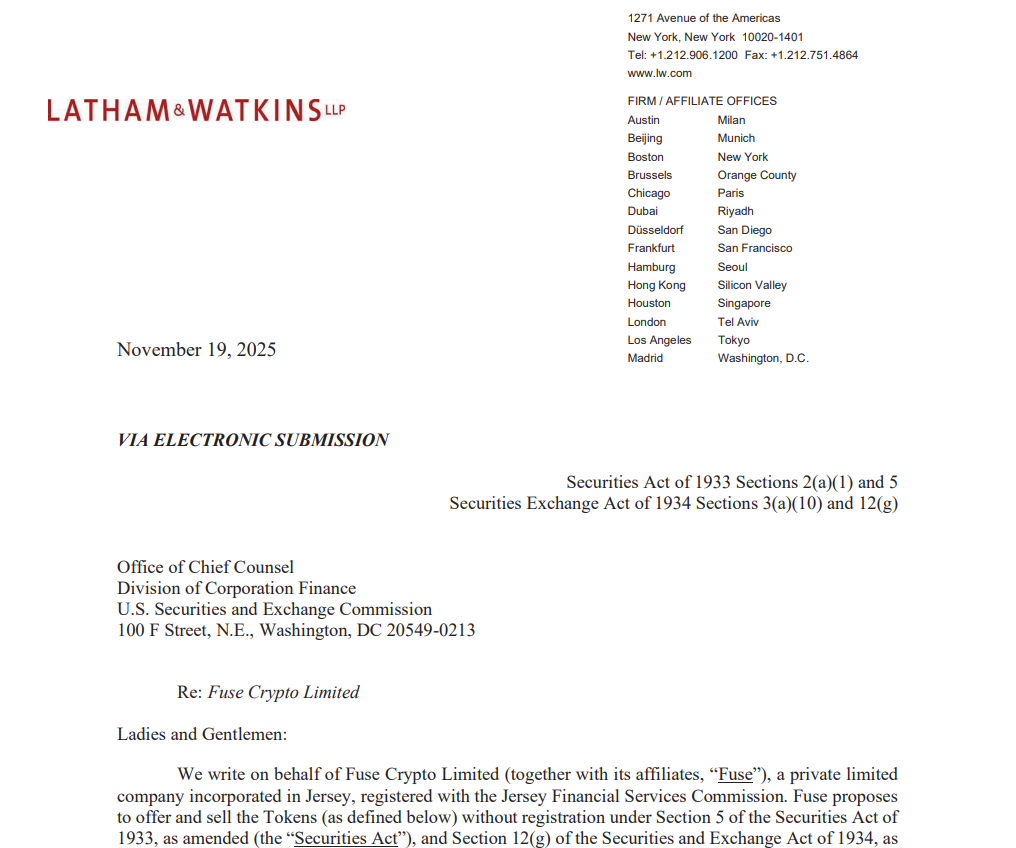
Jonathan Ingram from the SEC made it clear the okay is based strictly on Fuse’s facts—if things change, so could the relief. The letter doesn’t say if the token is or isn’t a security, just that enforcement won’t kick in right now.

Fuse’s Token and Why It’s Not a Security

Fuse works in clean energy across the U.S., putting in EV chargers, rooftop solar, and grid support gear. Their token, called FUSE or ENERGY, rewards people who join programs easing grid strain, like smart energy use.

Fuse argued it doesn’t fit the Howey Test no money invested for profits from others’ work. Users earn it for their own actions, like consuming energy smarter, not betting on Fuse’s success. The company sees it as a flexible rewards setup for a growing need in decentralized energy.

This is the second such letter lately the SEC gave one to DoubleZero in September for its DePIN token. Under Trump, the agency has shifted: hosting crypto talks, dropping old probes, starting “Project Crypto” to update rules, and working on a token taxonomy to sort securities from non-securities. Chair Paul Atkins pushed for clearer lines on digital assets.

For Fuse, it’s a green light to roll out without heavy registration, focusing on utility over speculation. For the crypto world, it’s a sign the SEC might ease up on tokens tied to real world use, cutting uncertainty after years of gray areas. Still, any slip from the described setup could flip the script fast.

Disclaimer: The articles reposted on this site are sourced from public platforms and are provided for informational purposes only. They do not necessarily reflect the views of MEXC. All rights remain with the original authors. If you believe any content infringes on third-party rights, please contact service@support.mexc.com for removal. MEXC makes no guarantees regarding the accuracy, completeness, or timeliness of the content and is not responsible for any actions taken based on the information provided. The content does not constitute financial, legal, or other professional advice, nor should it be considered a recommendation or endorsement by MEXC.

You May Also Like

U.S. Court Finds Pastor Found Guilty in $3M Crypto Scam
U.S. Court Finds Pastor Found Guilty in $3M Crypto Scam

The post U.S. Court Finds Pastor Found Guilty in $3M Crypto Scam appeared on BitcoinEthereumNews.com. Crime 18 September 2025 | 04:05 A Colorado judge has brought closure to one of the state’s most unusual cryptocurrency scandals, declaring INDXcoin to be a fraudulent operation and ordering its founders, Denver pastor Eli Regalado and his wife Kaitlyn, to repay $3.34 million. The ruling, issued by District Court Judge Heidi L. Kutcher, came nearly two years after the couple persuaded hundreds of people to invest in their token, promising safety and abundance through a Christian-branded platform called the Kingdom Wealth Exchange. The scheme ran between June 2022 and April 2023 and drew in more than 300 participants, many of them members of local church networks. Marketing materials portrayed INDXcoin as a low-risk gateway to prosperity, yet the project unraveled almost immediately. The exchange itself collapsed within 24 hours of launch, wiping out investors’ money. Despite this failure—and despite an auditor’s damning review that gave the system a “0 out of 10” for security—the Regalados kept presenting it as a solid opportunity. Colorado regulators argued that the couple’s faith-based appeal was central to the fraud. Securities Commissioner Tung Chan said the Regalados “dressed an old scam in new technology” and used their standing within the Christian community to convince people who had little knowledge of crypto. For him, the case illustrates how modern digital assets can be exploited to replicate classic Ponzi-style tactics under a different name. Court filings revealed where much of the money ended up: luxury goods, vacations, jewelry, a Range Rover, high-end clothing, and even dental procedures. In a video that drew worldwide attention earlier this year, Eli Regalado admitted the funds had been spent, explaining that a portion went to taxes while the remainder was used for a home renovation he claimed was divinely inspired. The judgment not only confirms that INDXcoin qualifies as a…
Share
BitcoinEthereumNews2025/09/18 09:14