Black Swan, a Mauritius-based Fintech startup, has emerged as the winner of the MEST Africa Challenge (MAC) 2025.…Black Swan, a Mauritius-based Fintech startup, has emerged as the winner of the MEST Africa Challenge (MAC) 2025.…

Mauritius-based fintech Black Swan emerges MEST Africa Challenge 2025 winner

2025/12/02 23:15

Black Swan, a Mauritius-based Fintech startup, has emerged as the winner of the MEST Africa Challenge (MAC) 2025. This follows the grand finale of the competition held at Innovation City in Cape Town on November 26, 2025.

In a statement released on Tuesday, as seen by Technext, MEST Africa said the 2025 edition focused on fintechs that deploy strategic innovations to bridge financial inclusion. The Grand Finale featured 10 finalists showcasing real, scalable solutions that tackle challenges across payments, credit, insurance, and trade finance.

As the 2025 winner, Black Swan will receive $50,000 in equity investment, entry into the MEST Portfolio, and the opportunity to pilot commercial solutions with Absa business units across Africa.
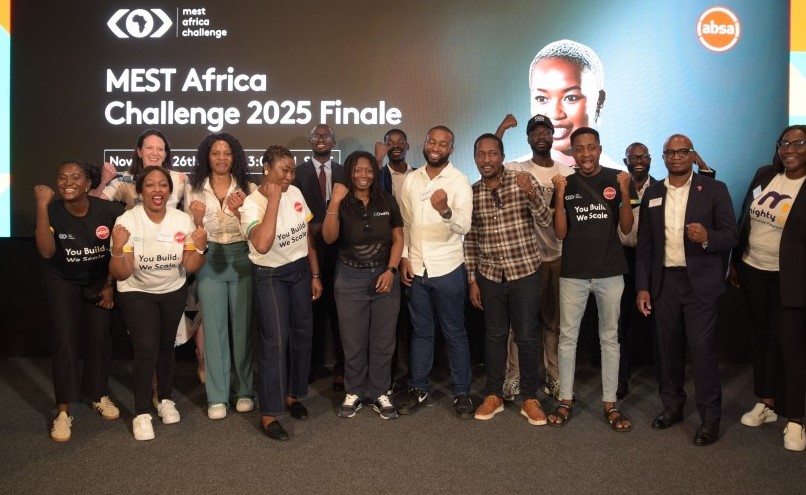
MEST AfricaMEST Africa Challenge 2025 finalists

Reacting to the development, Ashwin Ravichandran, Portfolio Advisor at MEST Africa, explained that Fintech is making a lasting impact by championing other sectors such as agriculture, energy, and trade. He added that the pitch competition shows a clear shift towards building for scale and founders’ readiness for cross-border operations.

“At MEST, we’re inspired to see entrepreneurs building solutions that are deeply local yet globally adaptable. It reflects a new maturity in African innovation; grounded in customer realities, and ambitious enough to scale across borders,” he said. 

Championed by the Meltwater Entrepreneurial School of Technology (MEST Africa) and powered by Absa Group, the MEST Africa Challenge is one of the continent’s leading Pan-African pitch competitions. The event aims to spotlight early-stage startups and guide them along their growth path. 

This year’s edition saw hundreds of entries from across Absa’s eight priority markets: Botswana, Ghana, Kenya, Mauritius, Mozambique, Seychelles, Uganda, and Zambia. Absa Group Limited is a major pan-African bank based in South Africa with a presence in 10 African countries, formerly a part of Barclays Africa.

After scrutiny, 20 startups advanced to the semifinals, and 10 startups moved on to the Cape Town finale, where they pitched to a panel of judges comprising investors, Absa executives, and industry leaders.
MEST Africa Challenge 2025MEST Africa Challenge 2025

Since 2008, the Meltwater Entrepreneurial School of Technology (MEST) Africa has trained and supported over 2,000 entrepreneurs and invested in over 90 startups. The MEST Africa Challenge (MAC) is its flagship pan-African pitch competition designed to identify, support, and scale high-potential technology ventures.

Also Read: Meet the 20 fintech startups selected for MEST Africa Challenge 2025 semifinals.

Meet Black Swan

Co-founded by Derick Kazimoto, Black Swan uses artificial intelligence and alternative data to build credit scores for Africa’s unbanked population. The company uses AI models to analyse alternative data such as mobile-money transactions and utility-bill payments to generate credit assessments for individuals and SMEs with little or no formal credit history.

Explaining the gap Black Swan aims to bridge, Kazimoto said that Africa’s financial system cannot ascertain the true creditworthiness of millions of consumers and Micro, Small, and Medium-sized Enterprises (MSMEs), as these data are invisible to traditional lenders. 

This invisibility locks out capable borrowers, limits credit growth, and slows economic mobility. Our mission is to make Africa bankable. We believe Africa is shifting from informal, collateral-heavy lending to data-driven credit. A transformation that’s changing how banks and FinTechs trust, lend, and grow,” Kazimoto added. 

The Mauritius-based startup is on a mission to bank the unbanked by turning fragmented data into instant credit intelligence.  The company rebranded from Tausi to Black Swan in April 2025. 

Market Opportunity
BLACKHOLE Logo
BLACKHOLE Price(BLACK)
$0.06444
$0.06444$0.06444
-4.03%
USD
BLACKHOLE (BLACK) Live Price Chart
Disclaimer: The articles reposted on this site are sourced from public platforms and are provided for informational purposes only. They do not necessarily reflect the views of MEXC. All rights remain with the original authors. If you believe any content infringes on third-party rights, please contact service@support.mexc.com for removal. MEXC makes no guarantees regarding the accuracy, completeness, or timeliness of the content and is not responsible for any actions taken based on the information provided. The content does not constitute financial, legal, or other professional advice, nor should it be considered a recommendation or endorsement by MEXC.

You May Also Like

The Channel Factories We’ve Been Waiting For

The Channel Factories We’ve Been Waiting For

The post The Channel Factories We’ve Been Waiting For appeared on BitcoinEthereumNews.com. Visions of future technology are often prescient about the broad strokes while flubbing the details. The tablets in “2001: A Space Odyssey” do indeed look like iPads, but you never see the astronauts paying for subscriptions or wasting hours on Candy Crush.  Channel factories are one vision that arose early in the history of the Lightning Network to address some challenges that Lightning has faced from the beginning. Despite having grown to become Bitcoin’s most successful layer-2 scaling solution, with instant and low-fee payments, Lightning’s scale is limited by its reliance on payment channels. Although Lightning shifts most transactions off-chain, each payment channel still requires an on-chain transaction to open and (usually) another to close. As adoption grows, pressure on the blockchain grows with it. The need for a more scalable approach to managing channels is clear. Channel factories were supposed to meet this need, but where are they? In 2025, subnetworks are emerging that revive the impetus of channel factories with some new details that vastly increase their potential. They are natively interoperable with Lightning and achieve greater scale by allowing a group of participants to open a shared multisig UTXO and create multiple bilateral channels, which reduces the number of on-chain transactions and improves capital efficiency. Achieving greater scale by reducing complexity, Ark and Spark perform the same function as traditional channel factories with new designs and additional capabilities based on shared UTXOs.  Channel Factories 101 Channel factories have been around since the inception of Lightning. A factory is a multiparty contract where multiple users (not just two, as in a Dryja-Poon channel) cooperatively lock funds in a single multisig UTXO. They can open, close and update channels off-chain without updating the blockchain for each operation. Only when participants leave or the factory dissolves is an on-chain transaction…
Share
BitcoinEthereumNews2025/09/18 00:09
XRP Price Prediction: Can Ripple Rally Past $2 Before the End of 2025?

XRP Price Prediction: Can Ripple Rally Past $2 Before the End of 2025?

The post XRP Price Prediction: Can Ripple Rally Past $2 Before the End of 2025? appeared first on Coinpedia Fintech News The XRP price has come under enormous pressure
Share
CoinPedia2025/12/16 19:22
BlackRock boosts AI and US equity exposure in $185 billion models

BlackRock boosts AI and US equity exposure in $185 billion models

The post BlackRock boosts AI and US equity exposure in $185 billion models appeared on BitcoinEthereumNews.com. BlackRock is steering $185 billion worth of model portfolios deeper into US stocks and artificial intelligence. The decision came this week as the asset manager adjusted its entire model suite, increasing its equity allocation and dumping exposure to international developed markets. The firm now sits 2% overweight on stocks, after money moved between several of its biggest exchange-traded funds. This wasn’t a slow shuffle. Billions flowed across multiple ETFs on Tuesday as BlackRock executed the realignment. The iShares S&P 100 ETF (OEF) alone brought in $3.4 billion, the largest single-day haul in its history. The iShares Core S&P 500 ETF (IVV) collected $2.3 billion, while the iShares US Equity Factor Rotation Active ETF (DYNF) added nearly $2 billion. The rebalancing triggered swift inflows and outflows that realigned investor exposure on the back of performance data and macroeconomic outlooks. BlackRock raises equities on strong US earnings The model updates come as BlackRock backs the rally in American stocks, fueled by strong earnings and optimism around rate cuts. In an investment letter obtained by Bloomberg, the firm said US companies have delivered 11% earnings growth since the third quarter of 2024. Meanwhile, earnings across other developed markets barely touched 2%. That gap helped push the decision to drop international holdings in favor of American ones. Michael Gates, lead portfolio manager for BlackRock’s Target Allocation ETF model portfolio suite, said the US market is the only one showing consistency in sales growth, profit delivery, and revisions in analyst forecasts. “The US equity market continues to stand alone in terms of earnings delivery, sales growth and sustainable trends in analyst estimates and revisions,” Michael wrote. He added that non-US developed markets lagged far behind, especially when it came to sales. This week’s changes reflect that position. The move was made ahead of the Federal…
Share
BitcoinEthereumNews2025/09/18 01:44