NEAR Protocol reached 1 million transactions per second in benchmark tests using 70 shards, demonstrating sharding's scalability potential far beyond Visa's peak capacity. The post NEAR Achieves 1M Transactions Per Second in Sharded, Test Environment appeared first on Coinspeaker.NEAR Protocol reached 1 million transactions per second in benchmark tests using 70 shards, demonstrating sharding's scalability potential far beyond Visa's peak capacity. The post NEAR Achieves 1M Transactions Per Second in Sharded, Test Environment appeared first on Coinspeaker.

NEAR Achieves 1M Transactions Per Second in Sharded, Test Environment

NEAR Protocol NEAR $1.75 24h volatility: 1.1% Market cap: $2.24 B Vol. 24h: $188.81 M has achieved a significant milestone of 1 million transactions per second (TPS) in a benchmark test environment created to simulate a real-world scenario. This development helps to demonstrate sharding is an efficient method for high scalability and throughput capacity for high-performance blockchains—surpassing Visa’s peak capacity of around 65,000 transactions per second.

The NEAR Foundation reported this recent achievement in a blog post on Dec. 8, explaining the benchmark’s methodology in “a publicly verifiable benchmark using real code, realistic workloads, and cost-effective and performant Google Compute Engine C4D machines across 70 shards,” as described.

Results are available in three Grafana dashboards that achieved 1,029,497, 1,037,334, and 1,037,495 transactions per second peaks, followed by a constant one million TPS performance for nearly one hour each.
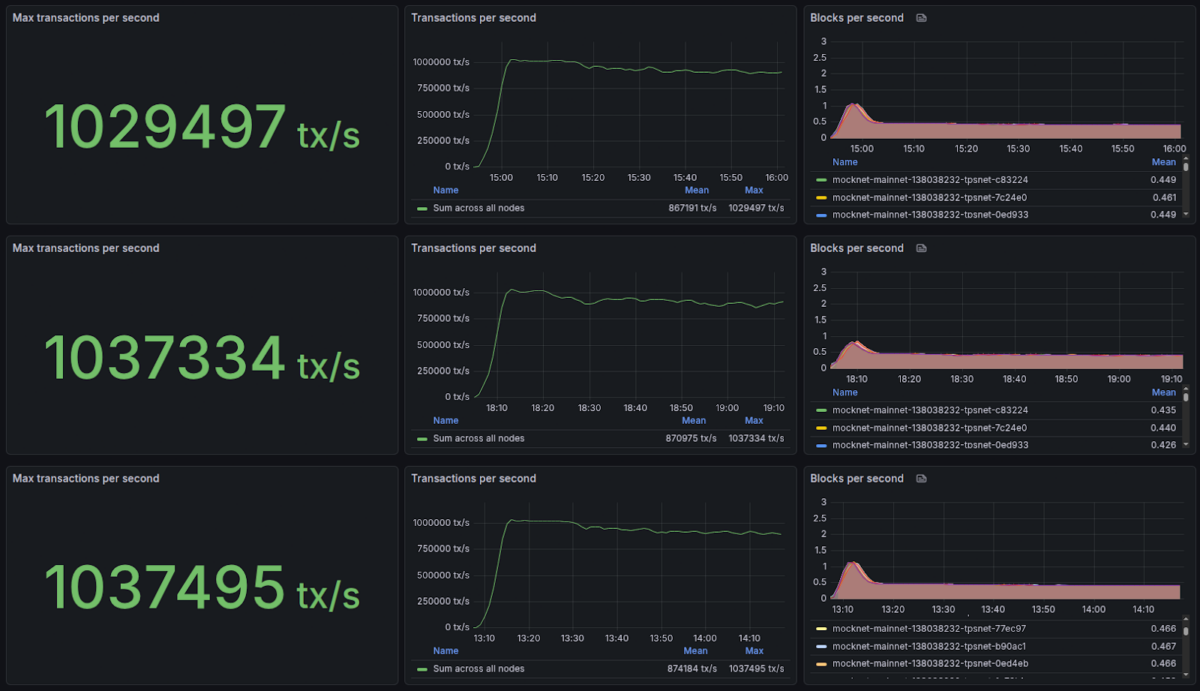
Grafana dashboards for three NEAR Protocol 1M-TPS tests | Source: NEAR Foundation/Grafana

Grafana dashboards for three NEAR Protocol 1M-TPS tests | Source: NEAR Foundation/Grafana

As described in the blog post, this benchmark had validators split in 70 shards, running commercial-grade hardware from Google Cloud, with an approximate cost of $900 per month. While accessible, this cost is significantly higher than the minimum required to run chunk validators on NEAR—currently estimated at $15 per month, according to Meta Pool’s Node Studio.

This test used only native token transfers, not broadcasting smart contract executions that require more network gas and computational power, which could reduce the overall capacity per second. Moreover, the NEAR blockchain currently has nine shards and not the 70 shards used for the tests, meaning the current mainnet capacity is likely orders of magnitude below the achieved one million transactions per second.

Nevertheless, it suggests NEAR Protocol is ready, with enough optimizations, to scale at any moment to something close to 1 million TPS with consistency and network reliability as adoptions and demand for block space grows.

How Many TPS Other Blockchains and Payment Processors Can Achieve?

Interestingly, Visa (NYSE: V) can scale to 65,000 transactions per second, according to The Banking Scene. In 2024, Visa processed an average of approximately 25,091 transactions per second globally, based on the total of roughly 293 billion payment transactions handled that year.

Data Coinspeaker gathered from Chainspect on Dec. 8 shows the theoretical maximum TPS other blockchains can achieve, based on benchmark tests like the one provided by NEAR, or rough calculations by the Chainspect analysts.

When comparing with some of the largest cryptocurrencies by market cap, Sonic, ICP, and Aptos have the largest maximum theoretical TPS after NEAR, with nearly 400,000, 210,000, and 160,000 transactions per second, respectively.

Sui SUI $1.61 24h volatility: 0.9% Market cap: $6.01 B Vol. 24h: $995.44 M , TON TON $1.63 24h volatility: 1.4% Market cap: $3.98 B Vol. 24h: $135.10 M , Polkadot DOT $2.12 24h volatility: 0.7% Market cap: $3.49 B Vol. 24h: $192.42 M , and Solana SOL $134.4 24h volatility: 1.0% Market cap: $75.38 B Vol. 24h: $5.34 B follow suit, with approximately 120,000, 105,000, 100,000, and 65,000 TPS, respectively. However, SOL is the one with the highest “Real-Time TPS” across all blockchains on Chainspect—at 1,238 transactions per second by the time of this writing.
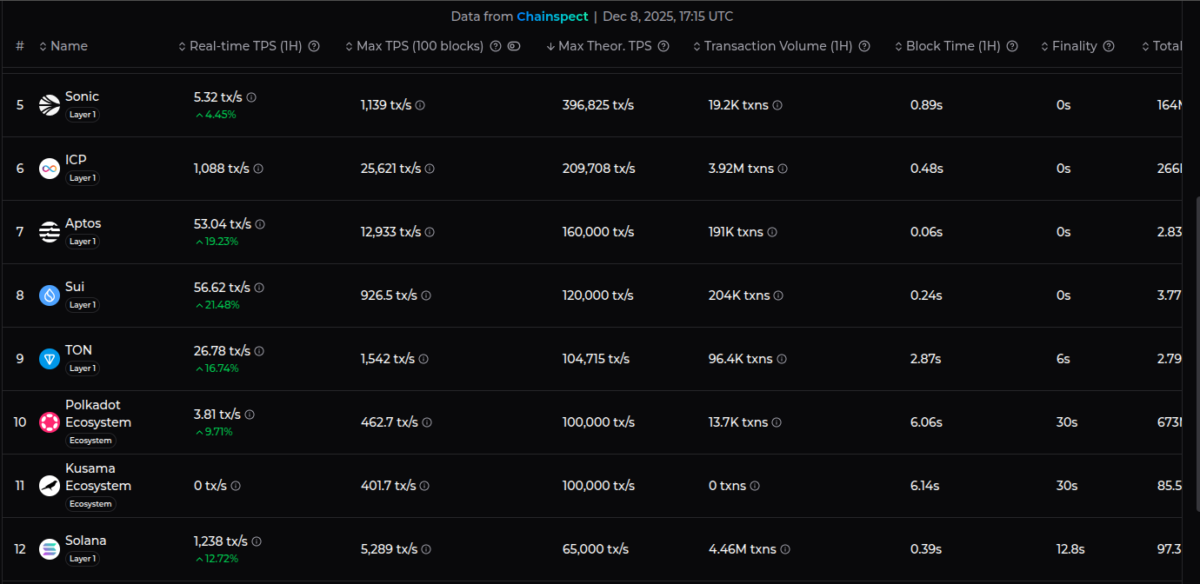
Fastest blockchains by transactions per second (TPS), as of Dec. 8 | Source: Coinspect

Fastest blockchains by transactions per second (TPS), as of Dec. 8 | Source: Coinspect

Therefore, this recent achievement positions NEAR as one of the layer-one blockchain networks with the highest theoretical capacity and scalability. This adds up to recent positive developments in the NEAR ecosystem, as Coinspeaker has covered and reported about.

On Dec. 5, NEAR launched TravAI, together with ADI Chain, where AI agents handle complete travel booking workflows from search to payment using crypto. On Dec. 3, the foundation announced NEAR AI Cloud and Private Chat, two related products that were already integrated by relevant players like the Brave Browser. Kalshi also recently added support to NEAR’s native token and NEAR Intents surpassed the $7 billion mark for its chain-abstracted swaps all-time volume.

next

The post NEAR Achieves 1M Transactions Per Second in Sharded, Test Environment appeared first on Coinspeaker.

Market Opportunity
NEAR Logo
NEAR Price(NEAR)
$1.581
$1.581$1.581
+7.99%
USD
NEAR (NEAR) Live Price Chart
Disclaimer: The articles reposted on this site are sourced from public platforms and are provided for informational purposes only. They do not necessarily reflect the views of MEXC. All rights remain with the original authors. If you believe any content infringes on third-party rights, please contact service@support.mexc.com for removal. MEXC makes no guarantees regarding the accuracy, completeness, or timeliness of the content and is not responsible for any actions taken based on the information provided. The content does not constitute financial, legal, or other professional advice, nor should it be considered a recommendation or endorsement by MEXC.

You May Also Like

YZi accelerates on BNB Chain

YZi accelerates on BNB Chain

The post YZi accelerates on BNB Chain appeared on BitcoinEthereumNews.com. According to on-chain data from DeFiLlama, the circulating supply of USDe has surpassed 13 billion dollars. Market analysts note that this growth fits into a broader picture of stablecoin expansion, with increasing demand for digital dollars and synthetic products, a trend verified in major on-chain dashboards and industry reports. The Picture: Record of USDe and Strategic Push by YZi USDe consolidates a growth record in the crypto dollar segment, with a circulating supply that has exceeded 13 billion, as reported by recently verified market sources. In parallel, YZi Labs — the family office of Changpeng “CZ” Zhao and Yi He — intensifies collaboration with Ethena Labs for the next phase of scalability, with a distinctly cross‑chain horizon. The roadmap outlines three main directions: expansion on BNB Chain, launch of a fiat‑backed stablecoin (USDtb), and development of a settlement layer for institutional flows. The goal is to combine liquidity, compliance, and cross‑chain use cases, while maintaining a focus on transparency and risk management. That said, execution remains the decisive point. What’s Coming: Products and Integrations USDtb (in development): stablecoin pegged to fiat currencies, designed for fiat–crypto flows and for more straightforward accounting needs compared to the synthetic dollar USDe. Converge: level of institutional settlement developed in collaboration with Securitize. The design aims for interoperability with tokenized assets; Securitize, which has collaborated with BlackRock on the tokenized fund BUIDL, intends to strengthen the bridge between crypto and traditional finance. BNB Chain: extension of the USDe ecosystem to expand accessibility and integration into the DeFi world, with potential synergies on liquidity and on‑ramp. USDe in brief: how the “synthetic dollar” works USDe combines reserves in crypto assets (e.g., bitcoin, ether, solana) with short positions on perpetual futures to maintain the peg close to 1 USD. The mechanism, designed to neutralize the underlying volatility,…
Share
BitcoinEthereumNews2025/09/22 22:53
Uniswap Fee Switch Set to Take Effect Before New Year

Uniswap Fee Switch Set to Take Effect Before New Year

The post Uniswap Fee Switch Set to Take Effect Before New Year appeared on BitcoinEthereumNews.com. The highly anticipated Uniswap protocol fee switch, dubbed “
Share
BitcoinEthereumNews2025/12/22 20:11
Ethereum Name Service price prediction 2025-2031: Is ENS a good investment?

Ethereum Name Service price prediction 2025-2031: Is ENS a good investment?

Key takeaways: The Ethereum Name Service is a network that enables crypto enthusiasts to rename their cryptocurrency addresses into something simpler, making them easier to remember. Renaming crypto addresses through ENS will enable users to recollect and write them quickly. Even though Ethereum Name Service is based on the Ethereum blockchain, it uses its cryptocurrency, […]
Share
Cryptopolitan2025/09/18 01:38