

Pakistan Moves Toward $2 Billion Asset Tokenization with Binance Partnership
Pakistan signs Binance MoU to explore $2 billion asset tokenization, advance stablecoin plans, and formalize crypto regulation.
Pakistan has accelerated its digital finance agenda by signing a memorandum with crypto exchange Binance. The agreement examines tokenization of up to $2 billion in state-owned assets. Moreover, officials confirmed parallel work on a national stablecoin. Consequently, the shift signifies a major push towards financial modernization in the blockchain world.
Binance Deal Targets Bonds, Bills, and Commodity Reserves
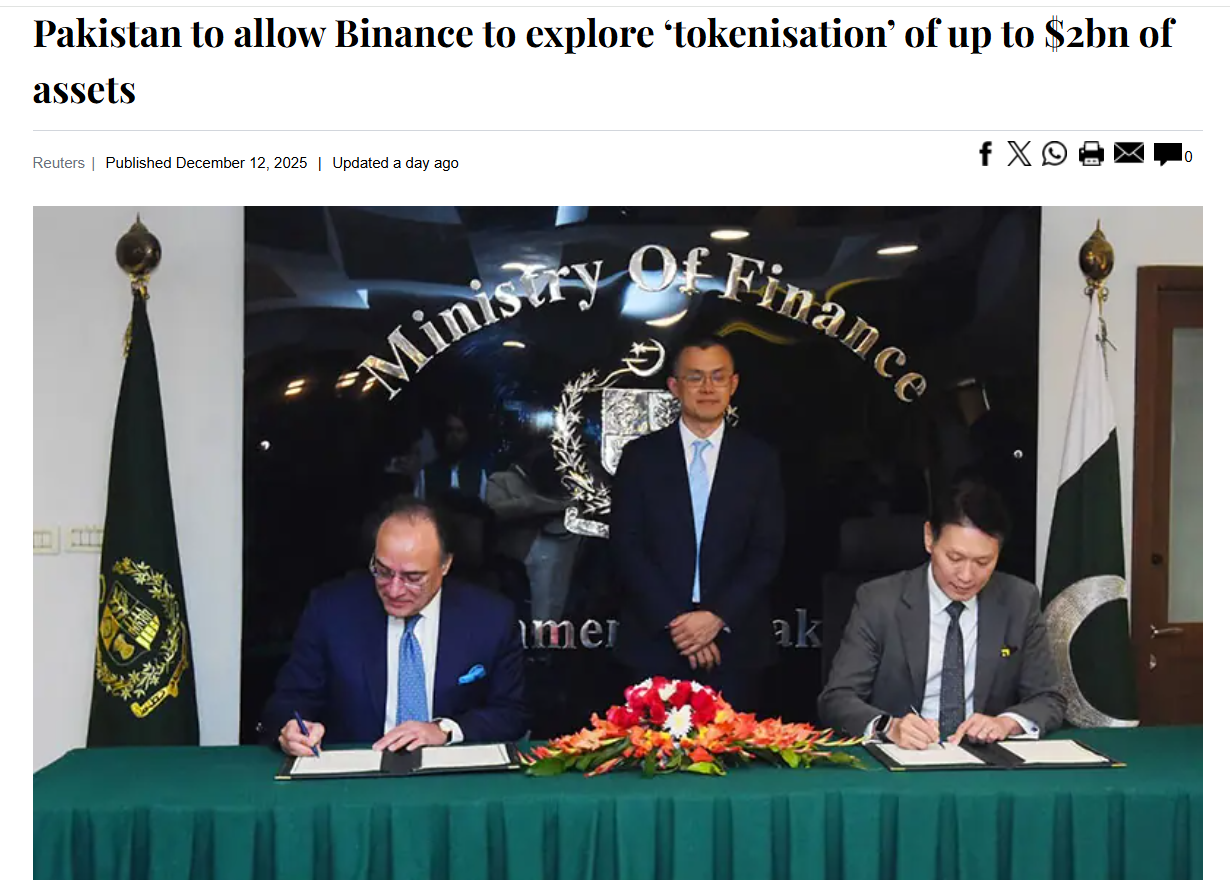
According to the finance ministry, the MoU had been announced on Friday. It gives Binance authority to provide advice on the blockchain-based asset distribution. Specifically, sovereign bonds and treasury bills are included. Additionally, commodity reserves like oil, gas and metals are being considered.
The MoU was signed by the Finance Minister Muhammad Aurangzeb and Chief Executive of Binance Richard Teng. The details of the signing were reported by Reuters. Furthermore, the framework allows exploring real-world asset tokenization. However, implementation is still subject to regulatory approvals.
Related Reading: Pakistan Signals Major Shift Toward Formal Crypto Regulation | Live Bitcoin News
Officials said tokenization could lead to increased liquidity of government assets. Therefore, assets potentially become easier to trade. Moreover, the distribution of blockchain could further increase accessibility for international investors. As a result, Pakistan can attract more capital participation.
 Source: DAWN
The ministry also stressed on improvements in transparency. Blockchain records can provide unalterable transaction histories. As a result, investor confidence may be boosted. Additionally, the initiative is consistent with the move to modernise financial infrastructure.
Separately, Binance and HTX received the first clearance in Pakistan. The platforms can now start getting regulatory registration. According to the Pakistan Virtual Assets Regulatory Authority, both the firms have been granted initial no-objection certificates. Therefore, efforts to prepare for full exchange licenses can begin.
Authorities clarified that the local subsidiaries would be necessary. Moreover, there is a need for firms to abide by domestic oversight. This step reflects Pakistan’s intention of responsibly bringing in the process of global exchanges. As such, oversight mechanisms may grow exponentially.
The agreement provides for a six-month period in which to negotiate. At this time, clear-cut agreements can be made. However, everything is subject to relevant laws. Therefore, timelines may change depending upon approvals.
Regulatory Shift Signals Formal Crypto Market Integration
This initiative is part of a larger crypto regulatory metamorphosis in Pakistan. Previously, the market was largely unregulated. However, there has been a noticeable change in the direction of policy. The State Bank of Pakistan said cryptocurrencies were not illegal.
After this clarification, new regulatory bodies were put in place. The Pakistan Virtual Assets Regulatory Authority is now licensing the service providers. Meanwhile, the Pakistan Crypto Council recommends policy frameworks. Together, these institutions support structured market development.
PVARA initial approvals enable exchanges to prepare for compliance systems. For this reason, anti-money laundering and counter-terrorism standards may be strengthened. Officials emphasized congruence with international requirements.
Despite advances, however, cryptocurrencies are not legal tender. However, authorities reiterated their commitment to regulatory clarity. Therefore, formal frameworks may be subject to incremental changes. This method is intended to be a balance between innovation and financial stability.
Market analysts point out that Pakistan has millions of crypto users. Estimates are that annual transaction volumes are greater than $20 billion. Consequently, the economic potential of formalization may be huge. Moreover, asset tokenization may diversify funding channels.
Overall, Pakistan’s strategy is indicative of regional competition in digital finance. Neighboring markets are making similar inroads. Therefore, policymakers seem keen to place Pakistan in a competitive position. The success of the efforts in the tokenization process may influence the capital flow in the future.
The post Pakistan Moves Toward $2 Billion Asset Tokenization with Binance Partnership appeared first on Live Bitcoin News.
You May Also Like

Trump Discusses Investment Impact on U.S. Economy

Watch Out: We Are Entering a Critical Week, with Numerous Economic Developments and Altcoin Events in the New Week – Here is the Day-by-Day, Hour-by-Hour List
