Hashed Open Finance, a subsidiary of South Korea–based crypto venture capital firm Hashed, has introduced the concept of a new Layer 1 blockchain called Maroo. Hashed Open Finance, a subsidiary of South Korea–based crypto venture capital firm Hashed, has introduced the concept of a new Layer 1 blockchain called Maroo.

Hashed Unveils Maroo Blockchain for Korea’s Stablecoin Era

4 min read

Hashed Open Finance, a subsidiary of South Korea–based crypto venture capital firm Hashed, has introduced the concept of a new Layer 1 blockchain called Maroo. The proposed network is intended to support the country’s emerging stablecoin economy by prioritizing regulatory compliance alongside blockchain openness. Maroo is positioned as part of South Korea’s broader digital finance transformation, with a focus on building infrastructure that aligns with national financial standards.

The blockchain is designed to address a long-standing challenge in the digital asset sector: balancing the transparency and accessibility of public blockchains with the strict regulatory requirements needed for financial applications. Maroo aims to integrate smoothly with South Korea’s existing financial systems while offering safeguards related to privacy, compliance, and institutional oversight.

Stablecoins and Regulatory Alignment

Hashed’s leadership has highlighted the growing importance of stablecoins in the global financial system and has indicated that Maroo is intended to provide a strong technical foundation that remains consistent with South Korea’s regulatory framework. The company has pointed out that many widely used public blockchains, including Ethereum, offer high levels of transparency but can be difficult environments for enforcing anti-money laundering and know-your-customer requirements.

Maroo is designed as a response to these limitations. Its architecture seeks to support stablecoin issuance and circulation while ensuring that compliance measures can be embedded directly into transaction flows. This approach reflects Hashed’s view that future financial blockchains must be built with regulation in mind rather than treating it as an external constraint.

Dual-Path Transaction Model

One of Maroo’s defining features is its dual-path transaction structure. The network is planned to include an open path that allows unrestricted transactions, alongside a regulated path that applies identity verification requirements or transaction limits based on size and risk. This model is intended to give users flexibility while ensuring that regulated financial activity can take place within clearly defined boundaries.

By offering both paths, Maroo seeks to accommodate a wide range of use cases, from decentralized finance experimentation to enterprise-grade financial services. The design is meant to allow participants to choose the level of compliance appropriate for their activity, without fragmenting the network.

Programmable Compliance and Verifiable Privacy

A central component of the Maroo blockchain is its Programmable Compliance Layer. This system is designed to automate regulatory checks during transactions, including enforcement of transfer limits and screening against sanctions lists. The layer is also intended to be adaptable, allowing rules to be updated as regulations evolve over time.

In parallel, Maroo incorporates a Verifiable Privacy framework that enables selective disclosure of transaction data when required by legal or regulatory processes. This mechanism is meant to provide oversight capabilities for authorities and institutions while preserving user privacy under normal circumstances. The combination of compliance automation and controlled transparency is positioned as a key differentiator for Maroo in regulated markets.

AI Integration and Future-Proof Design

Maroo is also being developed with future technological trends in mind. The blockchain includes planned AI-related tools that can authenticate AI agents operating on the network and manage their permissions. These tools are designed to revoke access when necessary, adding an additional layer of governance and security. This feature reflects expectations that AI-driven applications will play a growing role in digital finance ecosystems.

Alignment With South Korea’s Policy Direction

The timing of Maroo’s introduction aligns with South Korea’s ongoing efforts to modernize its financial infrastructure. The country is preparing legislation for a Korean won–pegged stablecoin market under the Digital Asset Basic Act, which is expected to be finalized in the first quarter of 2026. In anticipation, major corporations such as KB, Naver, and Kakao have begun developing related technologies and filing patents connected to stablecoin issuance.

At the same time, policy discussions continue around who should be eligible to issue stablecoins, with some lawmakers advocating for flexible rules to support innovation. Against this backdrop, Hashed has expressed an intention to work closely with regulators, financial institutions, and technology startups to help shape a compliant digital asset ecosystem.

Implications for the Broader Market

If successfully implemented, Maroo could become a foundational layer for South Korea’s stablecoin and blockchain initiatives. Its compliance-first design offers a potential model for other jurisdictions seeking to balance innovation with regulatory oversight. Beyond domestic use, the blockchain could also serve as a reference point for markets that prioritize regulated digital finance.

Overall, Maroo represents a strategic effort by Hashed to address the practical requirements of a regulated stablecoin economy. By combining programmable compliance, privacy controls, and forward-looking AI integration, the blockchain is positioned as a potential cornerstone of South Korea’s evolving digital finance landscape.

The post Hashed Unveils Maroo Blockchain for Korea’s Stablecoin Era appeared first on CoinTrust.

Disclaimer: The articles reposted on this site are sourced from public platforms and are provided for informational purposes only. They do not necessarily reflect the views of MEXC. All rights remain with the original authors. If you believe any content infringes on third-party rights, please contact service@support.mexc.com for removal. MEXC makes no guarantees regarding the accuracy, completeness, or timeliness of the content and is not responsible for any actions taken based on the information provided. The content does not constitute financial, legal, or other professional advice, nor should it be considered a recommendation or endorsement by MEXC.

You May Also Like

Best Crypto to Buy as Saylor & Crypto Execs Meet in US Treasury Council
Best Crypto to Buy as Saylor & Crypto Execs Meet in US Treasury Council

The post Best Crypto to Buy as Saylor & Crypto Execs Meet in US Treasury Council appeared on BitcoinEthereumNews.com. Michael Saylor and a group of crypto executives met in Washington, D.C. yesterday to push for the Strategic Bitcoin Reserve Bill (the BITCOIN Act), which would see the U.S. acquire up to 1M $BTC over five years. With Bitcoin being positioned yet again as a cornerstone of national monetary policy, many investors are turning their eyes to projects that lean into this narrative – altcoins, meme coins, and presales that could ride on the same wave. Read on for three of the best crypto projects that seem especially well‐suited to benefit from this macro shift:  Bitcoin Hyper, Best Wallet Token, and Remittix. These projects stand out for having a strong use case and high adoption potential, especially given the push for a U.S. Bitcoin reserve.   Why the Bitcoin Reserve Bill Matters for Crypto Markets The strategic Bitcoin Reserve Bill could mark a turning point for the U.S. approach to digital assets. The proposal would see America build a long-term Bitcoin reserve by acquiring up to one million $BTC over five years. To make this happen, lawmakers are exploring creative funding methods such as revaluing old gold certificates. The plan also leans on confiscated Bitcoin already held by the government, worth an estimated $15–20B. This isn’t just a headline for policy wonks. It signals that Bitcoin is moving from the margins into the core of financial strategy. Industry figures like Michael Saylor, Senator Cynthia Lummis, and Marathon Digital’s Fred Thiel are all backing the bill. They see Bitcoin not just as an investment, but as a hedge against systemic risks. For the wider crypto market, this opens the door for projects tied to Bitcoin and the infrastructure that supports it. 1. Bitcoin Hyper ($HYPER) – Turning Bitcoin Into More Than Just Digital Gold The U.S. may soon treat Bitcoin as…
Share
BitcoinEthereumNews2025/09/18 00:27
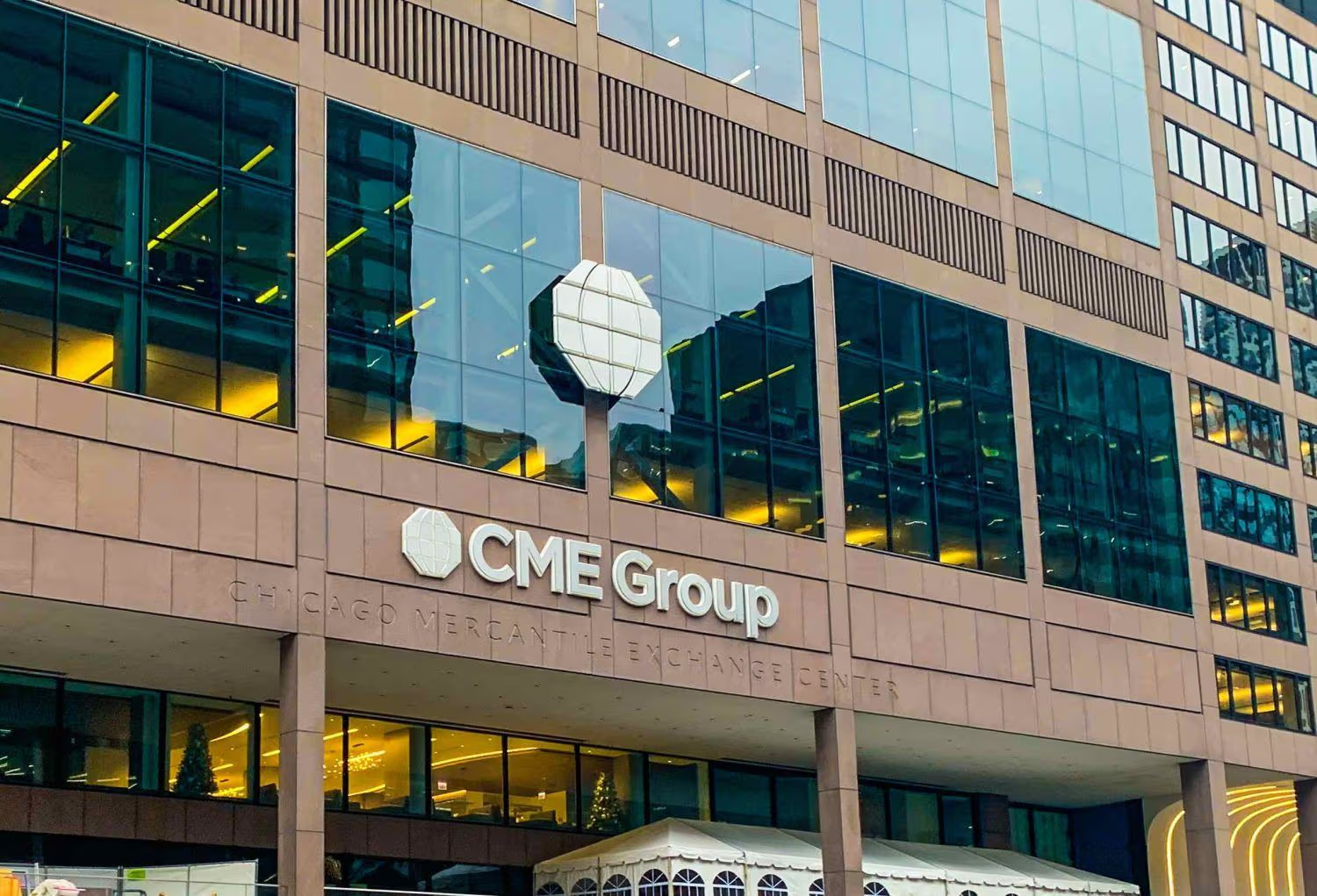
Breaking: CME Group Unveils Solana and XRP Options

Breaking: CME Group Unveils Solana and XRP Options

CME Group launches Solana and XRP options, expanding crypto offerings. SEC delays Solana and XRP ETF approvals, market awaits clarity. Strong institutional demand drives CME’s launch of crypto options contracts. In a bold move to broaden its cryptocurrency offerings, CME Group has officially launched options on Solana (SOL) and XRP futures. Available since October 13, 2025, these options will allow traders to hedge and manage exposure to two of the most widely traded digital assets in the market. The new contracts come in both full-size and micro-size formats, with expiration options available daily, monthly, and quarterly, providing flexibility for a diverse range of market participants. This expansion aligns with the rising demand for innovative products in the crypto space. Giovanni Vicioso, CME Group’s Global Head of Cryptocurrency Products, noted that the new options offer increased flexibility for traders, from institutions to active individual investors. The growing liquidity in Solana and XRP futures has made the introduction of these options a timely move to meet the needs of an expanding market. Also Read: Vitalik Buterin Reveals Ethereum’s Bold Plan to Stay Quantum-Secure and Simple! Rapid Growth in Solana and XRP Futures Trading CME Group’s decision to roll out options on Solana and XRP futures follows the substantial growth in these futures products. Since the launch of Solana futures in March 2025, more than 540,000 contracts, totaling $22.3 billion in notional value, have been traded. In August 2025, Solana futures set new records, with an average daily volume (ADV) of 9,000 contracts valued at $437.4 million. The average daily open interest (ADOI) hit 12,500 contracts, worth $895 million. Similarly, XRP futures, which launched in May 2025, have seen significant adoption, with over 370,000 contracts traded, totaling $16.2 billion. XRP futures also set records in August 2025, with an ADV of 6,600 contracts valued at $385 million and a record ADOI of 9,300 contracts, worth $942 million. Institutional Demand for Advanced Hedging Tools CME Group’s expansion into options is a direct response to growing institutional interest in sophisticated cryptocurrency products. Roman Makarov from Cumberland Options Trading at DRW highlighted the market demand for more varied crypto products, enabling more advanced risk management strategies. Joshua Lim from FalconX also noted that the new options products meet the increasing need for institutional hedging tools for assets like Solana and XRP, further cementing their role in the digital asset space. The launch of options on Solana and XRP futures marks another step toward the maturation of the cryptocurrency market, providing a broader range of tools for managing digital asset exposure. SEC’s Delay on Solana and XRP ETF Approvals While CME Group expands its offerings, the broader market is also watching the progress of Solana and XRP exchange-traded funds (ETFs). The U.S. Securities and Exchange Commission (SEC) has delayed its decisions on multiple crypto-related ETF filings, including those for Solana and XRP. Despite the delay, analysts anticipate approval may be on the horizon. This week, REX Shares and Osprey Funds are expected to launch an XRP ETF that will hold XRP directly and allocate at least 40% of its assets to other XRP-related ETFs. Despite the delays, some analysts believe that approval could come soon, fueling further interest in these assets. The delay by the SEC has left many crypto investors awaiting clarity, but approval of these ETFs could fuel further momentum in the Solana and XRP futures markets. Also Read: Tether CEO Breaks Silence on $117,000 Bitcoin Price – Market Reacts! The post Breaking: CME Group Unveils Solana and XRP Options appeared first on 36Crypto.
Share
Coinstats2025/09/18 02:35
Optimizely Named a Leader in the 2026 Gartner® Magic Quadrant™ for Personalization Engines

Optimizely Named a Leader in the 2026 Gartner® Magic Quadrant™ for Personalization Engines

Company recognized as a Leader for the second consecutive year NEW YORK, Feb. 5, 2026 /PRNewswire/ — Optimizely, the leading digital experience platform (DXP) provider
Share
AI Journal2026/02/06 00:47