Cardano has recently made some waves — in the past 24 hours, it briefly hit around $0.87 (as of July 20, 2025). It’s been a while since ADA climbed that high — the last time was back in May when…Cardano has recently made some waves — in the past 24 hours, it briefly hit around $0.87 (as of July 20, 2025). It’s been a while since ADA climbed that high — the last time was back in May when…

Realistic ADA price prediction 2030: Will Cardano hit $10 or fall short?

5 min read

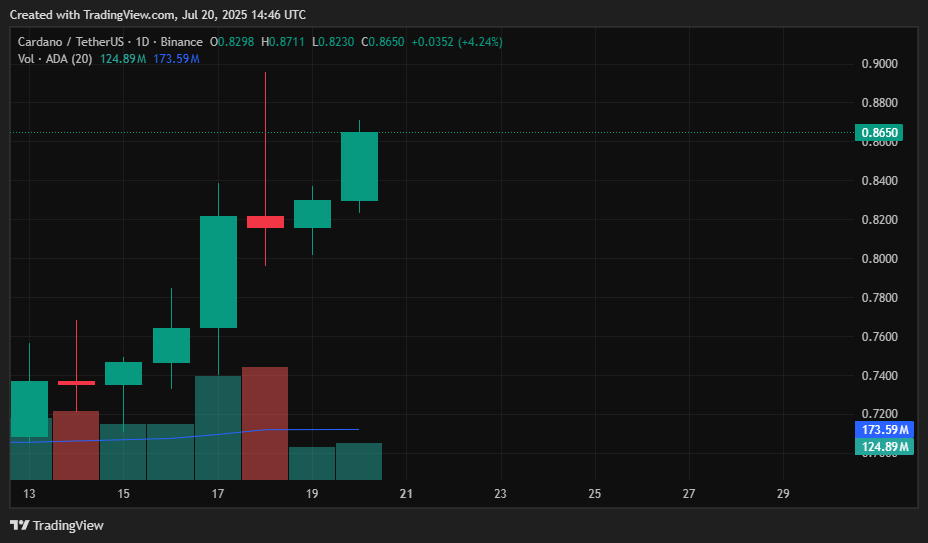
Cardano has recently made some waves — in the past 24 hours, it briefly hit around $0.87 (as of July 20, 2025). It’s been a while since ADA climbed that high — the last time was back in May when it reached roughly $0.84.

In this piece, we’ll take a closer look at what Cardano (ADA) is, whether ADA will hit $10 by 2030, and what factors could influence that. So, what will ADA be worth in 2030?

Table of Contents

  • What is Cardano?
  • Cardano price factors
  • Cardano price prediction 2030

What is Cardano?

Cardano is a smart contract platform that officially launched in 2017, built with a clear mission: to solve the core issues that have plagued earlier blockchains — namely, scalability, sustainability, and security. Unlike many projects that charge ahead with minimal testing, Cardano chose a different path. It was founded by Charles Hoskinson, one of Ethereum’s original co-founders, but it set itself apart early by following a slow, methodical, and research-first approach. Every update is peer-reviewed and rigorously tested, emphasizing academic research and formal methods — a rare trait in the fast-paced crypto world.

Cardano’s native token, ADA, is named in honor of Ada Lovelace — a 19th-century mathematician often recognized as the world’s first computer programmer.

ADA is more than just a cryptocurrency. It fuels the entire Cardano ecosystem. Token holders can use ADA to pay for transactions, stake their tokens to help secure the network, vote on governance proposals, and earn passive income through staking rewards. This creates an active, engaged community that helps guide the network’s direction — a kind of decentralized democracy in action.

Cardano is playing the long game, prioritizing solid infrastructure and real-world utility over flashy launches. It’s not the loudest voice in the room, but it’s quietly building a foundation designed to last — and in the ever-volatile world of crypto, that kind of discipline and patience stands out.

What exactly will shape Cardano’s price in the coming years, and what could the Cardano future price 2030 look like?

Cardano price factors

As of July 18, 2025, Cardano is sitting at $0.82, with a 2.55% bump in the last 24 hours and a solid 10.3% gain over the past week. That kind of movement isn’t going unnoticed — it’s a sign that investor interest is picking up, and momentum might just be building.
Realistic ADA price prediction 2030: Will Cardano hit $10 or fall short? - 1

One key driver is the July 16 announcement from Apex Fusion, a next-generation blockchain protocol that builds on Cardano’s open-source foundations. The project revealed a strategic partnership with Well-Typed, a respected Haskell engineering firm with deep roots in Cardano’s early development, dating back to the Byron phase. This collaboration is set to strengthen VECTOR — Apex Fusion’s enterprise-grade implementation of the Cardano codebase, with advanced formal verification and high-assurance engineering. For long-term investors, this adds technical credibility and reinforces confidence in Cardano’s evolution as a secure and scalable blockchain platform.

That same day, Emurgo — one of Cardano’s founding organizations — introduced the Cardano Card, a multi-functional financial tool designed to bridge crypto with real-world utility. While it already works as a payment card, its roadmap goes much further: staking ADA, earning DeFi yields, accessing collateralized loans, and even channeling part of its revenue back into the Cardano treasury. This vision positions Cardano not just as a smart contract platform, but as a comprehensive financial ecosystem — a move that could boost long-term demand for ADA as adoption grows.

Developments like these could play a significant role in shaping Cardano’s trajectory. Many long-term holders and analysts are watching closely to see whether ADA can move beyond speculation and become a core infrastructure layer in the future decentralized economy.

What can we expect from the Cardano price in 2030? Could ADA retest or even surpass its 2021 all-time high of $3.10 in five years? These are the big questions — and as the project continues to evolve, many are eyeing the Cardano expected price in 2030 and setting a potential target price based on broader crypto market trends, adoption, and the project’s unique approach to sustainability and innovation.

Cardano price prediction 2030

When it comes to long-term ADA price forecasts, there’s no clear consensus — and honestly, the numbers are all over the place depending on who you ask.

CoinCodex takes a fairly modest approach, predicting that Cardano could be trading between $1.13 and $2.12 by 2030. It’s not the kind of forecast that gets headlines, but it does point to slow, steady growth — especially if Cardano keeps expanding its ecosystem and gaining real-world adoption.

Wallet Investor’s projections say ADA could hit $5.72 by July 2030, which would be a massive win for long-term holders. But their lower estimate? An eye-watering $0.000001 — worthless.

DigitalCoinPrice’s projections put ADA somewhere between $3.81 and $4.36 by the end of the decade. Those numbers suggest a strong belief in Cardano’s long-term potential.

Of course, these are just projections — not promises. Still, they offer a snapshot of what could be possible. Will Cardano hit the higher end of these predictions? Maybe. But if it sticks to its research-driven approach and continues to build real utility quietly, it might just surprise everyone by 2030.

Disclosure: This article does not represent investment advice. The content and materials featured on this page are for educational purposes only.

Market Opportunity
Waves Logo
Waves Price(WAVES)
$0.5901
$0.5901$0.5901
+0.56%
USD
Waves (WAVES) Live Price Chart
Disclaimer: The articles reposted on this site are sourced from public platforms and are provided for informational purposes only. They do not necessarily reflect the views of MEXC. All rights remain with the original authors. If you believe any content infringes on third-party rights, please contact service@support.mexc.com for removal. MEXC makes no guarantees regarding the accuracy, completeness, or timeliness of the content and is not responsible for any actions taken based on the information provided. The content does not constitute financial, legal, or other professional advice, nor should it be considered a recommendation or endorsement by MEXC.

You May Also Like

MoneyGram launches stablecoin-powered app in Colombia

MoneyGram launches stablecoin-powered app in Colombia

The post MoneyGram launches stablecoin-powered app in Colombia appeared on BitcoinEthereumNews.com. MoneyGram has launched a new mobile application in Colombia that uses USD-pegged stablecoins to modernize cross-border remittances. According to an announcement on Wednesday, the app allows customers to receive money instantly into a US dollar balance backed by Circle’s USDC stablecoin, which can be stored, spent, or cashed out through MoneyGram’s global retail network. The rollout is designed to address the volatility of local currencies, particularly the Colombian peso. Built on the Stellar blockchain and supported by wallet infrastructure provider Crossmint, the app marks MoneyGram’s most significant move yet to integrate stablecoins into consumer-facing services. Colombia was selected as the first market due to its heavy reliance on inbound remittances—families in the country receive more than 22 times the amount they send abroad, according to Statista. The announcement said future expansions will target other remittance-heavy markets. MoneyGram, which has nearly 500,000 retail locations globally, has experimented with blockchain rails since partnering with the Stellar Development Foundation in 2021. It has since built cash on and off ramps for stablecoins, developed APIs for crypto integration, and incorporated stablecoins into its internal settlement processes. “This launch is the first step toward a world where every person, everywhere, has access to dollar stablecoins,” CEO Anthony Soohoo stated. The company emphasized compliance, citing decades of regulatory experience, though stablecoin oversight remains fluid. The US Congress passed the GENIUS Act earlier this year, establishing a framework for stablecoin regulation, which MoneyGram has pointed to as providing clearer guardrails. This is a developing story. This article was generated with the assistance of AI and reviewed by editor Jeffrey Albus before publication. Get the news in your inbox. Explore Blockworks newsletters: Source: https://blockworks.co/news/moneygram-stablecoin-app-colombia
Share
BitcoinEthereumNews2025/09/18 07:04
Solana Treasury Firm Holdings Could Double as Forward Industries Unveils $4 Billion Raise

Solana Treasury Firm Holdings Could Double as Forward Industries Unveils $4 Billion Raise

The post Solana Treasury Firm Holdings Could Double as Forward Industries Unveils $4 Billion Raise appeared on BitcoinEthereumNews.com. In brief Forward Industries, the largest publicly traded Solana treasury company, filed to raise $4 billion through an at-the-market equity offering to expand its SOL holdings. The company’s stock (FORD) fell 8.2% following the announcement, while the proceeds could more than double the $3.1 billion currently held in Solana treasuries. DeFi Development Corp. also registered a preferred stock offering with the SEC, following similar funding tactics used by Bitcoin treasury companies like MicroStrategy. Forward Industries, the newest and largest publicly traded Solana treasury company, has filed to raise $4 billion through an at-the-market equity offering. For the sake of comparison, this $4 billion raise is nearly the same size as Bitcoin treasury Strategy’s Stride preferred stock raise in July. And it’s double the size of the Strife preferred stock offering the company did in May. The proceeds would be used for working capital; pursuit of its Solana token strategy, and “the purchase of income-generating assets to grow its business,” the company said in a press release. Forward Industries declined to comment to Decrypt on what other income-generating assets it’s considering adding to its balance sheet.  As markets opened Wednesday morning, Forward saw its stock price take a dive. The shares, which trade under the FORD ticker on the Nasdaq, dipped to $31.29 before rebounding to $34.28 at the time of writing—marking a 8.2% fall for the session. If the company sells all the shares and spends the bulk of the proceeds on buying Solana, it could more than double the amount of SOL being held in treasuries. At the time of writing, there’s already $3.1 billion in Solana treasuries, according to crypto price aggregator CoinGecko. Users on Myriad, a prediction market owned by Decrypt parent company DASTAN, have been growing more confident that SOL will reach $250 sooner than…
Share
BitcoinEthereumNews2025/09/18 12:43
Microsoft plans to invest $4 billion in building a second AI data center in Wisconsin

Microsoft plans to invest $4 billion in building a second AI data center in Wisconsin

Microsoft will invest $4 billion to build a second AI data center in Wisconsin, bringing its total investment in the region to over $7 billion.
Share
Cryptopolitan2025/09/19 03:05