Ethereum co-founder Vitalik Buterin says he made $70,000 trading prediction markets on Polymarket last year, not by chasing hot narratives, but by fading what heEthereum co-founder Vitalik Buterin says he made $70,000 trading prediction markets on Polymarket last year, not by chasing hot narratives, but by fading what he

Ethereum Co-Founder Buterin Netted $70,000 On Polymarket Last Year, Here’s How

3 min read

Ethereum co-founder Vitalik Buterin says he made $70,000 trading prediction markets on Polymarket last year, not by chasing hot narratives, but by fading what he calls collective “madness.” The Ethereum co-founder framed the profit as a function of behavioral reflexes in thin, hype-prone markets, and used the conversation to surface a separate concern: oracle fragility in real-world event settlement.

Here’s How Ethereum’s Buterin Netted $70,000

In an interview posted by Foresight News reporter Joe Zhou on X, Zhou asked whether Buterin still used Polymarket after being active last year. “Yes, I made $70,000 on Polymarket last year,” Buterin replied. When pressed on sizing, he said his initial investment was $440,000, implying a mid-teens return that sits in sharp contrast to the more common retail experience of getting chopped up by headline-driven probability swings.

Buterin described his playbook as opportunistic mean reversion on sentiment rather than prediction as such. “My method is simple: I look for markets that are in ‘madness mode’ and then bet that ‘madness won’t happen,’” he said.

“For example, there’s a market betting on whether Trump will win the Nobel Peace Prize. Or some markets predict the dollar will go to zero next year during periods of extreme panic. When market sentiment enters this irrational ‘madness mode,’ I bet on the opposite, and this usually makes money.”

When Zhou asked where he tends to focus on Polymarket (crypto, politics, entertainment, economics), Buterin said his attention clusters around politics and technology, and reiterated that the edge, in his view, comes from arenas where participants are “caught up in a frenzy and irrationality.”

The more consequential part of the thread moved from trading style to settlement integrity. Zhou raised the question of informational asymmetries and “advance knowledge”, referencing online chatter around a Venezuela-related market and asked whether Buterin had seen similar dynamics. Buterin steered the answer toward oracle vulnerabilities, citing a wartime contract whose outcome hinged on a narrow operational definition.

He described a market on the Ukraine war that settled based on whether Russia “controlled a certain city,” where the smart contract defined “control” as control of the city’s most important train station. The oracle source, he said, was anchored to Institute for the Study of War (ISW) tweets and maps.

Then came the failure mode: “ISW employees, perhaps by mistake, or perhaps intentionally, hacked their own company’s system; their maps suddenly updated to show that the Russian army controlled the train station,” Buterin said. “This caused something that everyone thought had only a 5% probability (almost impossible) to instantly become 100% in the prediction market. Although ISW retracted the update the next day, the money may have already been paid out.”

For Buterin, the lesson is not merely that prediction markets can be wrong, but that the data supply chain they outsource to can be brittle in ways crypto participants systematically underestimate. “This reveals a huge problem: the security standards of current oracle data sources (such as Web2 news websites and Twitter) are too low,” he said. “They never imagined that a single message they posted would determine the ownership of $1 million on the blockchain.”

Asked how to solve the oracle problem, Buterin sketched two broad approaches. The first is a centralized trust model, effectively designating an authoritative publisher like Bloomberg. The second is token voting, a decentralized mechanism he associated with UMA. Buterin said confidence in UMA has been slipping due to a perceived game-theoretic weakness: if a whale coalition can dominate voting, minority “truth” voters can be punished economically, pressuring participants to mirror power rather than reality.

At press time, Ethereum traded at $3,010.
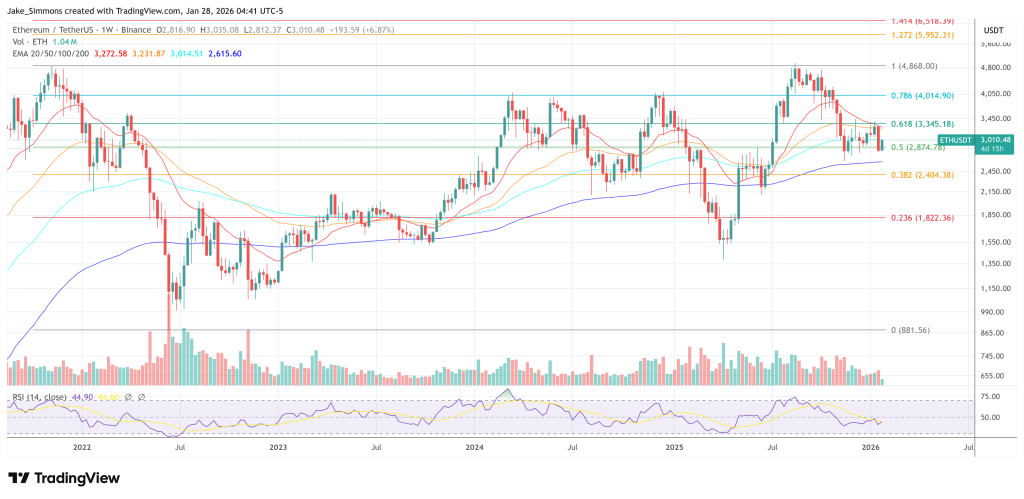
Ethereum price chart
Disclaimer: The articles reposted on this site are sourced from public platforms and are provided for informational purposes only. They do not necessarily reflect the views of MEXC. All rights remain with the original authors. If you believe any content infringes on third-party rights, please contact service@support.mexc.com for removal. MEXC makes no guarantees regarding the accuracy, completeness, or timeliness of the content and is not responsible for any actions taken based on the information provided. The content does not constitute financial, legal, or other professional advice, nor should it be considered a recommendation or endorsement by MEXC.

You May Also Like

Coinbase CEO advocates for crypto legislation reform in Washington DC

Coinbase CEO advocates for crypto legislation reform in Washington DC

The post Coinbase CEO advocates for crypto legislation reform in Washington DC appeared on BitcoinEthereumNews.com. Key Takeaways Coinbase CEO Brian Armstrong is actively working in Washington, D.C. to promote new crypto market structure legislation. Armstrong is aiming to prevent future SEC leadership similar to former chair Gary Gensler. Coinbase Chief Executive Officer Brian Armstrong said he is working in Washington to advance crypto market structure legislation and prevent another Securities and Exchange Commission chair like Gary Gensler from taking office. The Coinbase CEO said he is focused on getting crypto market structure legislation passed. Coinbase, the largest U.S. crypto exchange, has been among the companies navigating the regulatory landscape as lawmakers and agencies work to establish clearer rules for digital assets. Source: https://cryptobriefing.com/coinbase-ceo-crypto-legislation-washington-dc/
Share
BitcoinEthereumNews2025/09/18 09:43
Forex Expo 2025 Redefines the Trading Landscape

Forex Expo 2025 Redefines the Trading Landscape

The post Forex Expo 2025 Redefines the Trading Landscape appeared on BitcoinEthereumNews.com. Dubai, United Arab Emirates, October 1st, 2025, FinanceWire The Middle East’s largest forex and fintech event convenes the world’s most influential voices in trading, fintech, and digital assets.  With the countdown on, Forex Expo Dubai 2025 will open its doors next week on 6–7 October at Dubai World Trade Centre. The two-day event promises to be the Middle East’s largest and most dynamic gathering for the forex, fintech, and online trading community, bringing together more than 30,000 attendees, 250+ exhibitors, and 150+ global speakers.  A Benchmark for the Industry  Over the years, Forex Expo Dubai has evolved into more than a marketplace — it has become a benchmark for excellence in trading, investment, and fintech. By bringing together brokers, investors, affiliates, IBs, fintech pioneers, and payment solution providers from 60+ countries, the Expo offers an unmatched platform for knowledge exchange, deal-making, and shaping the future of trading.  Global Exhibitors & Cutting-Edge Solutions  At the heart of Forex Expo Dubai 2025 is its exhibition floor, showcasing 250+ international forex, fintech, and investment brands. Attendees will gain access to the latest technologies and solutions spanning the entire trading spectrum, including: Forex, stocks, ETFs, indices, and commodities Advanced liquidity aggregation tools for seamless execution Multi-asset trading platforms built for speed and efficiency RegTech and compliance systems to meet evolving regulations AI-based investing platforms and analytics for smarter decision-making Digital asset innovations bridging traditional finance. Confirmed exhibitors include ADSS, Alpari, CFI Financial Group, CXM, Eightcap, Equiti, Exness, FP Markets, IC Markets, Ingot, JustMarkets, Landmark Markets, Traze, VT Markets, Valetax, Vantage, xChief, XM, amongst many more. Dedicated B2B Zone & GCC Majlis The B2B Zone will once again serve as a dedicated area designed for companies catering to institutional clients, brokers, fintech partners, and solution providers. It will host: Regulatory service providers Technology providers Payment…
Share
BitcoinEthereumNews2025/10/01 22:46
Pi Network and Picoin Signal Long-Term Commitment to the Next Generation of Web3 Finance

Pi Network and Picoin Signal Long-Term Commitment to the Next Generation of Web3 Finance

As the crypto industry matures, a growing divide is emerging between projects built for short-term speculation and those designed with long-term generational i
Share
Hokanews2026/02/04 12:05