Bitcoin’s dominance is starting to slip as capital flows into a broader set of digital assets. From Ethereum’s sharp breakout to the resurgence of meme coins, the market has entered a phase of visible diversification. This raises a familiar question: Is an altcoin season underway? While the term often generates hype, verifying its arrival requires more than anecdotal gains. This analysis examines current price action, dominance metrics, and altcoin season indicators to assess whether the shift is technical noise or the beginning of a deeper rotation. Performance Snapshot: Ethereum, XRP, and Meme Tokens Ethereum surged from under $3,100 to over $3,750 in the first three weeks of July 2025, according to CoinMarketCap. The move coincided with a wave of liquidations and rising ETH inflows, especially into derivatives platforms. Market watchers tied the rally to anticipation around scaling upgrades and ETH’s improving market share. ↗️ #Crypto market is up today, the market cap has surpassed $4 trillion, #BTC is back above $120,350, #ETH is nearing $4,000, and ETH spot #ETFs saw the second-highest inflows yet. https://t.co/j23H5XZsPn — Cryptonews.com (@cryptonews) July 18, 2025 XRP outperformed even more dramatically. On July 17, it breached its previous all-time high, touching $3.49 before retreating slightly. CoinMarketCap data confirms this level marked a new price discovery zone, aided by regulatory clarity in Asia and adoption by financial services platforms. It is currently trading at $3.61. DOGE also participated in the rally. While not reaching new highs, it climbed nearly 40% in a two-week window, driven by retail enthusiasm and Elon Musk’s renewed social mentions. This broader participation suggests the rally was not limited to high-cap utility tokens alone. Interpreting the Climb with Altcoin Season Index As of July 21, the Altcoin Season Index— tracked by Blockchaincenter —stands at 59. This index measures the number of top 50 coins outperforming Bitcoin over the last 90 days. While 75 is the official “altcoin season” threshold, the current level marks a steep climb from 28 in early June. It shows a shift in relative strength, especially when paired with falling Bitcoin dominance. The trend is clear, even if the season isn’t official yet. CMC Altcoin Season Index (Source: CoinMarketCap) Similarly, the CMC Altcoin Season Index tracks the performance of 100 altcoins relative to Bitcoin for the past 90 days and is currently showing a reading of 56. Bitcoin Dominance and Capital Migration Bitcoin dominance dropped to 60.49% this week, its lowest level since March, according to TradingView’s BTC.D chart . The decline mirrors the expanding inflows into Ethereum, meme assets, and select infrastructure tokens. Historically, BTC.D falling below 50% has marked a transition toward broader risk appetite. ETH’s share of total market cap rose 1.5% in July, while DeFi tokens like AAVE and UNI posted double-digit weekly gains. These shifts show a familiar pattern: capital exits Bitcoin for potentially higher-yield altcoins when market sentiment turns risk-on. That behavior is now repeating, albeit more selectively than in prior cycles. Infrastructure Tokens and the Flight to Utility Analysts are flagging a parallel theme beneath the meme hype: a rotation into infrastructure plays with perceived longevity. Chainlink (LINK) , trading around $19, is attracting institutional interest again. LINK’s cross-chain interoperability could be seen as essential to upcoming RWAs and enterprise integrations. Cardano (ADA) Price (Source: CoinMarketCap) Cardano (ADA) has risen by more than 50% over the past month, buoyed by recent ecosystem launches and expanded stablecoin options. ADA’s sustained community development and regulatory alignment could be factors in its rebound. Avalanche (AVAX), also up 50% over the past 30 days, is being watched for subnetwork upgrades. Analysts argue that these layer-1s are regaining traction not as Ethereum killers but as specialized tools for selective growth sectors. A Measured But Shifting Environment A full altcoin season is not yet confirmed. But with rising participation, declining BTC dominance, and renewed attention on utility-based tokens, the conditions are forming. If momentum continues, the coming weeks could mark a decisive phase in crypto’s internal capital rotation. Altcoin market cycles often move in phases, with early breakouts in majors like ETH and XRP followed by delayed gains in mid- and small-cap tokens. If historical patterns hold, the current broadening could indicate a more sustained altcoin-led period. However, volatility remains high, and sector rotations can reverse quickly. Investors should continue monitoring key indicators like dominance, volume flows, and relative strength to navigate what may be the early innings of an altcoin resurgence.Bitcoin’s dominance is starting to slip as capital flows into a broader set of digital assets. From Ethereum’s sharp breakout to the resurgence of meme coins, the market has entered a phase of visible diversification. This raises a familiar question: Is an altcoin season underway? While the term often generates hype, verifying its arrival requires more than anecdotal gains. This analysis examines current price action, dominance metrics, and altcoin season indicators to assess whether the shift is technical noise or the beginning of a deeper rotation. Performance Snapshot: Ethereum, XRP, and Meme Tokens Ethereum surged from under $3,100 to over $3,750 in the first three weeks of July 2025, according to CoinMarketCap. The move coincided with a wave of liquidations and rising ETH inflows, especially into derivatives platforms. Market watchers tied the rally to anticipation around scaling upgrades and ETH’s improving market share. ↗️ #Crypto market is up today, the market cap has surpassed $4 trillion, #BTC is back above $120,350, #ETH is nearing $4,000, and ETH spot #ETFs saw the second-highest inflows yet. https://t.co/j23H5XZsPn — Cryptonews.com (@cryptonews) July 18, 2025 XRP outperformed even more dramatically. On July 17, it breached its previous all-time high, touching $3.49 before retreating slightly. CoinMarketCap data confirms this level marked a new price discovery zone, aided by regulatory clarity in Asia and adoption by financial services platforms. It is currently trading at $3.61. DOGE also participated in the rally. While not reaching new highs, it climbed nearly 40% in a two-week window, driven by retail enthusiasm and Elon Musk’s renewed social mentions. This broader participation suggests the rally was not limited to high-cap utility tokens alone. Interpreting the Climb with Altcoin Season Index As of July 21, the Altcoin Season Index— tracked by Blockchaincenter —stands at 59. This index measures the number of top 50 coins outperforming Bitcoin over the last 90 days. While 75 is the official “altcoin season” threshold, the current level marks a steep climb from 28 in early June. It shows a shift in relative strength, especially when paired with falling Bitcoin dominance. The trend is clear, even if the season isn’t official yet. CMC Altcoin Season Index (Source: CoinMarketCap) Similarly, the CMC Altcoin Season Index tracks the performance of 100 altcoins relative to Bitcoin for the past 90 days and is currently showing a reading of 56. Bitcoin Dominance and Capital Migration Bitcoin dominance dropped to 60.49% this week, its lowest level since March, according to TradingView’s BTC.D chart . The decline mirrors the expanding inflows into Ethereum, meme assets, and select infrastructure tokens. Historically, BTC.D falling below 50% has marked a transition toward broader risk appetite. ETH’s share of total market cap rose 1.5% in July, while DeFi tokens like AAVE and UNI posted double-digit weekly gains. These shifts show a familiar pattern: capital exits Bitcoin for potentially higher-yield altcoins when market sentiment turns risk-on. That behavior is now repeating, albeit more selectively than in prior cycles. Infrastructure Tokens and the Flight to Utility Analysts are flagging a parallel theme beneath the meme hype: a rotation into infrastructure plays with perceived longevity. Chainlink (LINK) , trading around $19, is attracting institutional interest again. LINK’s cross-chain interoperability could be seen as essential to upcoming RWAs and enterprise integrations. Cardano (ADA) Price (Source: CoinMarketCap) Cardano (ADA) has risen by more than 50% over the past month, buoyed by recent ecosystem launches and expanded stablecoin options. ADA’s sustained community development and regulatory alignment could be factors in its rebound. Avalanche (AVAX), also up 50% over the past 30 days, is being watched for subnetwork upgrades. Analysts argue that these layer-1s are regaining traction not as Ethereum killers but as specialized tools for selective growth sectors. A Measured But Shifting Environment A full altcoin season is not yet confirmed. But with rising participation, declining BTC dominance, and renewed attention on utility-based tokens, the conditions are forming. If momentum continues, the coming weeks could mark a decisive phase in crypto’s internal capital rotation. Altcoin market cycles often move in phases, with early breakouts in majors like ETH and XRP followed by delayed gains in mid- and small-cap tokens. If historical patterns hold, the current broadening could indicate a more sustained altcoin-led period. However, volatility remains high, and sector rotations can reverse quickly. Investors should continue monitoring key indicators like dominance, volume flows, and relative strength to navigate what may be the early innings of an altcoin resurgence.

Altcoin Season Indicators: Ethereum Rockets 21%, XRP Hits ATH as Bitcoin Dominance Wanes

4 min read

Bitcoin’s dominance is starting to slip as capital flows into a broader set of digital assets. From Ethereum’s sharp breakout to the resurgence of meme coins, the market has entered a phase of visible diversification. This raises a familiar question: Is an altcoin season underway?

While the term often generates hype, verifying its arrival requires more than anecdotal gains. This analysis examines current price action, dominance metrics, and altcoin season indicators to assess whether the shift is technical noise or the beginning of a deeper rotation.

Performance Snapshot: Ethereum, XRP, and Meme Tokens

Ethereum surged from under $3,100 to over $3,750 in the first three weeks of July 2025, according to CoinMarketCap. The move coincided with a wave of liquidations and rising ETH inflows, especially into derivatives platforms. Market watchers tied the rally to anticipation around scaling upgrades and ETH’s improving market share.

XRP outperformed even more dramatically. On July 17, it breached its previous all-time high, touching $3.49 before retreating slightly. CoinMarketCap data confirms this level marked a new price discovery zone, aided by regulatory clarity in Asia and adoption by financial services platforms. It is currently trading at $3.61.

DOGE also participated in the rally. While not reaching new highs, it climbed nearly 40% in a two-week window, driven by retail enthusiasm and Elon Musk’s renewed social mentions. This broader participation suggests the rally was not limited to high-cap utility tokens alone.

Interpreting the Climb with Altcoin Season Index

As of July 21, the Altcoin Season Index—tracked by Blockchaincenter—stands at 59. This index measures the number of top 50 coins outperforming Bitcoin over the last 90 days. While 75 is the official “altcoin season” threshold, the current level marks a steep climb from 28 in early June.

It shows a shift in relative strength, especially when paired with falling Bitcoin dominance. The trend is clear, even if the season isn’t official yet.
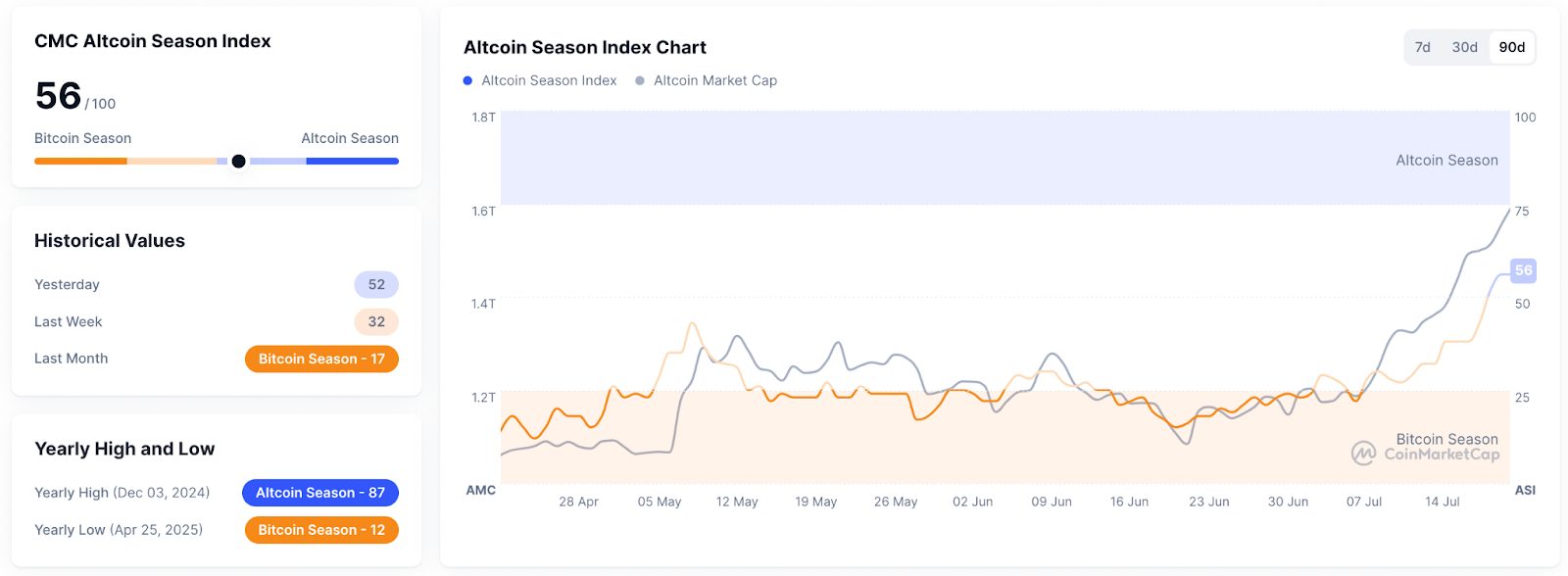
CMC Altcoin Season Index (Source: CoinMarketCap)

Similarly, the CMC Altcoin Season Index tracks the performance of 100 altcoins relative to Bitcoin for the past 90 days and is currently showing a reading of 56.

Bitcoin Dominance and Capital Migration

Bitcoin dominance dropped to 60.49% this week, its lowest level since March, according to TradingView’s BTC.D chart. The decline mirrors the expanding inflows into Ethereum, meme assets, and select infrastructure tokens.

Historically, BTC.D falling below 50% has marked a transition toward broader risk appetite. ETH’s share of total market cap rose 1.5% in July, while DeFi tokens like AAVE and UNI posted double-digit weekly gains.

These shifts show a familiar pattern: capital exits Bitcoin for potentially higher-yield altcoins when market sentiment turns risk-on. That behavior is now repeating, albeit more selectively than in prior cycles.

Infrastructure Tokens and the Flight to Utility

Analysts are flagging a parallel theme beneath the meme hype: a rotation into infrastructure plays with perceived longevity.

Chainlink (LINK), trading around $19, is attracting institutional interest again. LINK’s cross-chain interoperability could be seen as essential to upcoming RWAs and enterprise integrations.

Cardano (ADA) Price (Source: CoinMarketCap)

Cardano (ADA) has risen by more than 50% over the past month, buoyed by recent ecosystem launches and expanded stablecoin options. ADA’s sustained community development and regulatory alignment could be factors in its rebound.

Avalanche (AVAX), also up 50% over the past 30 days, is being watched for subnetwork upgrades. Analysts argue that these layer-1s are regaining traction not as Ethereum killers but as specialized tools for selective growth sectors.

A Measured But Shifting Environment

A full altcoin season is not yet confirmed. But with rising participation, declining BTC dominance, and renewed attention on utility-based tokens, the conditions are forming. If momentum continues, the coming weeks could mark a decisive phase in crypto’s internal capital rotation.

Altcoin market cycles often move in phases, with early breakouts in majors like ETH and XRP followed by delayed gains in mid- and small-cap tokens. If historical patterns hold, the current broadening could indicate a more sustained altcoin-led period.

However, volatility remains high, and sector rotations can reverse quickly. Investors should continue monitoring key indicators like dominance, volume flows, and relative strength to navigate what may be the early innings of an altcoin resurgence.

Market Opportunity
DAR Open Network Logo
DAR Open Network Price(D)
$0.01196
$0.01196$0.01196
-0.16%
USD
DAR Open Network (D) Live Price Chart
Disclaimer: The articles reposted on this site are sourced from public platforms and are provided for informational purposes only. They do not necessarily reflect the views of MEXC. All rights remain with the original authors. If you believe any content infringes on third-party rights, please contact service@support.mexc.com for removal. MEXC makes no guarantees regarding the accuracy, completeness, or timeliness of the content and is not responsible for any actions taken based on the information provided. The content does not constitute financial, legal, or other professional advice, nor should it be considered a recommendation or endorsement by MEXC.

You May Also Like

Shibarium May No Longer Turbocharge Shiba Inu Price Rally, Here’s Reason

Shibarium May No Longer Turbocharge Shiba Inu Price Rally, Here’s Reason

The post Shibarium May No Longer Turbocharge Shiba Inu Price Rally, Here’s Reason appeared on BitcoinEthereumNews.com. Shibarium, the layer-2 blockchain of the Shiba Inu (SHIB) ecosystem, is battling to stay active. Shibarium has slipped from hitting transaction milestones to struggling to record any transactions on its platform, a development that could severely impact SHIB. Shibarium transactions crash from millions to near zero As per Shibariumscan data, the total daily transactions on Shibarium as of Sept. 16 stood at 11,600. This volume of transactions reflects how low the transaction count has dropped for the L2, whose daily average ranged between 3.5 million and 4 million last month. However, in the last week of August, daily transaction volume on Shibarium lost momentum, slipping from 1.3 million to 9,590 as of Aug. 28. This pattern has lingered for much of September, with the highest peak so far being on Sept. 5, when it posted 1.26 million transactions. The low user engagement has greatly affected the transaction count in recent days. In addition, the security breach over the weekend by malicious attackers on Shibarium has probably worsened issues. Although developer Kaal Dhairya reassured the community that the attack to steal millions of BONE tokens was successfully prevented, users’ confidence appears shaken. This has also impacted the price outlook for Shiba Inu, the ecosystem’s native token. Following reports of the malicious attack on Shibarium, SHIB dipped immediately into the red zone. Unlike on previous occasions where investors accumulated on the dip, market participants did not flock to Shiba Inu. Shiba Inu price struggles, can burn mechanism help? With the current near-zero crash in transaction volume for Shibarium, SHIB’s price cannot depend on it to support a rally. It might take a while to rebuild user confidence and for transactions to pick up again. In the meantime, Shiba Inu might have to rely on other means to boost prices from its low levels. This…
Share
BitcoinEthereumNews2025/09/18 07:57
👨🏿‍🚀TechCabal Daily – When banks go cashless

👨🏿‍🚀TechCabal Daily – When banks go cashless

In today's edition: South Africa's biggest banks are going cashless || Onafriq and PAPSS pilot Naira wallet transfers from Nigeria to Ghana || South Africa just
Share
Techcabal2026/02/04 14:02
Wormhole launches reserve tying protocol revenue to token

Wormhole launches reserve tying protocol revenue to token

The post Wormhole launches reserve tying protocol revenue to token appeared on BitcoinEthereumNews.com. Wormhole is changing how its W token works by creating a new reserve designed to hold value for the long term. Announced on Wednesday, the Wormhole Reserve will collect onchain and offchain revenues and other value generated across the protocol and its applications (including Portal) and accumulate them into W, locking the tokens within the reserve. The reserve is part of a broader update called W 2.0. Other changes include a 4% targeted base yield for tokenholders who stake and take part in governance. While staking rewards will vary, Wormhole said active users of ecosystem apps can earn boosted yields through features like Portal Earn. The team stressed that no new tokens are being minted; rewards come from existing supply and protocol revenues, keeping the cap fixed at 10 billion. Wormhole is also overhauling its token release schedule. Instead of releasing large amounts of W at once under the old “cliff” model, the network will shift to steady, bi-weekly unlocks starting October 3, 2025. The aim is to avoid sharp periods of selling pressure and create a more predictable environment for investors. Lockups for some groups, including validators and investors, will extend an additional six months, until October 2028. Core contributor tokens remain under longer contractual time locks. Wormhole launched in 2020 as a cross-chain bridge and now connects more than 40 blockchains. The W token powers governance and staking, with a capped supply of 10 billion. By redirecting fees and revenues into the new reserve, Wormhole is betting that its token can maintain value as demand for moving assets and data between chains grows. This is a developing story. This article was generated with the assistance of AI and reviewed by editor Jeffrey Albus before publication. Get the news in your inbox. Explore Blockworks newsletters: Source: https://blockworks.co/news/wormhole-launches-reserve
Share
BitcoinEthereumNews2025/09/18 01:55