The Hong Kong financial regulator (HKMA) is about to approve the first license for a stablecoin issuer in March, as shown by a report by Reuters. The developmenThe Hong Kong financial regulator (HKMA) is about to approve the first license for a stablecoin issuer in March, as shown by a report by Reuters. The developmen

Hong Kong Set to Approve First Stablecoin Licenses in March — Who’s In?

The Hong Kong financial regulator (HKMA) is about to approve the first license for a stablecoin issuer in March, as shown by a report by Reuters.

The development occurs following a period of regulatory review and the unveiling of one of the most comprehensive stablecoin frameworks in the world, which came into force in August last year.

At a Legislative Council meeting on Monday, Hong Kong Monetary Authority chief executive Eddie Yue said that the review process is almost finished, adding that only a very small number of applicants will be approved at first.

Yue added that assessments are focusing on core areas such as stablecoin use cases, reserve backing, risk management, and anti-money laundering controls.

Hong Kong’s Stablecoin Era Begins Slowly as Regulators Tighten the Bar

As of early February, no stablecoin issuer has yet been approved under Hong Kong’s new regime.

The HKMA has indicated that it is assessing 36 applications in the first round, though the wider industry interest had more than 40 prospective applicants at one point.

The regulator has so far been cautious and in July 2025 introduced a public registry to monitor licensed issuers, but the registry is currently empty.
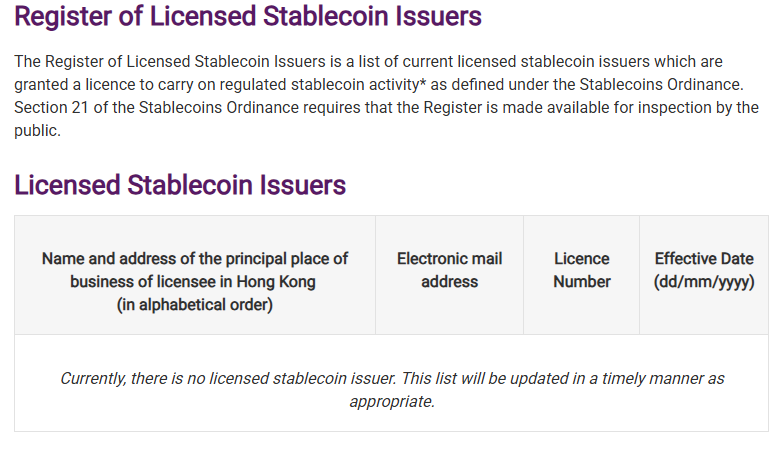
Source: HKMA

The licensing regime implemented in August covers all issuers of fiat-referenced stablecoins in Hong Kong, as well as foreign issuers of tokens pegged to the Hong Kong dollar.

The rules permit licensed issuers to issue, administer, and redeem stablecoins, as long as they have full 1:1 reserve support of high-quality, liquid assets under trust arrangements with approved custodians.

Issuers must honor redemption requests at par value within one business day and are prohibited from paying interest to stablecoin holders.

Governance and compliance are also given great focus by the regime.

According to the rules, issuers should be locally incorporated or authorized organizations that have strong internal controls and have boards that have independent directors with specific compliance functions.

They must perform due diligence of customers, adopt the use of wallets, and adhere to anti-money laundering and counter-terrorist financing requirements.

HKMA has a wide range of supervisory authority and can add further terms to the license, introduce managers, or cancel the license in case of breach of requirements.

Hong Kong Sandbox Draws Banks, Tech Giants, and Web3 Firms

A number of high-profile companies have already become the major participants by applying to the regulatory sandbox of the HKMA.

These include a joint venture between Standard Chartered’s Hong Kong arm, Animoca Brands, and telecoms provider HKT, operating under the name Anchorpoint Financial.

Ant Group’s digital technology unit has confirmed it is pursuing a license, while Bank of China Hong Kong has been reported as an applicant.

HSBC and ICBC also signaled their intention to apply last year, although the HKMA has not confirmed the identities of any applicants and has warned that early approvals should not be seen as endorsements of specific business models.

The stablecoin rollout sits within a broader regulatory and strategic push by Hong Kong to develop a full digital asset stack.

The city already operates a licensing regime for virtual asset trading platforms under the Securities and Futures Commission, with 11 exchanges approved so far, including OSL, HashKey, and Bullish.

Government officials have repeatedly framed stablecoins as infrastructure rather than speculative products.

At the World Economic Forum in Davos in January, Financial Secretary Paul Chan said Hong Kong’s approach to crypto regulation is intended to be “responsible and sustainable,” describing digital finance as a strategic growth pillar for the city.

At the same time, industry groups have cautioned that rising compliance costs could slow institutional participation if rules become overly restrictive.

Disclaimer: The articles reposted on this site are sourced from public platforms and are provided for informational purposes only. They do not necessarily reflect the views of MEXC. All rights remain with the original authors. If you believe any content infringes on third-party rights, please contact service@support.mexc.com for removal. MEXC makes no guarantees regarding the accuracy, completeness, or timeliness of the content and is not responsible for any actions taken based on the information provided. The content does not constitute financial, legal, or other professional advice, nor should it be considered a recommendation or endorsement by MEXC.

You May Also Like

Ethereum unveils roadmap focusing on scaling, interoperability, and security at Japan Dev Conference

Ethereum unveils roadmap focusing on scaling, interoperability, and security at Japan Dev Conference

The post Ethereum unveils roadmap focusing on scaling, interoperability, and security at Japan Dev Conference appeared on BitcoinEthereumNews.com. Key Takeaways Ethereum’s new roadmap was presented by Vitalik Buterin at the Japan Dev Conference. Short-term priorities include Layer 1 scaling and raising gas limits to enhance transaction throughput. Vitalik Buterin presented Ethereum’s development roadmap at the Japan Dev Conference today, outlining the blockchain platform’s priorities across multiple timeframes. The short-term goals focus on scaling solutions and increasing Layer 1 gas limits to improve transaction capacity. Mid-term objectives target enhanced cross-Layer 2 interoperability and faster network responsiveness to create a more seamless user experience across different scaling solutions. The long-term vision emphasizes building a secure, simple, quantum-resistant, and formally verified minimalist Ethereum network. This approach aims to future-proof the platform against emerging technological threats while maintaining its core functionality. The roadmap presentation comes as Ethereum continues to compete with other blockchain platforms for market share in the smart contract and decentralized application space. Source: https://cryptobriefing.com/ethereum-roadmap-scaling-interoperability-security-japan/
Share
BitcoinEthereumNews2025/09/18 00:25
Shocking OpenVPP Partnership Claim Draws Urgent Scrutiny

Shocking OpenVPP Partnership Claim Draws Urgent Scrutiny

The post Shocking OpenVPP Partnership Claim Draws Urgent Scrutiny appeared on BitcoinEthereumNews.com. The cryptocurrency world is buzzing with a recent controversy surrounding a bold OpenVPP partnership claim. This week, OpenVPP (OVPP) announced what it presented as a significant collaboration with the U.S. government in the innovative field of energy tokenization. However, this claim quickly drew the sharp eye of on-chain analyst ZachXBT, who highlighted a swift and official rebuttal that has sent ripples through the digital asset community. What Sparked the OpenVPP Partnership Claim Controversy? The core of the issue revolves around OpenVPP’s assertion of a U.S. government partnership. This kind of collaboration would typically be a monumental endorsement for any private cryptocurrency project, especially given the current regulatory climate. Such a partnership could signify a new era of mainstream adoption and legitimacy for energy tokenization initiatives. OpenVPP initially claimed cooperation with the U.S. government. This alleged partnership was said to be in the domain of energy tokenization. The announcement generated considerable interest and discussion online. ZachXBT, known for his diligent on-chain investigations, was quick to flag the development. He brought attention to the fact that U.S. Securities and Exchange Commission (SEC) Commissioner Hester Peirce had directly addressed the OpenVPP partnership claim. Her response, delivered within hours, was unequivocal and starkly contradicted OpenVPP’s narrative. How Did Regulatory Authorities Respond to the OpenVPP Partnership Claim? Commissioner Hester Peirce’s statement was a crucial turning point in this unfolding story. She clearly stated that the SEC, as an agency, does not engage in partnerships with private cryptocurrency projects. This response effectively dismantled the credibility of OpenVPP’s initial announcement regarding their supposed government collaboration. Peirce’s swift clarification underscores a fundamental principle of regulatory bodies: maintaining impartiality and avoiding endorsements of private entities. Her statement serves as a vital reminder to the crypto community about the official stance of government agencies concerning private ventures. Moreover, ZachXBT’s analysis…
Share
BitcoinEthereumNews2025/09/18 02:13
Telos Advisers Welcomes Stephen Gardner as a Strategic Advisory Board Member

Telos Advisers Welcomes Stephen Gardner as a Strategic Advisory Board Member

Former Amtrak CEO brings more than 25 years of leadership experience in rail, infrastructure delivery, and national transportation policy NEWARK, N.J.–(BUSINESS
Share
AI Journal2026/02/03 02:16