The post Vitalik Buterin issues a blunt reality check to the biggest crypto networks appeared on BitcoinEthereumNews.com. Ethereum co-founder Vitalik Buterin saidThe post Vitalik Buterin issues a blunt reality check to the biggest crypto networks appeared on BitcoinEthereumNews.com. Ethereum co-founder Vitalik Buterin said

Vitalik Buterin issues a blunt reality check to the biggest crypto networks

3 min read

Ethereum co-founder Vitalik Buterin said the role of layer-2 networks needs to be reconsidered as Ethereum’s main network continues to scale and transaction costs remain low.

In a post on X, Buterin said the original rollup-centric roadmap, which positioned layer-2s as the primary way Ethereum would scale, “no longer makes sense.” That roadmap envisioned layer-2s as secure extensions of Ethereum that would handle most transactions while inheriting Ethereum’s security guarantees, often described as “branded shards” of the network.

Layer 2s, such as Arbitrum, Optimism and Base, are offchain networks built on top of primary blockchains (Layer 1s) like Ethereum. The main purpose of these is to increase transaction speed and reduce transaction costs on the main network.

Think of Ethereum’s main network as a packed main hall at a conference. Space is limited, so getting in can be slow and expensive. Layer-2 networks act like overflow rooms, letting people participate and interact without crowding the main hall, while still staying connected to what’s happening there.

‘You are not scaling Ethereum’

According to Buterin, two developments have challenged that original vision for Layer 2 networks.

First, progress among layer-2s toward later stages of decentralization has been slower and more difficult than expected. Second, Ethereum itself is now scaling directly on layer-1, with fees remaining low and gas limits expected to increase significantly in 2026.

Buterin wrote that scaling Ethereum should mean creating “large quantities of block space that is backed by the full faith and credit of Ethereum,” where activity is “guaranteed to be valid, uncensored, unreverted, untouched, as long as Ethereum itself functions.”

He argued that high-throughput chains connected to Ethereum through multisig-controlled bridges do not meet that definition. “If you create a 10000 TPS EVM where its connection to L1 is mediated by a multisig bridge, then you are not scaling Ethereum,” he wrote.

In his view, Ethereum no longer needs layer-2s to function as “branded shards” for the network. This means that, because Ethereum itself is scaling, layer-2 networks are no longer required to function as official extensions of Ethereum. He also noted that many layer-2s are “not able or willing” to meet the decentralization and security standards required by the model.

Buterin also noted that some layer-2s may intentionally choose not to move beyond “stage 1,” including for regulatory reasons.

In one example, he wrote that a project argued it may never decentralize further because “their customers’ regulatory needs require them to have ultimate control.” While he said that approach may be appropriate for those users, he added that such systems should not be described as scaling Ethereum.

“This may be doing the right thing for your customers. But it should be obvious that if you are doing this, then you are not ‘scaling Ethereum’ in the sense meant by the rollup-centric roadmap,” Buterin wrote.”

Instead, Buterin suggested viewing layer-2s as a spectrum of networks with different levels of connection to Ethereum, each offering different trade-offs. He said layer-2s should focus on providing value beyond basic scaling, such as privacy features, application-specific design, ultra-fast transaction confirmation, or non-financial use cases, and be clear with users about what guarantees they provide.

Read more: Ethereum co-founder Vitalik Buterin warns decentralized stablecoins still have deep flaws

Source: https://www.coindesk.com/business/2026/02/03/you-are-not-scaling-ethereum-vitalik-buterin-issues-a-blunt-reality-check-to-the-biggest-crypto-networks


Disclaimer: The articles reposted on this site are sourced from public platforms and are provided for informational purposes only. They do not necessarily reflect the views of MEXC. All rights remain with the original authors. If you believe any content infringes on third-party rights, please contact service@support.mexc.com for removal. MEXC makes no guarantees regarding the accuracy, completeness, or timeliness of the content and is not responsible for any actions taken based on the information provided. The content does not constitute financial, legal, or other professional advice, nor should it be considered a recommendation or endorsement by MEXC.

You May Also Like

Three dormant wallets, suspected to belong to the same entity, purchased 5,970 ETH eight hours ago.

Three dormant wallets, suspected to belong to the same entity, purchased 5,970 ETH eight hours ago.

PANews reported on February 4 that, according to Lookonchain monitoring, three wallets that had been dormant for four years (likely controlled by the same entity
Share
PANews2026/02/04 11:36
BlackRock Increases U.S. Stock Exposure Amid AI Surge

BlackRock Increases U.S. Stock Exposure Amid AI Surge

The post BlackRock Increases U.S. Stock Exposure Amid AI Surge appeared on BitcoinEthereumNews.com. Key Points: BlackRock significantly increased U.S. stock exposure. AI sector driven gains boost S&P 500 to historic highs. Shift may set a precedent for other major asset managers. BlackRock, the largest asset manager, significantly increased U.S. stock and AI sector exposure, adjusting its $185 billion investment portfolios, according to a recent investment outlook report.. This strategic shift signals strong confidence in U.S. market growth, driven by AI and anticipated Federal Reserve moves, influencing significant fund flows into BlackRock’s ETFs. The reallocation increases U.S. stocks by 2% while reducing holdings in international developed markets. BlackRock’s move reflects confidence in the U.S. stock market’s trajectory, driven by robust earnings and the anticipation of Federal Reserve rate cuts. As a result, billions of dollars have flowed into BlackRock’s ETFs following the portfolio adjustment. “Our increased allocation to U.S. stocks, particularly in the AI sector, is a testament to our confidence in the growth potential of these technologies.” — Larry Fink, CEO, BlackRock The financial markets have responded favorably to this adjustment. The S&P 500 Index recently reached a historic high this year, supported by AI-driven investment enthusiasm. BlackRock’s decision aligns with widespread market speculation on the Federal Reserve’s next moves, further amplifying investor interest and confidence. AI Surge Propels S&P 500 to Historic Highs At no other time in history has the S&P 500 seen such dramatic gains driven by a single sector as the recent surge spurred by AI investments in 2023. Experts suggest that the strategic increase in U.S. stock exposure by BlackRock may set a precedent for other major asset managers. Historically, shifts of this magnitude have influenced broader market behaviors as others follow suit. Market analysts point to the favorable economic environment and technological advancements that are propelling the AI sector’s momentum. The continued growth of AI technologies is…
Share
BitcoinEthereumNews2025/09/18 02:49
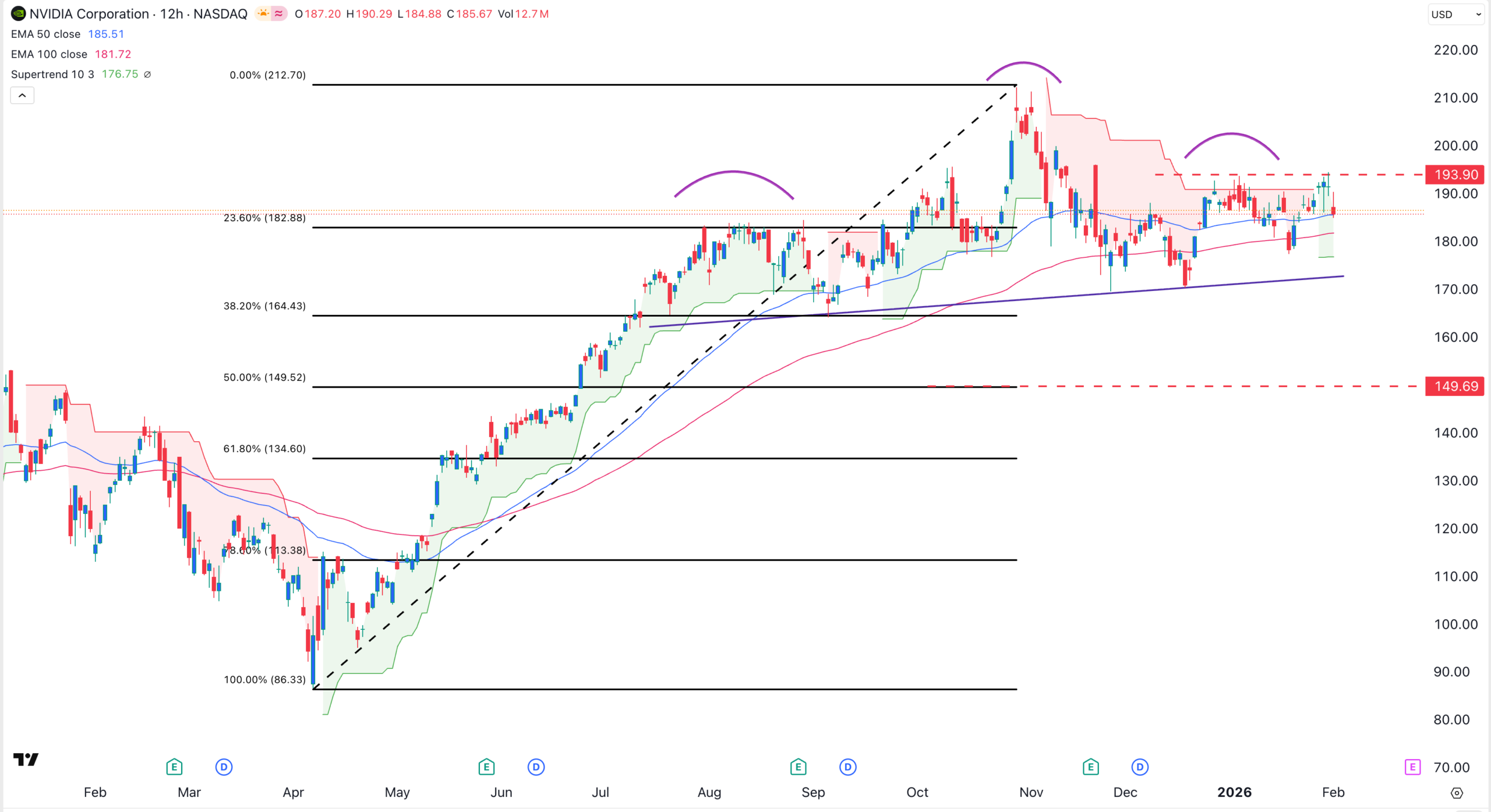
NVIDIA Stock Price Analysis as OpenAI Issues Concerns About its Chips

NVIDIA Stock Price Analysis as OpenAI Issues Concerns About its Chips

Key Insights NVIDIA stock started the week in the red. It crashed by over 2%. Meanwhile, the S&P 500, Dow Jones, and Nasdaq 100 moved close to their all-time highs
Share
Themarketperiodical2026/02/04 11:27