TLDR Ether (ETH) has crashed 30% in seven days, dropping from $2,800 to around $1,900-$2,000 ETH open interest fell by over $15 billion during the same period, TLDR Ether (ETH) has crashed 30% in seven days, dropping from $2,800 to around $1,900-$2,000 ETH open interest fell by over $15 billion during the same period,

Ethereum (ETH) Price: Where’s the Bottom After 30% Weekly Plunge?

2026/02/07 17:14
3 min read

TLDR

  • Ether (ETH) has crashed 30% in seven days, dropping from $2,800 to around $1,900-$2,000
  • ETH open interest fell by over $15 billion during the same period, with $400 million in long liquidations in the past 24 hours
  • US-based spot Ether ETFs recorded $1.1 billion in net outflows over the past two weeks
  • Technical analysis suggests ETH could fall to $1,000-$1,400 range based on multiple bearish patterns and historical trends
  • Key support levels to watch are $1,800, $1,580, $1,350, and $1,080 according to analyst accumulation zones

Ether has experienced a sharp decline over the past week. The cryptocurrency fell 30% in seven days, sliding from $2,800 to approximately $1,900.
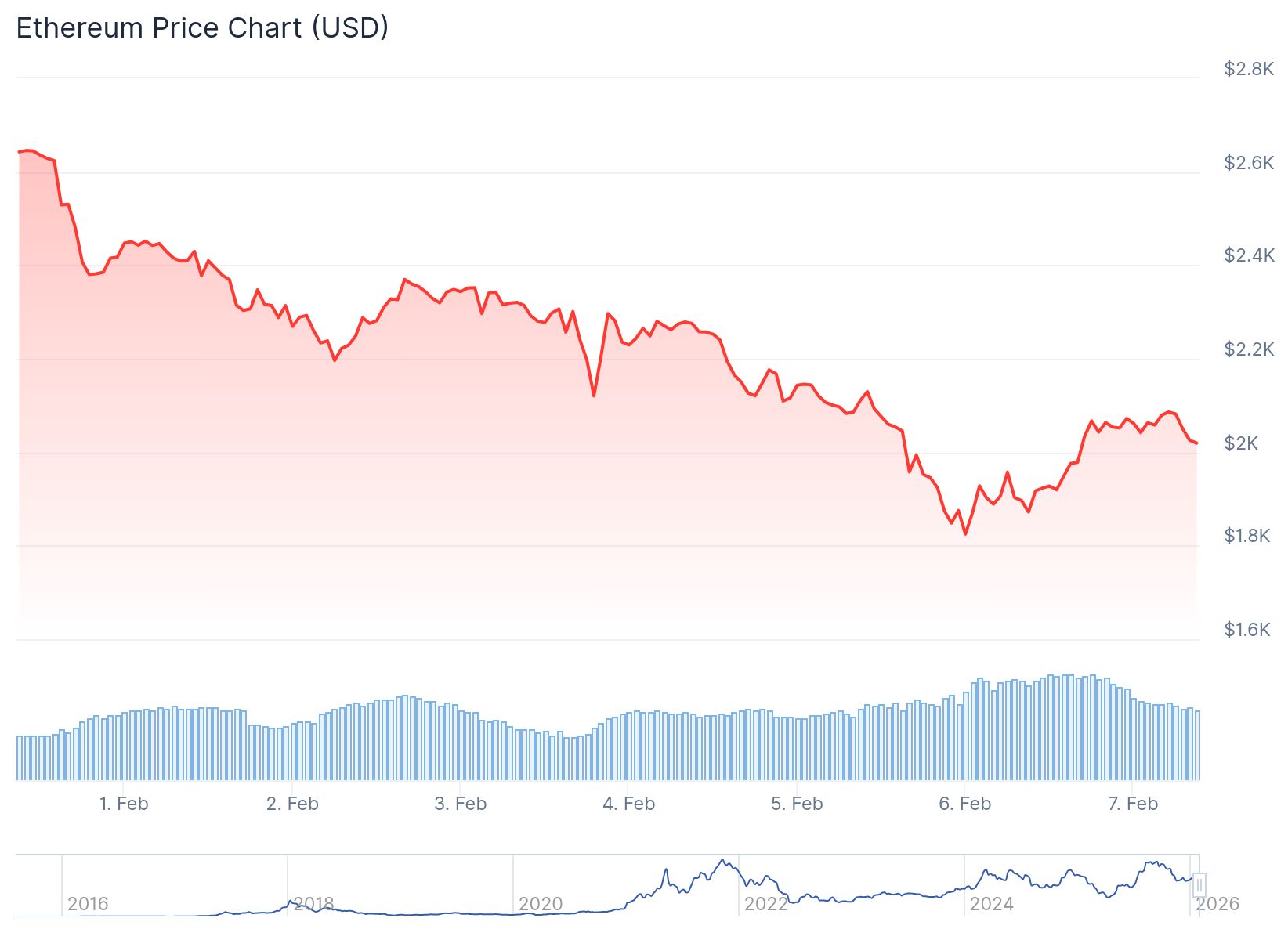
Ethereum (ETH) PriceEthereum (ETH) Price

The drop pushed ETH below the $2,000 psychological level for the first time since May 2025. On Friday, Ether reached a nine-month low of $1,740 before recovering slightly.

The decline represents the largest weekly drawdown among top cryptocurrencies. Bitcoin dropped 21% over the same period to $66,340. XRP fell more than 21% to trade above $1.37. Solana posted a 29% loss during the week.

The global crypto market capitalization declined 20% over the week to $2.23 trillion. Ether’s futures activity saw a sharp contraction. Open interest fell by more than $15 billion during the seven-day period.

Long liquidations totaled $400 million over the last 24 hours. This signals intense selling pressure from traders in the market.

Institutional Selling Pressure Mounts

US-based spot Ether ETFs recorded $1.1 billion in net outflows over the past two weeks. The selling pressure came from multiple sources beyond ETFs.

Source: Farside Investors

Trend Research and Ethereum co-founder Vitalik Buterin both sold ETH holdings. These sales added to the overhead pressure on the price.

Ether has lost two key support levels in the past two weeks. The cryptocurrency dropped below the 200-week simple moving average and the psychological levels at $3,000 and $2,000.

The last time Ethereum decisively dropped below the 200-week SMA was in March 2025. That move was followed by a 45% price decline.

Technical Targets Point Lower

Multiple technical patterns suggest further downside potential. An inverse V-shaped pattern targets $1,385, representing a 28% drop from current prices.

An inverse cup-and-handle pattern places the downward target at $1,665. MVRV bands point to a target of $1,725.

Analysts have identified three major liquidation zones. These sit around $1,500, $1,300, and $1,000.

Onchain data from Glassnode shows little previous volume below $1,900. This suggests buyers might not step in until the price drops to lower support levels.

The next support level sits at $1,200. Approximately 1.5 million ETH were previously acquired at this price point.

Analysts have mapped key accumulation zones based on historical dollar-cost average purchases. These zones are located at $1,800, $1,580, $1,350, and $1,080.

ETH is currently trading at $2,053.14 at press time. The coin trades below both its 50-day and 200-day moving averages. This indicates extended bearish control in the market.

The post Ethereum (ETH) Price: Where’s the Bottom After 30% Weekly Plunge? appeared first on CoinCentral.

Market Opportunity
Ethereum Logo
Ethereum Price(ETH)
$1.968,39
$1.968,39$1.968,39
+%2,00
USD
Ethereum (ETH) Live Price Chart
Disclaimer: The articles reposted on this site are sourced from public platforms and are provided for informational purposes only. They do not necessarily reflect the views of MEXC. All rights remain with the original authors. If you believe any content infringes on third-party rights, please contact service@support.mexc.com for removal. MEXC makes no guarantees regarding the accuracy, completeness, or timeliness of the content and is not responsible for any actions taken based on the information provided. The content does not constitute financial, legal, or other professional advice, nor should it be considered a recommendation or endorsement by MEXC.

You May Also Like

Chorus One and MEV Zone Team Up to Boost Avalanche Staking Rewards

Chorus One and MEV Zone Team Up to Boost Avalanche Staking Rewards

The post Chorus One and MEV Zone Team Up to Boost Avalanche Staking Rewards appeared on BitcoinEthereumNews.com. Through the partnership with MEV Zone, Chorus One users will earn extra yield automatically. The Chorus One Avalanche node has a total stake of over 1.7 million, valued at around $55 million. This collaboration will introduce MEV Zone to both public nodes and Validator-as-a-Service. The Avalanche network stands to benefit from fairer and more efficient markets due to enhanced transparency. Chorus One, a highly decorated institutional-grade staking provider, has inked a strategic partnership with MEV Zone to enhance yield generation on the Avalanche (AVAX) network. The Chorus One partnered with MEV Zone to increase the AVAX staking yields, while simultaneously contributing to the general growth of the Avalanche network. “At Chorus One, we see this as an important step in our ongoing journey to provide robust infrastructure and innovative yield strategies for our partners and clients,” the announcement noted.  Why Did Chorus One Partner With MEV Zone? The Chorus One platform has grown to a top-tier institutional-grade staking ecosystem, with more than 40 blockchains, since 2018. In a bid to evolve with the needs of crypto investors and the supported blockchains, Chorus One has inked several strategic partnerships in the recent past, including MEV Zone. In the recent past, MEV Zone has specialized in addressing the Maximal Extractable Value (MEV) challenges on the Avalanche network. The MEV Zone will help Chorus One’s AVAX node validator to use Proposer-Builder Separation (PBS). As such, Chorus One’s AVAX node will seamlessly select certain transactions that are more profitable when making blocks. For instance, MEV Zone will help Chorus One’s AVAX node validator to capture arbitrage and liquidation transactions more often since they are more profitable.  How will Chorus One’s AVAX Stakers Benefit Via This Partnership? The Chorus One AVAX node has grown over the years to more than 1.77 million coins staked, valued…
Share
BitcoinEthereumNews2025/09/18 03:19
Strategy CEO: The company will issue more perpetual preferred stock to alleviate investor concerns about the share price.

Strategy CEO: The company will issue more perpetual preferred stock to alleviate investor concerns about the share price.

PANews reported on February 12th, citing Bloomberg, that Strategy CEO Phong Le stated in an interview that the company will issue more perpetual preferred stock
Share
PANews2026/02/12 08:13
USD/MYR Exchange Rate Faces Critical Test: Range-Bound Trading Near Multi-Year Lows Sparks Market Watch

USD/MYR Exchange Rate Faces Critical Test: Range-Bound Trading Near Multi-Year Lows Sparks Market Watch

BitcoinWorld USD/MYR Exchange Rate Faces Critical Test: Range-Bound Trading Near Multi-Year Lows Sparks Market Watch KUALA LUMPUR, March 2025 – The USD/MYR currency
Share
bitcoinworld2026/02/12 08:35