Strategy has disclosed a new bitcoin buy covering the period of Aug. 11–17, 2025: 430 BTC acquired for $51.4 million, implying an average purchase price of $119,666 per Bitcoin. Strategy has acquired 430 BTC for ~$51.4 million at ~$119,666 per bitcoin and has achieved BTC Yield of 25.1% YTD 2025. As of 8/17/2025, we hodl 629,376 $BTC acquired for ~$46.15 billion at ~$73,320 per bitcoin. $MSTR $STRC $STRK $STRF $STRD https://t.co/8zSHvPTFJO — Strategy (@Strategy) August 18, 2025 The add-on continues the company’s program of tactically increasing its treasury position during windows of liquidity. Following the transaction, total holdings stand at 629,376 BTC as of Aug. 17, 2025. Management also flagged a 25.1% BTC yield year-to-date for 2025, showing how balance-sheet exposure has contributed to performance during this year’s rally. Cost Basis and Scale of the Bet The update puts Strategy’s aggregate bitcoin cost at $46.15 billion, translating to an average purchase price of $73,320 per coin across the life of the program. Against that historical cost basis, the latest tranche—bought near $120,000—shows the company continuing to accumulate at elevated market levels while maintaining a long-duration thesis. The company’s approach remains simple: expand core holdings when capital is available and market conditions permit, with the expectation that bitcoin’s multi-cycle appreciation will outweigh near-term price volatility. ATM Playbook: Issuance Trigger Below 2.5x mNAV Alongside the treasury update, Strategy refined its guidance on how it may use its Common ATM equity program. When mNAV (as defined on Strategy.com) falls below 2.5×, the company may tactically issue MSTR shares to: pay interest on debt obligations fund preferred-equity dividends deploy capital “when otherwise deemed advantageous to the Company.” This formalizes how equity issuance fits into the firm’s balance-sheet toolkit. In practice, it gives management a rules-based trigger to raise cash when market conditions pressure the multiple, preserving liquidity for debt service and opportunistic treasury actions. Saylor Updates MSTR Equity Guidance to Boost Capital Flexibility Strategy has rolled out updated MSTR Equity ATM guidance, which offers investors a clearer look at how management will approach capital allocation. Strategy’s latest purchase is modest in size but consistent with its long-running thesis: use corporate finance levers—debt, equity, and cash flow—to compound a large, low-cost bitcoin position. With a clarified ATM framework and a transparent disclosure cadence, the company is showing that it will keep adding selectively while managing obligations and market cycles. Last week, Saylor took to X (formerly Twitter) to explain why shares of MSTR trade at a premium to Bitcoin’s net asset value (NAV). In his post , Saylor attributed this advantage to four key factors: Credit Amplification, Options Advantage, Passive Flows, and Superior Institutional Access—benefits that equity and credit instruments offer over commodity assets like Bitcoin.Strategy has disclosed a new bitcoin buy covering the period of Aug. 11–17, 2025: 430 BTC acquired for $51.4 million, implying an average purchase price of $119,666 per Bitcoin. Strategy has acquired 430 BTC for ~$51.4 million at ~$119,666 per bitcoin and has achieved BTC Yield of 25.1% YTD 2025. As of 8/17/2025, we hodl 629,376 $BTC acquired for ~$46.15 billion at ~$73,320 per bitcoin. $MSTR $STRC $STRK $STRF $STRD https://t.co/8zSHvPTFJO — Strategy (@Strategy) August 18, 2025 The add-on continues the company’s program of tactically increasing its treasury position during windows of liquidity. Following the transaction, total holdings stand at 629,376 BTC as of Aug. 17, 2025. Management also flagged a 25.1% BTC yield year-to-date for 2025, showing how balance-sheet exposure has contributed to performance during this year’s rally. Cost Basis and Scale of the Bet The update puts Strategy’s aggregate bitcoin cost at $46.15 billion, translating to an average purchase price of $73,320 per coin across the life of the program. Against that historical cost basis, the latest tranche—bought near $120,000—shows the company continuing to accumulate at elevated market levels while maintaining a long-duration thesis. The company’s approach remains simple: expand core holdings when capital is available and market conditions permit, with the expectation that bitcoin’s multi-cycle appreciation will outweigh near-term price volatility. ATM Playbook: Issuance Trigger Below 2.5x mNAV Alongside the treasury update, Strategy refined its guidance on how it may use its Common ATM equity program. When mNAV (as defined on Strategy.com) falls below 2.5×, the company may tactically issue MSTR shares to: pay interest on debt obligations fund preferred-equity dividends deploy capital “when otherwise deemed advantageous to the Company.” This formalizes how equity issuance fits into the firm’s balance-sheet toolkit. In practice, it gives management a rules-based trigger to raise cash when market conditions pressure the multiple, preserving liquidity for debt service and opportunistic treasury actions. Saylor Updates MSTR Equity Guidance to Boost Capital Flexibility Strategy has rolled out updated MSTR Equity ATM guidance, which offers investors a clearer look at how management will approach capital allocation. Strategy’s latest purchase is modest in size but consistent with its long-running thesis: use corporate finance levers—debt, equity, and cash flow—to compound a large, low-cost bitcoin position. With a clarified ATM framework and a transparent disclosure cadence, the company is showing that it will keep adding selectively while managing obligations and market cycles. Last week, Saylor took to X (formerly Twitter) to explain why shares of MSTR trade at a premium to Bitcoin’s net asset value (NAV). In his post , Saylor attributed this advantage to four key factors: Credit Amplification, Options Advantage, Passive Flows, and Superior Institutional Access—benefits that equity and credit instruments offer over commodity assets like Bitcoin.

Michael Saylor’s Strategy Adds 430 BTC, Holdings Hit 629,376 – What’s the Catch?

3 min read

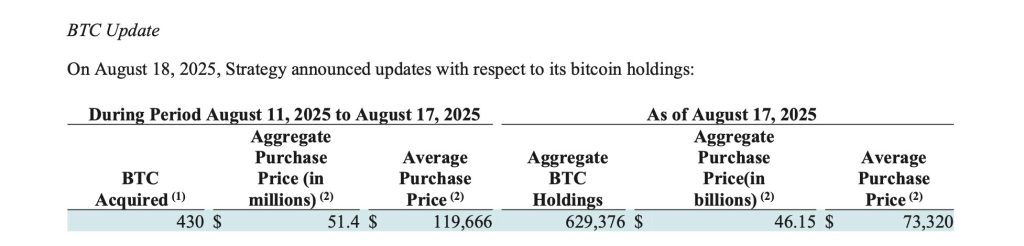
Strategy has disclosed a new bitcoin buy covering the period of Aug. 11–17, 2025: 430 BTC acquired for $51.4 million, implying an average purchase price of $119,666 per Bitcoin.

The add-on continues the company’s program of tactically increasing its treasury position during windows of liquidity.

Following the transaction, total holdings stand at 629,376 BTC as of Aug. 17, 2025. Management also flagged a 25.1% BTC yield year-to-date for 2025, showing how balance-sheet exposure has contributed to performance during this year’s rally.
Cost Basis and Scale of the Bet

The update puts Strategy’s aggregate bitcoin cost at $46.15 billion, translating to an average purchase price of $73,320 per coin across the life of the program.

Against that historical cost basis, the latest tranche—bought near $120,000—shows the company continuing to accumulate at elevated market levels while maintaining a long-duration thesis.

The company’s approach remains simple: expand core holdings when capital is available and market conditions permit, with the expectation that bitcoin’s multi-cycle appreciation will outweigh near-term price volatility.

ATM Playbook: Issuance Trigger Below 2.5x mNAV

Alongside the treasury update, Strategy refined its guidance on how it may use its Common ATM equity program. When mNAV (as defined on Strategy.com) falls below 2.5×, the company may tactically issue MSTR shares to:

  1. pay interest on debt obligations
  2. fund preferred-equity dividends
  3. deploy capital “when otherwise deemed advantageous to the Company.”

This formalizes how equity issuance fits into the firm’s balance-sheet toolkit. In practice, it gives management a rules-based trigger to raise cash when market conditions pressure the multiple, preserving liquidity for debt service and opportunistic treasury actions.

Saylor Updates MSTR Equity Guidance to Boost Capital Flexibility

Strategy has rolled out updated MSTR Equity ATM guidance, which offers investors a clearer look at how management will approach capital allocation.

Strategy’s latest purchase is modest in size but consistent with its long-running thesis: use corporate finance levers—debt, equity, and cash flow—to compound a large, low-cost bitcoin position.

With a clarified ATM framework and a transparent disclosure cadence, the company is showing that it will keep adding selectively while managing obligations and market cycles.

Last week, Saylor took to X (formerly Twitter) to explain why shares of MSTR trade at a premium to Bitcoin’s net asset value (NAV).

In his post, Saylor attributed this advantage to four key factors: Credit Amplification, Options Advantage, Passive Flows, and Superior Institutional Access—benefits that equity and credit instruments offer over commodity assets like Bitcoin.

Market Opportunity
NEAR Logo
NEAR Price(NEAR)
$1.19
$1.19$1.19
-1.32%
USD
NEAR (NEAR) Live Price Chart
Disclaimer: The articles reposted on this site are sourced from public platforms and are provided for informational purposes only. They do not necessarily reflect the views of MEXC. All rights remain with the original authors. If you believe any content infringes on third-party rights, please contact service@support.mexc.com for removal. MEXC makes no guarantees regarding the accuracy, completeness, or timeliness of the content and is not responsible for any actions taken based on the information provided. The content does not constitute financial, legal, or other professional advice, nor should it be considered a recommendation or endorsement by MEXC.

You May Also Like

Solana Hits $4B in Corporate Treasuries as Companies Boost Reserves

Solana Hits $4B in Corporate Treasuries as Companies Boost Reserves

TLDR Solana-based corporate treasuries have surpassed $4 billion in value. These reserves account for nearly 3% of Solana’s total circulating supply. Forward Industries is the largest holder with over 6.8 million SOL tokens. Helius Medical Technologies launched a $500 million Solana treasury reserve. Pantera Capital has a $1.1 billion position in Solana, emphasizing its potential. [...] The post Solana Hits $4B in Corporate Treasuries as Companies Boost Reserves appeared first on CoinCentral.
Share
Coincentral2025/09/18 04:08
SHIB Price Prediction: Mixed Signals Point to $0.0000085 Target by February End

SHIB Price Prediction: Mixed Signals Point to $0.0000085 Target by February End

Technical analysis reveals SHIB trading near oversold levels with RSI at 35.06. Despite bearish MACD momentum, support levels suggest potential recovery toward $
Share
BlockChain News2026/02/04 16:04
CEO Sandeep Nailwal Shared Highlights About RWA on Polygon

CEO Sandeep Nailwal Shared Highlights About RWA on Polygon

The post CEO Sandeep Nailwal Shared Highlights About RWA on Polygon appeared on BitcoinEthereumNews.com. Polygon CEO Sandeep Nailwal highlighted Polygon’s lead in global bonds, Spiko US T-Bill, and Spiko Euro T-Bill. Polygon published an X post to share that its roadmap to GigaGas was still scaling. Sentiments around POL price were last seen to be bearish. Polygon CEO Sandeep Nailwal shared key pointers from the Dune and RWA.xyz report. These pertain to highlights about RWA on Polygon. Simultaneously, Polygon underlined its roadmap towards GigaGas. Sentiments around POL price were last seen fumbling under bearish emotions. Polygon CEO Sandeep Nailwal on Polygon RWA CEO Sandeep Nailwal highlighted three key points from the Dune and RWA.xyz report. The Chief Executive of Polygon maintained that Polygon PoS was hosting RWA TVL worth $1.13 billion across 269 assets plus 2,900 holders. Nailwal confirmed from the report that RWA was happening on Polygon. The Dune and https://t.co/W6WSFlHoQF report on RWA is out and it shows that RWA is happening on Polygon. Here are a few highlights: – Leading in Global Bonds: Polygon holds 62% share of tokenized global bonds (driven by Spiko’s euro MMF and Cashlink euro issues) – Spiko U.S.… — Sandeep | CEO, Polygon Foundation (※,※) (@sandeepnailwal) September 17, 2025 The X post published by Polygon CEO Sandeep Nailwal underlined that the ecosystem was leading in global bonds by holding a 62% share of tokenized global bonds. He further highlighted that Polygon was leading with Spiko US T-Bill at approximately 29% share of TVL along with Ethereum, adding that the ecosystem had more than 50% share in the number of holders. Finally, Sandeep highlighted from the report that there was a strong adoption for Spiko Euro T-Bill with 38% share of TVL. He added that 68% of returns were on Polygon across all the chains. Polygon Roadmap to GigaGas In a different update from Polygon, the community…
Share
BitcoinEthereumNews2025/09/18 01:10