Project 11 CEO Alex Pruden is challenging a CoinShares estimate that only 10,200 bitcoin sit in “genuinely” quantum-vulnerable legacy addresses, arguing insteadProject 11 CEO Alex Pruden is challenging a CoinShares estimate that only 10,200 bitcoin sit in “genuinely” quantum-vulnerable legacy addresses, arguing instead

How Much Bitcoin Is Quantum-Vulnerable? Researcher Says 6.9 Million BTC

2026/02/11 13:00
4 min read

Project 11 CEO Alex Pruden is challenging a CoinShares estimate that only 10,200 bitcoin sit in “genuinely” quantum-vulnerable legacy addresses, arguing instead that roughly 6.9 million BTC could be exposed if cryptographically relevant quantum computers arrive sooner than the market expects.

The dispute, amplified by Castle Island partner Nic Carter, goes to the heart of a debate that has started to spill out of academic circles and into investor-facing research: not whether quantum computing would be catastrophic for today’s signature schemes, but how much Bitcoin is already exposed given how keys are used on-chain and how quickly the ecosystem would need to coordinate a migration.

Why ‘Only 10,000’ Bitcoin Are The Wrong Estimate

Pruden’s core objection to the “only 10k BTC” framing is definitional. In his thread, he argues quantum vulnerability extends well beyond old-style pay-to-public-key (P2PK) outputs and includes “any address that has signed a transaction once (and left residual funds there),” because the public key becomes visible on-chain once a spend is signed. In that model, coins left behind in those UTXOs could be vulnerable to an attacker able to derive a private key from a known public key.

He points to a “constantly updated tracker” run by Project Eleven listing 6,910,186 BTC as quantum-vulnerable, and cites Chaincode Labs’ technical report on post-quantum threats to Bitcoin as a cross-reference.

Pruden also singles out Satoshi Nakamoto’s presumed holdings as a large, dormant target surface. “The entity believed to be Satoshi alone holds 1,096,152 BTC across 21,924 addresses. All vulnerable,” he wrote, framing those coins as exposed under his broader definition.

Carter, responding to coverage circulating around the CoinShares number, said: “re that number of ‘only 10k quantum-vulnerable BTC’ you are seeing reported today… as much as I respect Chris and his work at Coinshares, he’s wrong on this one.”

Pruden situates the Bitcoin debate inside a wider shift among large tech companies and security institutions toward post-quantum planning. He cites a Google blog post by Hartmut Neven and Kent Walker that characterizes post-quantum cryptography as an urgent, systemic transition requiring coordinated action and accelerated adoption.

He also references a Google research result suggesting breaking RSA-2048 may require “~1 million noisy qubits,” lower than earlier estimates, and argues this compresses perceived timelines — even if Bitcoin uses ECDSA rather than RSA. To reinforce the uncertainty, Pruden quotes prominent theoretical computer scientist Scott Aaronson warning against complacency around Shor-vulnerable systems:

“On the other hand, if you think Bitcoin, and SSL, and all the other protocols based on Shor-breakable cryptography, are almost certainly safe for the next 5 years … then I submit that your confidence is also unwarranted. Your confidence might then be like most physicists’ confidence in 1938 that nuclear weapons were decades away, or like my own confidence in 2015 that an AI able to pass a reasonable Turing Test was decades away… The trouble is that sometimes people, y’know, do that.”

Pruden’s conclusion from that framing is less about predicting a date and more about avoiding a planning regime built on “it’ll be slow.”

Pruden argues the CoinShares post underestimates the operational reality of a post-quantum transition for an already-deployed, decentralized system. He highlights the need to migrate “millions of distributed keys,” the lack of a centralized authority, and the fact that asset ownership is enforced purely by digital signatures, with “no fallback.”

He also cites peer-reviewed research claiming “the BTC blockchain would have to shut down for 76 days” to process migration transactions for the existing UTXO set in a best-case scenario — a datapoint meant to stress that even a distant threat can demand near-term engineering and governance work.

Pruden further criticizes what he calls an appeal to authority in citing a hardware-wallet executive as evidence quantum is far away, arguing vendors may have incentives to downplay urgency if quantum-resistant signatures would obsolete existing devices.

At press time, BTC traded at $69,050.
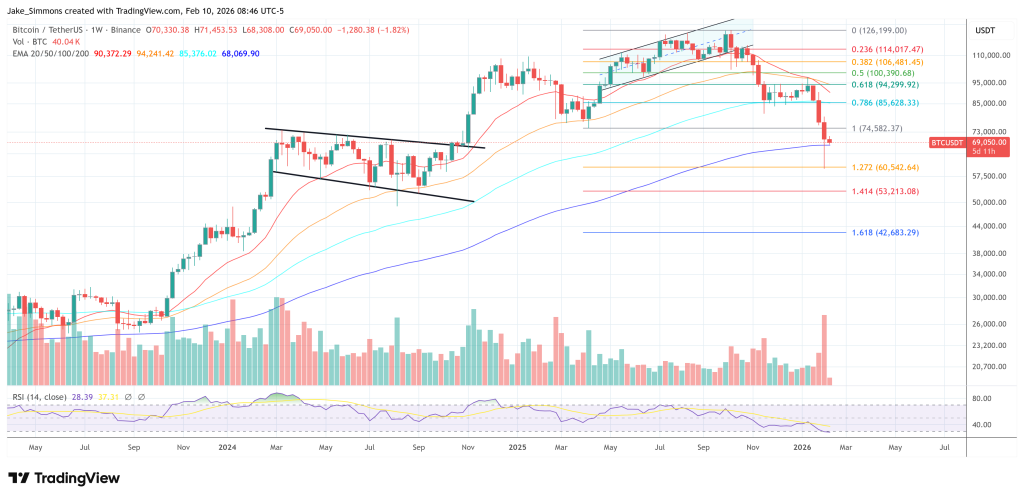
Bitcoin price chart
Market Opportunity
QUANTUM Logo
QUANTUM Price(QUANTUM)
$0.003406
$0.003406$0.003406
+0.05%
USD
QUANTUM (QUANTUM) Live Price Chart
Disclaimer: The articles reposted on this site are sourced from public platforms and are provided for informational purposes only. They do not necessarily reflect the views of MEXC. All rights remain with the original authors. If you believe any content infringes on third-party rights, please contact service@support.mexc.com for removal. MEXC makes no guarantees regarding the accuracy, completeness, or timeliness of the content and is not responsible for any actions taken based on the information provided. The content does not constitute financial, legal, or other professional advice, nor should it be considered a recommendation or endorsement by MEXC.

You May Also Like

Xenea Wallet Daily Quiz 11 February 2026: Claim Your Free Crypto Coins Now

Xenea Wallet Daily Quiz 11 February 2026: Claim Your Free Crypto Coins Now

Xenea Wallet Daily Quiz February 11, 2026: Today’s Correct Answer and How Users Are Learning Web3 While Earning Rewards The Xenea Wallet Daily Quiz for Febr
Share
Hokanews2026/02/11 15:36
Crucial Fed Rate Cut: October Probability Surges to 94%
Crucial Fed Rate Cut: October Probability Surges to 94%

BitcoinWorld Crucial Fed Rate Cut: October Probability Surges to 94% The financial world is buzzing with a significant development: the probability of a Fed rate cut in October has just seen a dramatic increase. This isn’t just a minor shift; it’s a monumental change that could ripple through global markets, including the dynamic cryptocurrency space. For anyone tracking economic indicators and their impact on investments, this update from the U.S. interest rate futures market is absolutely crucial. What Just Happened? Unpacking the FOMC Statement’s Impact Following the latest Federal Open Market Committee (FOMC) statement, market sentiment has decisively shifted. Before the announcement, the U.S. interest rate futures market had priced in a 71.6% chance of an October rate cut. However, after the statement, this figure surged to an astounding 94%. This jump indicates that traders and analysts are now overwhelmingly confident that the Federal Reserve will lower interest rates next month. Such a high probability suggests a strong consensus emerging from the Fed’s latest communications and economic outlook. A Fed rate cut typically means cheaper borrowing costs for businesses and consumers, which can stimulate economic activity. But what does this really signify for investors, especially those in the digital asset realm? Why is a Fed Rate Cut So Significant for Markets? When the Federal Reserve adjusts interest rates, it sends powerful signals across the entire financial ecosystem. A rate cut generally implies a more accommodative monetary policy, often enacted to boost economic growth or combat deflationary pressures. Impact on Traditional Markets: Stocks: Lower interest rates can make borrowing cheaper for companies, potentially boosting earnings and making stocks more attractive compared to bonds. Bonds: Existing bonds with higher yields might become more valuable, but new bonds will likely offer lower returns. Dollar Strength: A rate cut can weaken the U.S. dollar, making exports cheaper and potentially benefiting multinational corporations. Potential for Cryptocurrency Markets: The cryptocurrency market, while often seen as uncorrelated, can still react significantly to macro-economic shifts. A Fed rate cut could be interpreted as: Increased Risk Appetite: With traditional investments offering lower returns, investors might seek higher-yielding or more volatile assets like cryptocurrencies. Inflation Hedge Narrative: If rate cuts are perceived as a precursor to inflation, assets like Bitcoin, often dubbed “digital gold,” could gain traction as an inflation hedge. Liquidity Influx: A more accommodative monetary environment generally means more liquidity in the financial system, some of which could flow into digital assets. Looking Ahead: What Could This Mean for Your Portfolio? While the 94% probability for a Fed rate cut in October is compelling, it’s essential to consider the nuances. Market probabilities can shift, and the Fed’s ultimate decision will depend on incoming economic data. Actionable Insights: Stay Informed: Continue to monitor economic reports, inflation data, and future Fed statements. Diversify: A diversified portfolio can help mitigate risks associated with sudden market shifts. Assess Risk Tolerance: Understand how a potential rate cut might affect your specific investments and adjust your strategy accordingly. This increased likelihood of a Fed rate cut presents both opportunities and challenges. It underscores the interconnectedness of traditional finance and the emerging digital asset space. Investors should remain vigilant and prepared for potential volatility. The financial landscape is always evolving, and the significant surge in the probability of an October Fed rate cut is a clear signal of impending change. From stimulating economic growth to potentially fueling interest in digital assets, the implications are vast. Staying informed and strategically positioned will be key as we approach this crucial decision point. The market is now almost certain of a rate cut, and understanding its potential ripple effects is paramount for every investor. Frequently Asked Questions (FAQs) Q1: What is the Federal Open Market Committee (FOMC)? A1: The FOMC is the monetary policymaking body of the Federal Reserve System. It sets the federal funds rate, which influences other interest rates and economic conditions. Q2: How does a Fed rate cut impact the U.S. dollar? A2: A rate cut typically makes the U.S. dollar less attractive to foreign investors seeking higher returns, potentially leading to a weakening of the dollar against other currencies. Q3: Why might a Fed rate cut be good for cryptocurrency? A3: Lower interest rates can reduce the appeal of traditional investments, encouraging investors to seek higher returns in alternative assets like cryptocurrencies. It can also be seen as a sign of increased liquidity or potential inflation, benefiting assets like Bitcoin. Q4: Is a 94% probability a guarantee of a rate cut? A4: While a 94% probability is very high, it is not a guarantee. Market probabilities reflect current sentiment and data, but the Federal Reserve’s final decision will depend on all available economic information leading up to their meeting. Q5: What should investors do in response to this news? A5: Investors should stay informed about economic developments, review their portfolio diversification, and assess their risk tolerance. Consider how potential changes in interest rates might affect different asset classes and adjust strategies as needed. Did you find this analysis helpful? Share this article with your network to keep others informed about the potential impact of the upcoming Fed rate cut and its implications for the financial markets! To learn more about the latest crypto market trends, explore our article on key developments shaping Bitcoin price action. This post Crucial Fed Rate Cut: October Probability Surges to 94% first appeared on BitcoinWorld.
Share
Coinstats2025/09/18 02:25
Remittix Latest News & Bitcoin Price Prediction From Global Experts

Remittix Latest News & Bitcoin Price Prediction From Global Experts

Bitcoin price prediction headlines dominated crypto news this week. Global analysts reacted to sharp macro signals, rising liquidity and new payment technology
Share
TechFinancials2026/02/11 15:01