Meanwhile, the PI token has been recovering in the past few days.Meanwhile, the PI token has been recovering in the past few days.

Pi Network’s Latest Update Explained – And Why It’s a Big Deal

3 min read

TL;DR

  • The team behind Pi Network introduced a new update just a few days ago that many users had wanted for years – support for Linux.
  • Here’s why the Core Team believes it could be a game-changer, at least for those opting to use the alternative OS.

Why the Linux Addition Matters?

As CryptoPotato reported at the end of last week, the Pi ecosystem has expanded its OS capabilities beyond Windows and Mac with the release of its Linux Node software. The move aims to enhance the project’s decentralized backbone, as the team is also preparing for a major protocol upgrade from version 19 to 23.

Obviously, the introduction of a third OS alternative allows for greater flexibility for developers and partners. Until now, many of them had to rely on custom node builds to work with Pi’s infrastructure. Now, they can migrate to standardized node software, which should ensure faster maintenance, smoother protocol updates, and overall network consistency.

For the tech-savvy, the Linux Node allows greater participation in the ecosystem, even though it’s not directly linked to mining rewards. It still provides broader accessibility for devs and open-source contributors who prefer such environments.

The aforementioned upgrade from version 19 to 23 is considered the most ambitious one for the protocol yet. It’s influenced by Stellar and aims to bring expanded functionality and improved control layers. Its rollout will be staged in a few steps to minimize disruption:

  1. Testnet1 upgrades begin this week, with minor outages possible as the new community node container is deployed.
  2. Testnet2 and Mainnet will follow in the coming weeks, bringing the full ecosystem to protocol version 23.
  3. Short outages may also affect centralized exchanges (CEXs) as they adapt to the upgrade.

This upgrade also aims to address some of the KYC issues with the project, but we will dedicate a separate article on this, as there has already been community backlash or doubts, to say the least.

PI Token Reacts

Perhaps driven by these positive developments within the broader Pi ecosystem, the protocol’s native token is among the few that ended the week in the green. Unlike most of its altcoin brethren, PI has jumped by over 5% since this time last week and trades close to $0.37 as of press time.

Recall that the asset plunged to a new all-time low on August 26 of $0.33 (on CoinGecko) but has recovered 10% of value since then. However, it could face some enhanced selling pressure in the following days due to the large number of token unlocks scheduled for September 2 and September 6. After that, though, the unlocks should reduce the pressure, at least in theory.
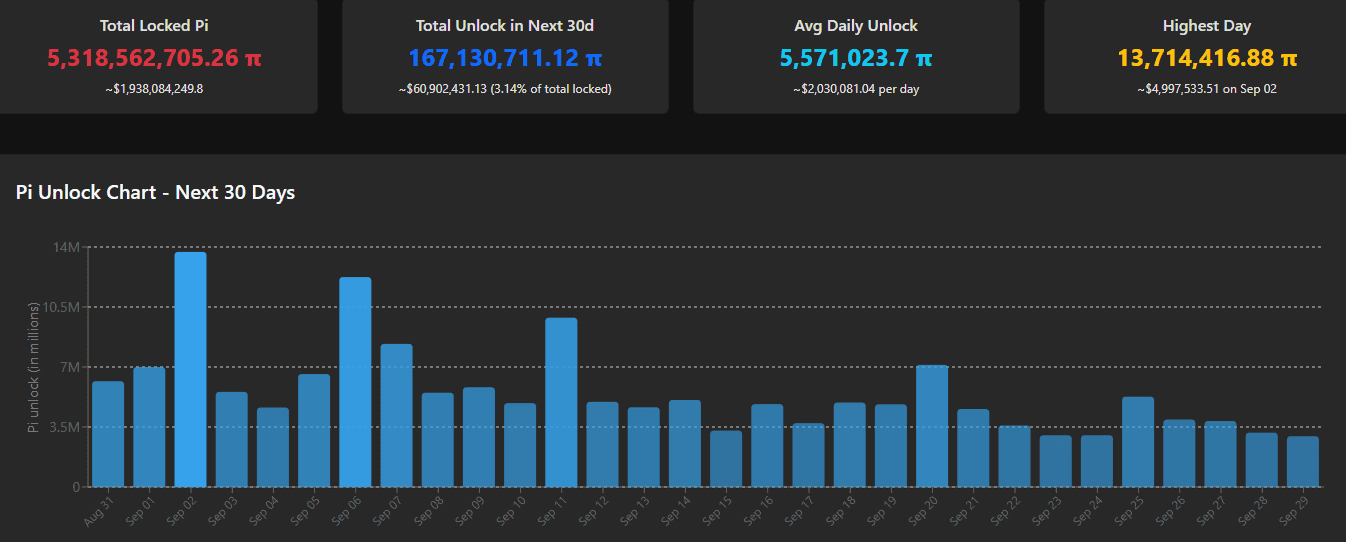
PI Token Unlock Schedule. Source: PiscanPI Token Unlock Schedule. Source: Piscan

The post Pi Network’s Latest Update Explained – And Why It’s a Big Deal appeared first on CryptoPotato.

Disclaimer: The articles reposted on this site are sourced from public platforms and are provided for informational purposes only. They do not necessarily reflect the views of MEXC. All rights remain with the original authors. If you believe any content infringes on third-party rights, please contact service@support.mexc.com for removal. MEXC makes no guarantees regarding the accuracy, completeness, or timeliness of the content and is not responsible for any actions taken based on the information provided. The content does not constitute financial, legal, or other professional advice, nor should it be considered a recommendation or endorsement by MEXC.
Tags:

You May Also Like

Cashing In On University Patents Means Giving Up On Our Innovation Future

Cashing In On University Patents Means Giving Up On Our Innovation Future

The post Cashing In On University Patents Means Giving Up On Our Innovation Future appeared on BitcoinEthereumNews.com. “It’s a raid on American innovation that would deliver pennies to the Treasury while kneecapping the very engine of our economic and medical progress,” writes Pipes. Getty Images Washington is addicted to taxing success. Now, Commerce Secretary Howard Lutnick is floating a plan to skim half the patent earnings from inventions developed at universities with federal funding. It’s being sold as a way to shore up programs like Social Security. In reality, it’s a raid on American innovation that would deliver pennies to the Treasury while kneecapping the very engine of our economic and medical progress. Yes, taxpayer dollars support early-stage research. But the real payoff comes later—in the jobs created, cures discovered, and industries launched when universities and private industry turn those discoveries into real products. By comparison, the sums at stake in patent licensing are trivial. Universities collectively earn only about $3.6 billion annually in patent income—less than the federal government spends on Social Security in a single day. Even confiscating half would barely register against a $6 trillion federal budget. And yet the damage from such a policy would be anything but trivial. The true return on taxpayer investment isn’t in licensing checks sent to Washington, but in the downstream economic activity that federally supported research unleashes. Thanks to the bipartisan Bayh-Dole Act of 1980, universities and private industry have powerful incentives to translate early-stage discoveries into real-world products. Before Bayh-Dole, the government hoarded patents from federally funded research, and fewer than 5% were ever licensed. Once universities could own and license their own inventions, innovation exploded. The result has been one of the best returns on investment in government history. Since 1996, university research has added nearly $2 trillion to U.S. industrial output, supported 6.5 million jobs, and launched more than 19,000 startups. Those companies pay…
Share
BitcoinEthereumNews2025/09/18 03:26
VectorUSA Achieves Fortinet’s Engage Preferred Services Partner Designation

VectorUSA Achieves Fortinet’s Engage Preferred Services Partner Designation

TORRANCE, Calif., Feb. 3, 2026 /PRNewswire/ — VectorUSA, a trusted technology solutions provider, specializes in delivering integrated IT, security, and infrastructure
Share
AI Journal2026/02/05 00:02
Top Solana Treasury Firm Forward Industries Unveils $4 Billion Capital Raise To Buy More SOL ⋆ ZyCrypto

Top Solana Treasury Firm Forward Industries Unveils $4 Billion Capital Raise To Buy More SOL ⋆ ZyCrypto

The post Top Solana Treasury Firm Forward Industries Unveils $4 Billion Capital Raise To Buy More SOL ⋆ ZyCrypto appeared on BitcoinEthereumNews.com. Advertisement &nbsp &nbsp Forward Industries, the largest publicly traded Solana treasury company, has filed a $4 billion at-the-market (ATM) equity offering program with the U.S. SEC  to raise more capital for additional SOL accumulation. Forward Strategies Doubles Down On Solana Strategy In a Wednesday press release, Forward Industries revealed that the 4 billion ATM equity offering program will allow the company to issue and sell common stock via Cantor Fitzgerald under a sales agreement dated Sept. 16, 2025. Forward said proceeds will go toward “general corporate purposes,” including the pursuit of its Solana balance sheet and purchases of income-generating assets. The sales of the shares are covered by an automatic shelf registration statement filed with the US Securities and Exchange Commission that is already effective – meaning the shares will be tradable once they’re sold. An automatic shelf registration allows certain publicly listed companies to raise capital with flexibility swiftly.  Kyle Samani, Forward’s chairman, astutely described the ATM offering as “a flexible and efficient mechanism” to raise and deploy capital for the company’s Solana strategy and bolster its balance sheet.  Advertisement &nbsp Though the maximum amount is listed as $4 billion, the firm indicated that sales may or may not occur depending on existing market conditions. “The ATM Program enhances our ability to continue scaling that position, strengthen our balance sheet, and pursue growth initiatives in alignment with our long-term vision,” Samani said. Forward Industries kicked off its Solana treasury strategy on Sept. 8. The Wednesday S-3 form follows Forward’s $1.65 billion private investment in public equity that closed last week, led by crypto heavyweights like Galaxy Digital, Jump Crypto, and Multicoin Capital. The company started deploying that capital this week, announcing it snatched up 6.8 million SOL for approximately $1.58 billion at an average price of $232…
Share
BitcoinEthereumNews2025/09/18 03:42