Solana has achieved a major milestone with its community voting overwhelmingly to approve the Alpenglow upgrade. The proposal passed with 98.27% approval from validators, marking the biggest technical change in the blockchain's history.Solana has achieved a major milestone with its community voting overwhelmingly to approve the Alpenglow upgrade. The proposal passed with 98.27% approval from validators, marking the biggest technical change in the blockchain's history.

Solana’s Alpenglow Upgrade Passes with 98% Approval, Promising 100x Speed Boost

4 min read
Solana's Alpenglow Upgrade Passes with 98% Approval, Promising 100x Speed Boost

The governance vote concluded on September 2, 2025, with 52% of the network’s total stake participating. Only 1.05% voted against the upgrade, while 0.69% abstained. This strong support clears the way for Solana to implement changes that could make it the fastest major blockchain network.

What Makes Alpenglow Revolutionary

The Alpenglow upgrade will cut transaction finality times from over 12 seconds to just 100-150 milliseconds. This represents a 100x improvement in speed, bringing Solana’s performance closer to traditional payment systems like Visa.

The upgrade replaces two core systems that currently run Solana. Proof-of-History, which timestamps transactions, will be replaced by a new system called Rotor. TowerBFT, which handles validator voting, will be replaced by Votor.

Votor uses off-chain voting to speed up the consensus process. When 80% of validators participate, blocks can finalize in just one round. If only 60% participate, the system still works but takes two rounds to complete.

Rotor improves how data moves between validators. It cuts the number of network hops needed and reduces bandwidth usage by 40%. This helps the entire network run more efficiently.

Strong Network Security Features

The upgrade includes a “20+20” resilience model that keeps the network running even during major problems. The system can continue operating if 20% of validators act maliciously and another 20% go offline simultaneously.

This fault tolerance addresses concerns that institutions often have about blockchain reliability. Traditional financial systems need to maintain uptime, and Alpenglow helps Solana meet these standards.
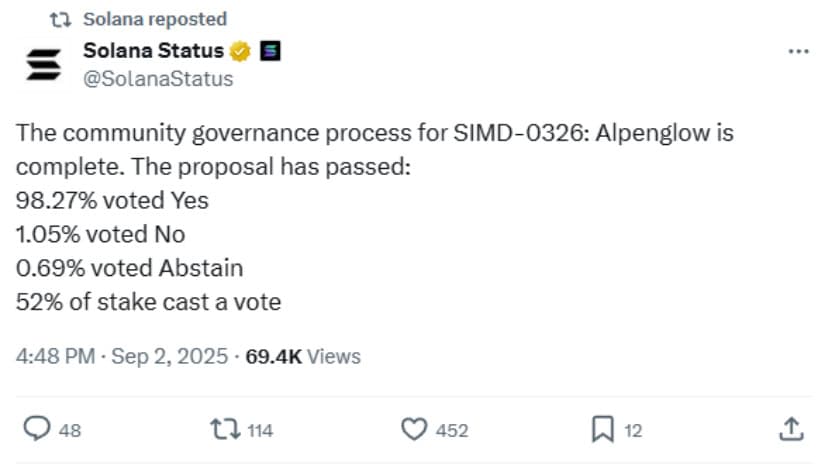
Strong Network Security Features

Source: @SolanaStatus

The upgrade also dramatically reduces costs for validators. Running a validator node will cost about $1,000 per year instead of the current $60,000. This change makes it easier for more people to participate in securing the network, which improves decentralization.

Validators will also save roughly $5,000 monthly in on-chain voting fees since the new system moves voting off-chain.

Growing Institutional Interest

Major institutions are showing increased interest in Solana’s capabilities. The network has seen growing corporate adoption, with companies like BlackRock, Stripe, and SpaceX forming partnerships with projects in the Solana ecosystem.

Solana’s DeFi ecosystem continues growing rapidly. Total Value Locked reached $8.6 billion in Q2 2025, representing a 30.4% increase from the previous quarter. The network’s App Revenue Capture Ratio hit 211.6%, showing strong economic activity.

The REX-Osprey Solana ETF has gained traction with investors seeking regulated exposure to Solana. Recent trading sessions have shown strong institutional interest in Solana-based investment products.

Hedge funds and trading firms are positioning for the upgrade’s benefits. The combination of faster transactions and lower costs makes Solana attractive for high-frequency trading applications.

Technical Performance Advantages

The speed improvements put Solana ahead of major competitors. Ethereum takes about 15 minutes to reach finality after the Merge upgrade. Sui, another fast blockchain, achieves 400-millisecond finality. Alpenglow’s 150-millisecond target would make Solana faster than both.

The upgrade enables new use cases that require near-instant confirmation. High-frequency trading, real-time gaming, and instant payments become more practical when transactions finalize in milliseconds rather than seconds.

The development firm Anza, which created Alpenglow, designed the system to handle over 107,000 transactions per second. This throughput exceeds most traditional payment networks while maintaining blockchain security benefits.

The environmental impact remains low despite the performance gains. Solana already uses less energy than proof-of-work blockchains, and Alpenglow maintains this efficiency while adding speed.

Market Response and Price Impact

SOL price has remained stable above $200 despite broader market volatility. The Alpenglow approval has contributed to positive sentiment among traders and investors.

Technical analysts see potential for SOL to reach $250-300 if the upgrade delivers on its promises. Some long-term projections suggest the token could reach higher levels as adoption increases.

Staking yields of 7.16% attract institutional investors compared to Ethereum’s 3.01% yield. About 64.8% of SOL’s circulating supply is now staked, with liquid staking rates rising to 12.2%.

The combination of technical improvements and growing institutional adoption creates positive momentum for the network’s future value.

The Path Ahead

While no official timeline exists for mainnet deployment, the upgrade is expected to launch by late 2025 or early 2026. The strong governance support removes a major hurdle for implementation.

Solana’s broader roadmap includes additional features like Application-Controlled Execution and Multiple Concurrent Leaders. These future upgrades would further enhance the network’s capabilities for financial applications.

Developers are already preparing applications that take advantage of the faster finality times. Gaming platforms, DeFi protocols, and payment systems all benefit from sub-second transaction confirmation.

Market Opportunity
ChangeX Logo
ChangeX Price(CHANGE)
$0.00032485
$0.00032485$0.00032485
-0.26%
USD
ChangeX (CHANGE) Live Price Chart
Disclaimer: The articles reposted on this site are sourced from public platforms and are provided for informational purposes only. They do not necessarily reflect the views of MEXC. All rights remain with the original authors. If you believe any content infringes on third-party rights, please contact service@support.mexc.com for removal. MEXC makes no guarantees regarding the accuracy, completeness, or timeliness of the content and is not responsible for any actions taken based on the information provided. The content does not constitute financial, legal, or other professional advice, nor should it be considered a recommendation or endorsement by MEXC.

You May Also Like

CEO Sandeep Nailwal Shared Highlights About RWA on Polygon

CEO Sandeep Nailwal Shared Highlights About RWA on Polygon

The post CEO Sandeep Nailwal Shared Highlights About RWA on Polygon appeared on BitcoinEthereumNews.com. Polygon CEO Sandeep Nailwal highlighted Polygon’s lead in global bonds, Spiko US T-Bill, and Spiko Euro T-Bill. Polygon published an X post to share that its roadmap to GigaGas was still scaling. Sentiments around POL price were last seen to be bearish. Polygon CEO Sandeep Nailwal shared key pointers from the Dune and RWA.xyz report. These pertain to highlights about RWA on Polygon. Simultaneously, Polygon underlined its roadmap towards GigaGas. Sentiments around POL price were last seen fumbling under bearish emotions. Polygon CEO Sandeep Nailwal on Polygon RWA CEO Sandeep Nailwal highlighted three key points from the Dune and RWA.xyz report. The Chief Executive of Polygon maintained that Polygon PoS was hosting RWA TVL worth $1.13 billion across 269 assets plus 2,900 holders. Nailwal confirmed from the report that RWA was happening on Polygon. The Dune and https://t.co/W6WSFlHoQF report on RWA is out and it shows that RWA is happening on Polygon. Here are a few highlights: – Leading in Global Bonds: Polygon holds 62% share of tokenized global bonds (driven by Spiko’s euro MMF and Cashlink euro issues) – Spiko U.S.… — Sandeep | CEO, Polygon Foundation (※,※) (@sandeepnailwal) September 17, 2025 The X post published by Polygon CEO Sandeep Nailwal underlined that the ecosystem was leading in global bonds by holding a 62% share of tokenized global bonds. He further highlighted that Polygon was leading with Spiko US T-Bill at approximately 29% share of TVL along with Ethereum, adding that the ecosystem had more than 50% share in the number of holders. Finally, Sandeep highlighted from the report that there was a strong adoption for Spiko Euro T-Bill with 38% share of TVL. He added that 68% of returns were on Polygon across all the chains. Polygon Roadmap to GigaGas In a different update from Polygon, the community…
Share
BitcoinEthereumNews2025/09/18 01:10
TRM Labs Becomes Unicorn with 70M$: BTC Fraud Risk

TRM Labs Becomes Unicorn with 70M$: BTC Fraud Risk

The post TRM Labs Becomes Unicorn with 70M$: BTC Fraud Risk appeared on BitcoinEthereumNews.com. TRM Labs Reaches 1 Billion Dollar Valuation Blockchain intelligence
Share
BitcoinEthereumNews2026/02/05 03:33
Bitcoin Set For ‘Promising’ Q4, Next Two Weeks Could Be Decisive

Bitcoin Set For ‘Promising’ Q4, Next Two Weeks Could Be Decisive

The post Bitcoin Set For ‘Promising’ Q4, Next Two Weeks Could Be Decisive appeared on BitcoinEthereumNews.com. Rubmar is a writer and translator who has been a crypto enthusiast for the past four years. Her goal as a writer is to create informative, complete, and easily understandable pieces accessible to those entering the crypto space. After learning about cryptocurrencies in 2019, Rubmar became curious about the world of possibilities the industry offered, quickly learning that financial freedom was at the palm of her hand with the developing technology. From a young age, Rubmar was curious about how languages work, finding special interest in wordplay and the peculiarities of dialects. Her curiosity grew as she became an avid reader in her teenage years. She explored freedom and new words through her favorite books, which shaped her view of the world. Rubmar acquired the necessary skills for in-depth research and analytical thinking at university, where she studied Literature and Linguistics. Her studies have given her a sharp perspective on several topics and allowed her to turn every stone in her investigations. In 2019, she first dipped her toes in the crypto industry when a friend introduced her to Bitcoin and cryptocurrencies, but it wasn’t until 2020 that she started to dive into the depth of the industry. As Rubmar began to understand the mechanics of the crypto sphere, she saw a new world yet to be explored. At the beginning of her crypto voyage, she discovered a new system that allowed her to have control over her finances. As a young adult of the 21st century, Rubmar has faced the challenges of the traditional banking system and the restrictions of fiat money. After the failure of her home country’s economy, the limitations of traditional finances became clear. The bureaucratic, outdated structure made her feel hopeless and powerless amid an aggressive and distorted system created by hyperinflation. However, learning about…
Share
BitcoinEthereumNews2025/09/18 23:00