By Thejaswini MA Compiled by: Block Unicorn Preface The check bounced. Fifteen-year-old Chris Larsen discovered that getting paid was harder than doing the work itself. He ran a dent-repair business out of his driveway in San Francisco. Neighbors would bring their wrecked cars, and he would use borrowed tools and the determination of a teenager to pound out the dents. He did honest work and offered fair prices, but when a client didn't pay, fifteen-year-old Larsen learned his first harsh lesson about how the financial system works. His father repaired airplane engines at San Francisco International Airport, earning his salary every two weeks. His mother drew illustrations for clients, who often paid months later or not at all. Both parents understood that money flowed easily to those who already had it, while being stingy with everyone else. This is how the system is designed. That frustration, decades in the making, drove him to found three multibillion-dollar companies, each challenging a part of the financial system that treated ordinary people as a nuisance rather than as customers. The Son of a Mechanic Who Sees Through the System San Francisco, 1960. Chris Larsen grew up in a family that understood the value of stable employment. Growing up in a working-class household meant he experienced the financial system from the customer's perspective, not the bank's. When his parents needed a car loan or a mortgage, they faced bank employees who made the decisions behind the scenes. The process was opaque, slow, and often unfair. Why can some people get loans easily while others can't? Why do banks charge different customers different interest rates for the same service? Why do decisions that could take minutes take so long? These are personal struggles faced by millions of families, but few have experienced them firsthand by those with the power to make a difference. After graduating from high school, Larson began studying aeronautics at San Jose State University, hoping to pursue a practical career in engineering. However, he felt the curriculum was too narrow, so he transferred to San Francisco State University to major in international business and accounting. After graduating in 1984, Larsen joined Chevron as a financial auditor. This work took him to Brazil, Ecuador, and Indonesia. His global business experience allowed him to witness firsthand the workings of the international financial system. But he needed to understand the system more deeply before he could change it. In 1991, Larsen earned his MBA from Stanford Graduate School of Business. His professor, Jim Collins, taught him how to build companies that outlive their founders. These lessons stuck with him. Larsen wasn't interested in short-term wins or trendy business models. He wanted to build infrastructure that would remain relevant decades from now. The combination of the Internet and finance In 1996, the Internet boom was just beginning. While most entrepreneurs were busy building websites for pet supplies or grocery delivery, Larson saw a different opportunity: What if the internet were applied to that most traditional of industries: mortgage lending? He then co-founded E-Loan with Janina Pawlowski. The concept is to take mortgage applications online so borrowers can apply for loans online without having to deal with brokers who charge unnecessary fees. At the time, most financial institutions were operating like it was 1976, requiring borrowers to physically visit a bank branch, fill out paper forms, and wait weeks for an approval decision that software could deliver in minutes. E-Loan's website launched in 1997, allowing borrowers to compare rates, submit applications, and track their progress online. The company eliminated broker commissions and cut processing time from weeks to days. But Larson made a decision. E-Loan became the first company to offer consumers free FICO credit scores. This is revolutionary. For decades, banks and credit card companies have used these scores to make lending decisions, but consumers haven't been able to see their own scores. The credit scoring system is a black box that determines whether you can buy a house or a car, but you don't know what's inside. This move forces transparency across the entire credit industry. If borrowers can see their scores, they can understand why they were offered a certain interest rate and take steps to improve their credit worthiness. In 1999, at the height of the dot-com boom, E-Loan went public. At its peak, the company was valued at approximately $1 billion. But Larsen wasn't interested in chasing the bubble. In 2005, he sold E-Loan to Banco Popular for $300 million. E-Loan was successful because it automated processes that banks used to handle manually. But shouldn’t we rethink how these processes actually work? Freedom from the constraints of banks By 2005, Larsen was already thinking about his next target: the bank itself. What if ordinary people could borrow money directly from other ordinary people, completely without the involvement of banks? He co-founded Prosper Marketplace, the first peer-to-peer lending platform in the United States, with John Witchel. What's the idea? Borrowers can post loan requests, specifying what they need the funds for and the interest rate they're willing to pay. Individual investors can browse these requests and choose which loans to fund. The market will determine the interest rate based on actual supply and demand, not a bank's opaque formula. The platform democratizes both lending and borrowing. People with good credit can earn higher returns than they would with a savings account. People with less-than-perfect credit can get loans that traditional banks won't offer. But Prosper faced a problem that e-Loan didn't: regulatory uncertainty. When securities laws were written decades ago, no one imagined that ordinary people would lend money to strangers online. In 2008, the US Securities and Exchange Commission (SEC) ruled that P2P loans were, in fact, securities requiring registration and disclosure. Many companies might have chosen to fight regulators or find loopholes. But Larson chose a different path. Rather than confront the authorities, he worked with them. Prosper filed a prospectus with the SEC and adapted its business model to comply with securities laws. This enabled the company to survive regulatory challenges and continue to grow. Because it’s not enough to just build better technology. You also have to help regulators understand why new rules are needed. In 2012, Larsen resigned as CEO of Prosper, but remained chairman. He was already thinking about his next project. P2P lending had shown him that technology could replace the intermediaries in traditional finance. But his truly ambitious goal wasn't domestic lending. It's international payments. Building a valuable Internet The idea for Ripple stemmed from a simple observation: sending money across borders is still harder than sending an email. International wire transfers take days, are expensive, and often fail for unknown reasons. In an age where information can travel around the world in milliseconds, transferring money feels like something out of the 1970s. In September 2012, Larsen co-founded OpenCoin with programmer Jed McCaleb. Their goal was to build a payment protocol that could settle transactions between any currency in seconds, rather than days. The company changed names several times, from OpenCoin to Ripple Labs in 2013 to simply Ripple in 2015. But the mission remained the same: to build what Larsen called the "Internet of Value." Ripple's approach differs from Bitcoin, which was designed as an alternative to traditional currencies. Ripple's technology allows traditional currencies to flow more efficiently. Banks can use Ripple's network to settle international payments without having to maintain accounts in every country they do business in. The system uses XRP, Ripple's native digital currency, as a bridge asset. Instead of going through multiple intermediaries to convert dollars into euros, a bank can simply convert dollars into XRP, transfer the XRP to another bank, and then convert the XRP into euros. The entire process can be completed in seconds. During Larsen's tenure as CEO, Ripple signed partnerships with major financial institutions, including Santander, American Express, and Standard Chartered. You could call it a pilot program or an experiment. But the banks were using Ripple's technology to process millions of dollars worth of real customer payments. As the cryptocurrency market exploded in 2017 and 2018, XRP became one of the world’s most valuable digital assets. At its peak, Larsen’s holdings were worth more than $59 billion on paper, briefly making him one of the richest people in the United States. But Larson learned from his previous company that scaling requires a different skill set than building one. In 2016, he stepped down as CEO to become executive chairman and hired Brad Garlinghouse to run day-to-day operations while he focused on strategy and overseeing relationships. With success comes scrutiny. The test of supervision December 2020. The call every cryptocurrency executive dreads. The U.S. Securities and Exchange Commission sued Ripple, alleging that XRP is an unregistered security and that the company raised $1.3 billion through an illegal securities offering. The lawsuit brought nearly five years of uncertainty. XRP's price plummeted, and exchanges began delisting the token to avoid regulatory risks. Ripple faced potentially hefty fines and a fundamental shift in its business model. Larsen could have quickly settled the case and moved on to other projects, as many cryptocurrency entrepreneurs do. But he chose to fight. Ripple has spent tens of millions of dollars on legal fees arguing that XRP is a currency, not a security. The company’s lawyers point out that Bitcoin and Ethereum have been deemed non-securities by regulators, and that XRP operates in a similar manner. The strategy proved correct, but it took years to be vindicated. In 2023, Judge Analisa Torres ruled that programmatic sales of XRP to retail investors did not constitute a securities offering. The decision was a partial victory that helped clarify the regulatory status of digital assets. In 2025, the SEC dropped its appeal and settled for $125 million, a substantial fine but far less than many had expected. The legal victory validated Larsen’s long-term strategy in building his cryptocurrency company. Unlike many crypto companies that operate in a regulatory gray area, Ripple has cooperated with regulators from the beginning, and when regulatory crackdowns came, the company was ready. Throughout the legal battle, Ripple continued to expand its business. In April 2025, the company acquired top brokerage firm Hidden Road for $1.25 billion, adding trading and custody services. Ripple also sought a national banking license and partnered with Bank of New York Mellon to provide custody services for its RLUSD stablecoin reserves. Silent influence Today, Larson's influence extends far beyond the company he founded. In 2019, he and his wife, Lina Lamm, donated $25 million worth of XRP to San Francisco State University, the largest cryptocurrency donation to a US university at the time. The gift established an endowed chair in fintech and innovation and funded global student programs. Universities have rigorous procedures for accepting and managing donations. By collaborating with these institutions, Larsen helped formalize cryptocurrency philanthropy. He also funded privacy advocacy through the coalition Californians for Privacy Now, which successfully pushed California to pass a financial privacy law requiring companies to obtain consumer permission before sharing personal data. The campaign collected 600,000 signatures and lobbied major financial companies to withdraw their opposition. More recently, Larsen has focused on the environmental impact of cryptocurrency. In 2021, he launched the "Change Code, Not Climate" campaign, which funds efforts to convince Bitcoin miners to switch from energy-intensive proof-of-work mining to more efficient alternatives. That stance puts him at odds with bitcoin maximalists who insist proof-of-work is essential for network security, but Larsen believes that climate change must be addressed if cryptocurrencies are to gain mainstream adoption. “This movement is not anti-Bitcoin, it’s anti-pollution,” Larsen explained. “We need to clean up our industry. The issue is not powering Bitcoin with clean energy, as some suggest. We need to use limited clean energy for other important purposes. The issue is changing the code to drastically reduce energy use. That’s the way forward for the environment.” His willingness to challenge cryptocurrency orthodoxy reflects the same thinking that has characterized his career: What’s popular isn’t always what’s best. At 64, Larson still works six days a week while pursuing hobbies that reflect his methodical approach to complex problems. He and his sons restore classic cars from the 1960s, stripping them down and rebuilding them from the frame up. These projects, which take three years to complete, embody the meticulous approach that has characterized his career. He envisions a future where sending $100 from San Francisco to Lagos takes seconds and costs pennies, allowing small businesses to access international markets without having to deal with complex banking relationships. His three companies challenge different parts of the financial system that have failed to serve ordinary people well. E-Loan brings transparency to mortgage shopping. Prosper democratizes lending. Ripple accelerates international payments. Each company succeeds by building infrastructure that others can use, rather than trying to control the entire market. This approach requires patience and long-term thinking, rare qualities in an industry known for hype and quick profits. In an era where cryptocurrencies are often associated with speculation and volatility, Larsen has demonstrated that patient infrastructure development can bring about lasting change. His work isn’t done, but the foundation for a financial system that serves users, not institutions, has been laid. Money is becoming more like information—faster, cheaper, and more accessible to those previously excluded from financial services. This transformation is still unfolding, but the direction is clear, and Chris Larsen has been building the track that will propel it forward. That's the story of Chris Larsen. See you in the next post.By Thejaswini MA Compiled by: Block Unicorn Preface The check bounced. Fifteen-year-old Chris Larsen discovered that getting paid was harder than doing the work itself. He ran a dent-repair business out of his driveway in San Francisco. Neighbors would bring their wrecked cars, and he would use borrowed tools and the determination of a teenager to pound out the dents. He did honest work and offered fair prices, but when a client didn't pay, fifteen-year-old Larsen learned his first harsh lesson about how the financial system works. His father repaired airplane engines at San Francisco International Airport, earning his salary every two weeks. His mother drew illustrations for clients, who often paid months later or not at all. Both parents understood that money flowed easily to those who already had it, while being stingy with everyone else. This is how the system is designed. That frustration, decades in the making, drove him to found three multibillion-dollar companies, each challenging a part of the financial system that treated ordinary people as a nuisance rather than as customers. The Son of a Mechanic Who Sees Through the System San Francisco, 1960. Chris Larsen grew up in a family that understood the value of stable employment. Growing up in a working-class household meant he experienced the financial system from the customer's perspective, not the bank's. When his parents needed a car loan or a mortgage, they faced bank employees who made the decisions behind the scenes. The process was opaque, slow, and often unfair. Why can some people get loans easily while others can't? Why do banks charge different customers different interest rates for the same service? Why do decisions that could take minutes take so long? These are personal struggles faced by millions of families, but few have experienced them firsthand by those with the power to make a difference. After graduating from high school, Larson began studying aeronautics at San Jose State University, hoping to pursue a practical career in engineering. However, he felt the curriculum was too narrow, so he transferred to San Francisco State University to major in international business and accounting. After graduating in 1984, Larsen joined Chevron as a financial auditor. This work took him to Brazil, Ecuador, and Indonesia. His global business experience allowed him to witness firsthand the workings of the international financial system. But he needed to understand the system more deeply before he could change it. In 1991, Larsen earned his MBA from Stanford Graduate School of Business. His professor, Jim Collins, taught him how to build companies that outlive their founders. These lessons stuck with him. Larsen wasn't interested in short-term wins or trendy business models. He wanted to build infrastructure that would remain relevant decades from now. The combination of the Internet and finance In 1996, the Internet boom was just beginning. While most entrepreneurs were busy building websites for pet supplies or grocery delivery, Larson saw a different opportunity: What if the internet were applied to that most traditional of industries: mortgage lending? He then co-founded E-Loan with Janina Pawlowski. The concept is to take mortgage applications online so borrowers can apply for loans online without having to deal with brokers who charge unnecessary fees. At the time, most financial institutions were operating like it was 1976, requiring borrowers to physically visit a bank branch, fill out paper forms, and wait weeks for an approval decision that software could deliver in minutes. E-Loan's website launched in 1997, allowing borrowers to compare rates, submit applications, and track their progress online. The company eliminated broker commissions and cut processing time from weeks to days. But Larson made a decision. E-Loan became the first company to offer consumers free FICO credit scores. This is revolutionary. For decades, banks and credit card companies have used these scores to make lending decisions, but consumers haven't been able to see their own scores. The credit scoring system is a black box that determines whether you can buy a house or a car, but you don't know what's inside. This move forces transparency across the entire credit industry. If borrowers can see their scores, they can understand why they were offered a certain interest rate and take steps to improve their credit worthiness. In 1999, at the height of the dot-com boom, E-Loan went public. At its peak, the company was valued at approximately $1 billion. But Larsen wasn't interested in chasing the bubble. In 2005, he sold E-Loan to Banco Popular for $300 million. E-Loan was successful because it automated processes that banks used to handle manually. But shouldn’t we rethink how these processes actually work? Freedom from the constraints of banks By 2005, Larsen was already thinking about his next target: the bank itself. What if ordinary people could borrow money directly from other ordinary people, completely without the involvement of banks? He co-founded Prosper Marketplace, the first peer-to-peer lending platform in the United States, with John Witchel. What's the idea? Borrowers can post loan requests, specifying what they need the funds for and the interest rate they're willing to pay. Individual investors can browse these requests and choose which loans to fund. The market will determine the interest rate based on actual supply and demand, not a bank's opaque formula. The platform democratizes both lending and borrowing. People with good credit can earn higher returns than they would with a savings account. People with less-than-perfect credit can get loans that traditional banks won't offer. But Prosper faced a problem that e-Loan didn't: regulatory uncertainty. When securities laws were written decades ago, no one imagined that ordinary people would lend money to strangers online. In 2008, the US Securities and Exchange Commission (SEC) ruled that P2P loans were, in fact, securities requiring registration and disclosure. Many companies might have chosen to fight regulators or find loopholes. But Larson chose a different path. Rather than confront the authorities, he worked with them. Prosper filed a prospectus with the SEC and adapted its business model to comply with securities laws. This enabled the company to survive regulatory challenges and continue to grow. Because it’s not enough to just build better technology. You also have to help regulators understand why new rules are needed. In 2012, Larsen resigned as CEO of Prosper, but remained chairman. He was already thinking about his next project. P2P lending had shown him that technology could replace the intermediaries in traditional finance. But his truly ambitious goal wasn't domestic lending. It's international payments. Building a valuable Internet The idea for Ripple stemmed from a simple observation: sending money across borders is still harder than sending an email. International wire transfers take days, are expensive, and often fail for unknown reasons. In an age where information can travel around the world in milliseconds, transferring money feels like something out of the 1970s. In September 2012, Larsen co-founded OpenCoin with programmer Jed McCaleb. Their goal was to build a payment protocol that could settle transactions between any currency in seconds, rather than days. The company changed names several times, from OpenCoin to Ripple Labs in 2013 to simply Ripple in 2015. But the mission remained the same: to build what Larsen called the "Internet of Value." Ripple's approach differs from Bitcoin, which was designed as an alternative to traditional currencies. Ripple's technology allows traditional currencies to flow more efficiently. Banks can use Ripple's network to settle international payments without having to maintain accounts in every country they do business in. The system uses XRP, Ripple's native digital currency, as a bridge asset. Instead of going through multiple intermediaries to convert dollars into euros, a bank can simply convert dollars into XRP, transfer the XRP to another bank, and then convert the XRP into euros. The entire process can be completed in seconds. During Larsen's tenure as CEO, Ripple signed partnerships with major financial institutions, including Santander, American Express, and Standard Chartered. You could call it a pilot program or an experiment. But the banks were using Ripple's technology to process millions of dollars worth of real customer payments. As the cryptocurrency market exploded in 2017 and 2018, XRP became one of the world’s most valuable digital assets. At its peak, Larsen’s holdings were worth more than $59 billion on paper, briefly making him one of the richest people in the United States. But Larson learned from his previous company that scaling requires a different skill set than building one. In 2016, he stepped down as CEO to become executive chairman and hired Brad Garlinghouse to run day-to-day operations while he focused on strategy and overseeing relationships. With success comes scrutiny. The test of supervision December 2020. The call every cryptocurrency executive dreads. The U.S. Securities and Exchange Commission sued Ripple, alleging that XRP is an unregistered security and that the company raised $1.3 billion through an illegal securities offering. The lawsuit brought nearly five years of uncertainty. XRP's price plummeted, and exchanges began delisting the token to avoid regulatory risks. Ripple faced potentially hefty fines and a fundamental shift in its business model. Larsen could have quickly settled the case and moved on to other projects, as many cryptocurrency entrepreneurs do. But he chose to fight. Ripple has spent tens of millions of dollars on legal fees arguing that XRP is a currency, not a security. The company’s lawyers point out that Bitcoin and Ethereum have been deemed non-securities by regulators, and that XRP operates in a similar manner. The strategy proved correct, but it took years to be vindicated. In 2023, Judge Analisa Torres ruled that programmatic sales of XRP to retail investors did not constitute a securities offering. The decision was a partial victory that helped clarify the regulatory status of digital assets. In 2025, the SEC dropped its appeal and settled for $125 million, a substantial fine but far less than many had expected. The legal victory validated Larsen’s long-term strategy in building his cryptocurrency company. Unlike many crypto companies that operate in a regulatory gray area, Ripple has cooperated with regulators from the beginning, and when regulatory crackdowns came, the company was ready. Throughout the legal battle, Ripple continued to expand its business. In April 2025, the company acquired top brokerage firm Hidden Road for $1.25 billion, adding trading and custody services. Ripple also sought a national banking license and partnered with Bank of New York Mellon to provide custody services for its RLUSD stablecoin reserves. Silent influence Today, Larson's influence extends far beyond the company he founded. In 2019, he and his wife, Lina Lamm, donated $25 million worth of XRP to San Francisco State University, the largest cryptocurrency donation to a US university at the time. The gift established an endowed chair in fintech and innovation and funded global student programs. Universities have rigorous procedures for accepting and managing donations. By collaborating with these institutions, Larsen helped formalize cryptocurrency philanthropy. He also funded privacy advocacy through the coalition Californians for Privacy Now, which successfully pushed California to pass a financial privacy law requiring companies to obtain consumer permission before sharing personal data. The campaign collected 600,000 signatures and lobbied major financial companies to withdraw their opposition. More recently, Larsen has focused on the environmental impact of cryptocurrency. In 2021, he launched the "Change Code, Not Climate" campaign, which funds efforts to convince Bitcoin miners to switch from energy-intensive proof-of-work mining to more efficient alternatives. That stance puts him at odds with bitcoin maximalists who insist proof-of-work is essential for network security, but Larsen believes that climate change must be addressed if cryptocurrencies are to gain mainstream adoption. “This movement is not anti-Bitcoin, it’s anti-pollution,” Larsen explained. “We need to clean up our industry. The issue is not powering Bitcoin with clean energy, as some suggest. We need to use limited clean energy for other important purposes. The issue is changing the code to drastically reduce energy use. That’s the way forward for the environment.” His willingness to challenge cryptocurrency orthodoxy reflects the same thinking that has characterized his career: What’s popular isn’t always what’s best. At 64, Larson still works six days a week while pursuing hobbies that reflect his methodical approach to complex problems. He and his sons restore classic cars from the 1960s, stripping them down and rebuilding them from the frame up. These projects, which take three years to complete, embody the meticulous approach that has characterized his career. He envisions a future where sending $100 from San Francisco to Lagos takes seconds and costs pennies, allowing small businesses to access international markets without having to deal with complex banking relationships. His three companies challenge different parts of the financial system that have failed to serve ordinary people well. E-Loan brings transparency to mortgage shopping. Prosper democratizes lending. Ripple accelerates international payments. Each company succeeds by building infrastructure that others can use, rather than trying to control the entire market. This approach requires patience and long-term thinking, rare qualities in an industry known for hype and quick profits. In an era where cryptocurrencies are often associated with speculation and volatility, Larsen has demonstrated that patient infrastructure development can bring about lasting change. His work isn’t done, but the foundation for a financial system that serves users, not institutions, has been laid. Money is becoming more like information—faster, cheaper, and more accessible to those previously excluded from financial services. This transformation is still unfolding, but the direction is clear, and Chris Larsen has been building the track that will propel it forward. That's the story of Chris Larsen. See you in the next post.
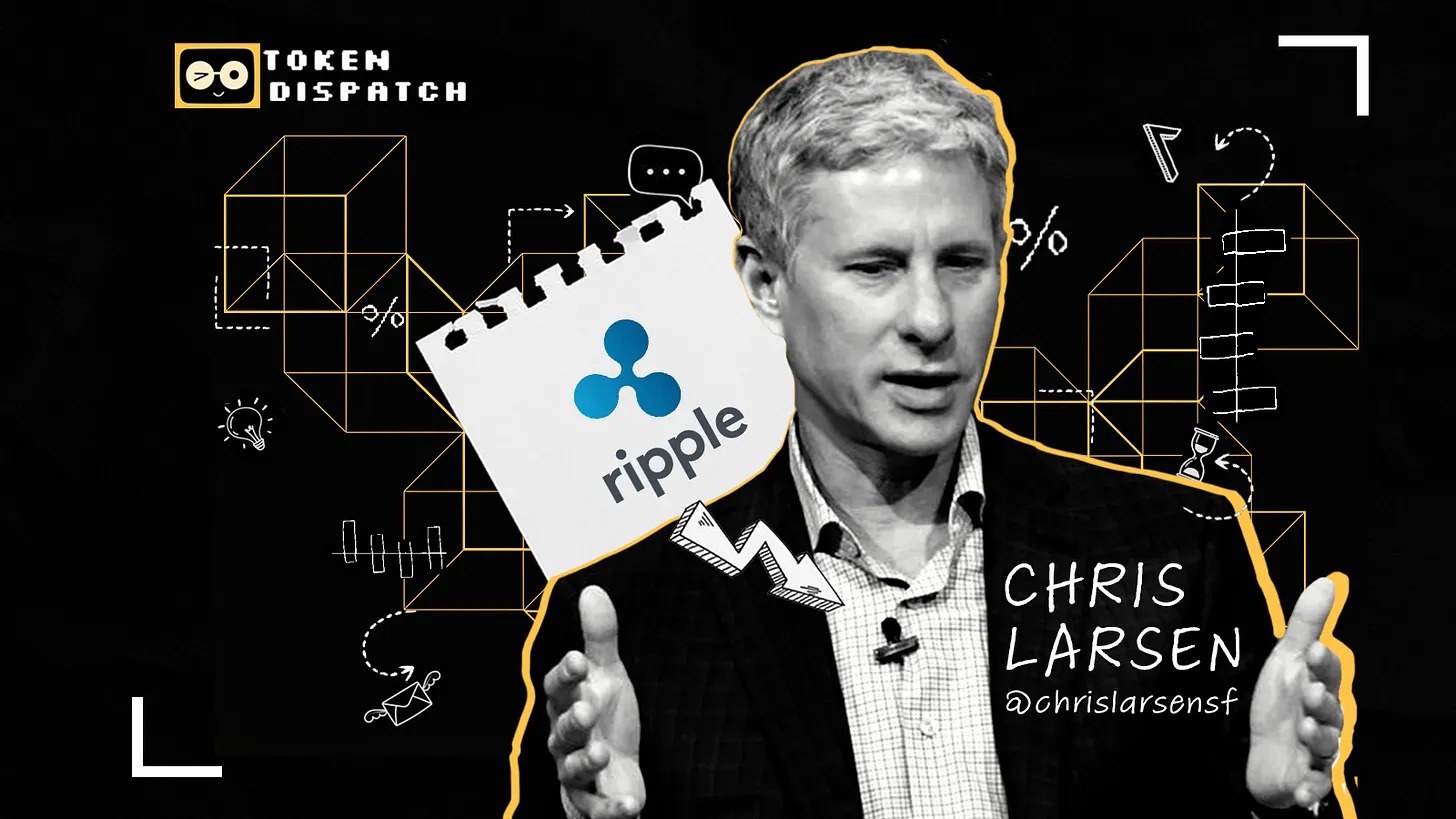
The machinist's son who challenged Wall Street: Chris Larsen, who disrupted the financial system three times

2025/09/11 15:00
12 min read

By Thejaswini MA

Compiled by: Block Unicorn

Preface

The check bounced.

Fifteen-year-old Chris Larsen discovered that getting paid was harder than doing the work itself.

He ran a dent-repair business out of his driveway in San Francisco. Neighbors would bring their wrecked cars, and he would use borrowed tools and the determination of a teenager to pound out the dents.

He did honest work and offered fair prices, but when a client didn't pay, fifteen-year-old Larsen learned his first harsh lesson about how the financial system works.

His father repaired airplane engines at San Francisco International Airport, earning his salary every two weeks. His mother drew illustrations for clients, who often paid months later or not at all. Both parents understood that money flowed easily to those who already had it, while being stingy with everyone else.

This is how the system is designed.

That frustration, decades in the making, drove him to found three multibillion-dollar companies, each challenging a part of the financial system that treated ordinary people as a nuisance rather than as customers.

The Son of a Mechanic Who Sees Through the System

San Francisco, 1960.

Chris Larsen grew up in a family that understood the value of stable employment. Growing up in a working-class household meant he experienced the financial system from the customer's perspective, not the bank's. When his parents needed a car loan or a mortgage, they faced bank employees who made the decisions behind the scenes. The process was opaque, slow, and often unfair.

Why can some people get loans easily while others can't? Why do banks charge different customers different interest rates for the same service? Why do decisions that could take minutes take so long?

These are personal struggles faced by millions of families, but few have experienced them firsthand by those with the power to make a difference.

After graduating from high school, Larson began studying aeronautics at San Jose State University, hoping to pursue a practical career in engineering. However, he felt the curriculum was too narrow, so he transferred to San Francisco State University to major in international business and accounting.

After graduating in 1984, Larsen joined Chevron as a financial auditor. This work took him to Brazil, Ecuador, and Indonesia. His global business experience allowed him to witness firsthand the workings of the international financial system.

But he needed to understand the system more deeply before he could change it.

In 1991, Larsen earned his MBA from Stanford Graduate School of Business. His professor, Jim Collins, taught him how to build companies that outlive their founders. These lessons stuck with him. Larsen wasn't interested in short-term wins or trendy business models. He wanted to build infrastructure that would remain relevant decades from now.

The combination of the Internet and finance

In 1996, the Internet boom was just beginning.

While most entrepreneurs were busy building websites for pet supplies or grocery delivery, Larson saw a different opportunity: What if the internet were applied to that most traditional of industries: mortgage lending?

He then co-founded E-Loan with Janina Pawlowski.

The concept is to take mortgage applications online so borrowers can apply for loans online without having to deal with brokers who charge unnecessary fees.

At the time, most financial institutions were operating like it was 1976, requiring borrowers to physically visit a bank branch, fill out paper forms, and wait weeks for an approval decision that software could deliver in minutes.

E-Loan's website launched in 1997, allowing borrowers to compare rates, submit applications, and track their progress online. The company eliminated broker commissions and cut processing time from weeks to days.

But Larson made a decision. E-Loan became the first company to offer consumers free FICO credit scores.

This is revolutionary. For decades, banks and credit card companies have used these scores to make lending decisions, but consumers haven't been able to see their own scores. The credit scoring system is a black box that determines whether you can buy a house or a car, but you don't know what's inside. This move forces transparency across the entire credit industry. If borrowers can see their scores, they can understand why they were offered a certain interest rate and take steps to improve their credit worthiness.

In 1999, at the height of the dot-com boom, E-Loan went public. At its peak, the company was valued at approximately $1 billion. But Larsen wasn't interested in chasing the bubble. In 2005, he sold E-Loan to Banco Popular for $300 million.

E-Loan was successful because it automated processes that banks used to handle manually. But shouldn’t we rethink how these processes actually work?

Freedom from the constraints of banks

By 2005, Larsen was already thinking about his next target: the bank itself.

What if ordinary people could borrow money directly from other ordinary people, completely without the involvement of banks?

He co-founded Prosper Marketplace, the first peer-to-peer lending platform in the United States, with John Witchel.

What's the idea? Borrowers can post loan requests, specifying what they need the funds for and the interest rate they're willing to pay. Individual investors can browse these requests and choose which loans to fund. The market will determine the interest rate based on actual supply and demand, not a bank's opaque formula.

The platform democratizes both lending and borrowing. People with good credit can earn higher returns than they would with a savings account. People with less-than-perfect credit can get loans that traditional banks won't offer.

But Prosper faced a problem that e-Loan didn't: regulatory uncertainty. When securities laws were written decades ago, no one imagined that ordinary people would lend money to strangers online. In 2008, the US Securities and Exchange Commission (SEC) ruled that P2P loans were, in fact, securities requiring registration and disclosure. Many companies might have chosen to fight regulators or find loopholes. But Larson chose a different path.

Rather than confront the authorities, he worked with them. Prosper filed a prospectus with the SEC and adapted its business model to comply with securities laws. This enabled the company to survive regulatory challenges and continue to grow.

Because it’s not enough to just build better technology. You also have to help regulators understand why new rules are needed.

In 2012, Larsen resigned as CEO of Prosper, but remained chairman. He was already thinking about his next project. P2P lending had shown him that technology could replace the intermediaries in traditional finance. But his truly ambitious goal wasn't domestic lending.

It's international payments.

Building a valuable Internet

The idea for Ripple stemmed from a simple observation: sending money across borders is still harder than sending an email.

International wire transfers take days, are expensive, and often fail for unknown reasons. In an age where information can travel around the world in milliseconds, transferring money feels like something out of the 1970s.

In September 2012, Larsen co-founded OpenCoin with programmer Jed McCaleb. Their goal was to build a payment protocol that could settle transactions between any currency in seconds, rather than days. The company changed names several times, from OpenCoin to Ripple Labs in 2013 to simply Ripple in 2015. But the mission remained the same: to build what Larsen called the "Internet of Value."

Ripple's approach differs from Bitcoin, which was designed as an alternative to traditional currencies. Ripple's technology allows traditional currencies to flow more efficiently. Banks can use Ripple's network to settle international payments without having to maintain accounts in every country they do business in. The system uses XRP, Ripple's native digital currency, as a bridge asset.

Instead of going through multiple intermediaries to convert dollars into euros, a bank can simply convert dollars into XRP, transfer the XRP to another bank, and then convert the XRP into euros. The entire process can be completed in seconds.

During Larsen's tenure as CEO, Ripple signed partnerships with major financial institutions, including Santander, American Express, and Standard Chartered. You could call it a pilot program or an experiment. But the banks were using Ripple's technology to process millions of dollars worth of real customer payments.

As the cryptocurrency market exploded in 2017 and 2018, XRP became one of the world’s most valuable digital assets. At its peak, Larsen’s holdings were worth more than $59 billion on paper, briefly making him one of the richest people in the United States.

But Larson learned from his previous company that scaling requires a different skill set than building one. In 2016, he stepped down as CEO to become executive chairman and hired Brad Garlinghouse to run day-to-day operations while he focused on strategy and overseeing relationships.

With success comes scrutiny.

The test of supervision

December 2020. The call every cryptocurrency executive dreads.

The U.S. Securities and Exchange Commission sued Ripple, alleging that XRP is an unregistered security and that the company raised $1.3 billion through an illegal securities offering.

The lawsuit brought nearly five years of uncertainty. XRP's price plummeted, and exchanges began delisting the token to avoid regulatory risks. Ripple faced potentially hefty fines and a fundamental shift in its business model.

Larsen could have quickly settled the case and moved on to other projects, as many cryptocurrency entrepreneurs do. But he chose to fight.

Ripple has spent tens of millions of dollars on legal fees arguing that XRP is a currency, not a security. The company’s lawyers point out that Bitcoin and Ethereum have been deemed non-securities by regulators, and that XRP operates in a similar manner.

The strategy proved correct, but it took years to be vindicated.

In 2023, Judge Analisa Torres ruled that programmatic sales of XRP to retail investors did not constitute a securities offering. The decision was a partial victory that helped clarify the regulatory status of digital assets.

In 2025, the SEC dropped its appeal and settled for $125 million, a substantial fine but far less than many had expected. The legal victory validated Larsen’s long-term strategy in building his cryptocurrency company.

Unlike many crypto companies that operate in a regulatory gray area, Ripple has cooperated with regulators from the beginning, and when regulatory crackdowns came, the company was ready.

Throughout the legal battle, Ripple continued to expand its business. In April 2025, the company acquired top brokerage firm Hidden Road for $1.25 billion, adding trading and custody services. Ripple also sought a national banking license and partnered with Bank of New York Mellon to provide custody services for its RLUSD stablecoin reserves.

Silent influence

Today, Larson's influence extends far beyond the company he founded.

In 2019, he and his wife, Lina Lamm, donated $25 million worth of XRP to San Francisco State University, the largest cryptocurrency donation to a US university at the time. The gift established an endowed chair in fintech and innovation and funded global student programs. Universities have rigorous procedures for accepting and managing donations. By collaborating with these institutions, Larsen helped formalize cryptocurrency philanthropy.

He also funded privacy advocacy through the coalition Californians for Privacy Now, which successfully pushed California to pass a financial privacy law requiring companies to obtain consumer permission before sharing personal data. The campaign collected 600,000 signatures and lobbied major financial companies to withdraw their opposition.

More recently, Larsen has focused on the environmental impact of cryptocurrency. In 2021, he launched the "Change Code, Not Climate" campaign, which funds efforts to convince Bitcoin miners to switch from energy-intensive proof-of-work mining to more efficient alternatives.

That stance puts him at odds with bitcoin maximalists who insist proof-of-work is essential for network security, but Larsen believes that climate change must be addressed if cryptocurrencies are to gain mainstream adoption.

“This movement is not anti-Bitcoin, it’s anti-pollution,” Larsen explained. “We need to clean up our industry. The issue is not powering Bitcoin with clean energy, as some suggest. We need to use limited clean energy for other important purposes. The issue is changing the code to drastically reduce energy use. That’s the way forward for the environment.”

His willingness to challenge cryptocurrency orthodoxy reflects the same thinking that has characterized his career: What’s popular isn’t always what’s best.

At 64, Larson still works six days a week while pursuing hobbies that reflect his methodical approach to complex problems. He and his sons restore classic cars from the 1960s, stripping them down and rebuilding them from the frame up. These projects, which take three years to complete, embody the meticulous approach that has characterized his career.

He envisions a future where sending $100 from San Francisco to Lagos takes seconds and costs pennies, allowing small businesses to access international markets without having to deal with complex banking relationships.

His three companies challenge different parts of the financial system that have failed to serve ordinary people well.

E-Loan brings transparency to mortgage shopping. Prosper democratizes lending. Ripple accelerates international payments.

Each company succeeds by building infrastructure that others can use, rather than trying to control the entire market. This approach requires patience and long-term thinking, rare qualities in an industry known for hype and quick profits.

In an era where cryptocurrencies are often associated with speculation and volatility, Larsen has demonstrated that patient infrastructure development can bring about lasting change. His work isn’t done, but the foundation for a financial system that serves users, not institutions, has been laid.

Money is becoming more like information—faster, cheaper, and more accessible to those previously excluded from financial services.

This transformation is still unfolding, but the direction is clear, and Chris Larsen has been building the track that will propel it forward.

That's the story of Chris Larsen. See you in the next post.

Market Opportunity
Threshold Logo
Threshold Price(T)
$0.006945
$0.006945$0.006945
-0.04%
USD
Threshold (T) Live Price Chart
Disclaimer: The articles reposted on this site are sourced from public platforms and are provided for informational purposes only. They do not necessarily reflect the views of MEXC. All rights remain with the original authors. If you believe any content infringes on third-party rights, please contact service@support.mexc.com for removal. MEXC makes no guarantees regarding the accuracy, completeness, or timeliness of the content and is not responsible for any actions taken based on the information provided. The content does not constitute financial, legal, or other professional advice, nor should it be considered a recommendation or endorsement by MEXC.

You May Also Like

The UA Sprinkler Fitters Local 669 JATC – Notice of Privacy Incident
The UA Sprinkler Fitters Local 669 JATC – Notice of Privacy Incident

Landover, Maryland, February 6, 2026– The UA Sprinkler Fitters Local 669 Joint Apprenticeship and Training Committee (“JATC”) is providing notice of an event that
Share
AI Journal2026/02/07 07:30
CME pushes Solana, XRP into derivatives spotlight with new options
CME pushes Solana, XRP into derivatives spotlight with new options

CME Group is launching options for Solana and XRP futures this October. The move signals a major shift, acknowledging that institutional liquidity is now firmly expanding beyond the established dominance of Bitcoin and Ether. According to a press release dated…
Share
Crypto.news2025/09/18 01:18
Ethereum koers toont zeldzaam dubbel koopsignaal en richt zich op $4.550

Ethereum koers toont zeldzaam dubbel koopsignaal en richt zich op $4.550

Connect met Like-minded Crypto Enthusiasts! Connect op Discord! Check onze Discord   Ethereum laat op de uurgrafiek twee opeenvolgende TD Sequential koopsignalen zien. Deze indicator meet uitputting in een trend en geeft vaak een signaal dat de verkoopdruk kan afnemen. Dit dubbele signaal verschijnt rond het niveau van $4.516, waar de ETH prijs kortstondig steun vindt. Dit type formatie komt zelden voor en wordt daarom extra nauwlettend gevolgd. Wat gaat de Ethereum koers hiermee doen? Ethereum koers test steun rond $4.516 De scherpe daling van de Ethereum koers vanaf de prijszone rond $4.800 bracht de ETH prijs in korte tijd naar ongeveer $4.516. Op dit niveau trad duidelijke koopactiviteit op, waardoor de neerwaartse beweging tijdelijk werd gestopt. Het dubbele signaal dat door de TD Sequential indicator is gegenereerd, viel precies samen met dit prijspunt. De TD Sequential is opgebouwd uit negen candles die een trend meetellen. Wanneer de negende candle verschijnt, kan dit duiden op een trendomslag. In dit geval verschenen zelfs twee signalen kort na elkaar, wat aangeeft dat de verkoopdruk mogelijk uitgeput is. Het feit dat dit gebeurde in een zone waar ETH kopers actief bleven, maakt het patroon extra opvallend. TD Sequential just flashed two buy signals for Ethereum $ETH! pic.twitter.com/JPO8EhiEPi — Ali (@ali_charts) September 16, 2025 Welke crypto nu kopen?Lees onze uitgebreide gids en leer welke crypto nu kopen verstandig kan zijn! Welke crypto nu kopen? Fed-voorzitter Jerome Powell heeft aangekondigd dat de rentes binnenkort zomaar eens omlaag zouden kunnen gaan, en tegelijkertijd blijft BlackRock volop crypto kopen, en dus lijkt de markt klaar om te gaan stijgen. Eén vraag komt telkens terug: welke crypto moet je nu kopen? In dit artikel bespreken we de munten die… Continue reading Ethereum koers toont zeldzaam dubbel koopsignaal en richt zich op $4.550 document.addEventListener('DOMContentLoaded', function() { var screenWidth = window.innerWidth; var excerpts = document.querySelectorAll('.lees-ook-description'); excerpts.forEach(function(description) { var excerpt = description.getAttribute('data-description'); var wordLimit = screenWidth wordLimit) { var trimmedDescription = excerpt.split(' ').slice(0, wordLimit).join(' ') + '...'; description.textContent = trimmedDescription; } }); }); Technische indicatoren schetsen herstelkans voor ETH Naast de dubbele koopsignalen verstrekken ook andere indicatoren belangrijke aanwijzingen. Tijdens de daling van de ETH koers waren grote rode candles zichtbaar, maar na de test van $4.516 stabiliseerde de Ethereum koers. Dit wijst op een mogelijke verschuiving in het evenwicht tussen de bears en bulls. Als deze opwaartse beweging doorzet, liggen de eerste weerstanden rond $4.550. Daarboven wacht een sterkere zone rond $4.650. Deze niveaus zijn in eerdere Ethereum sessies al meerdere keren getest. Een doorbraak zou ruimte openen richting de all-time high van ETH rond $4.953. Wanneer de prijs toch opnieuw onder $4.516 zakt, liggen er zones rond $4.500 en $4.450 waar grotere kooporders worden verwacht. Deze niveaus kunnen als een vangnet fungeren, mocht de druk opnieuw toenemen. Marktdynamiek bevestigt technische indicatoren De huidige situatie volgt op een bredere correctie in de cryptomarkt. Verschillende vooraanstaande crypto tokens zagen scherpe koersdalingen, waarna traders op zoek gingen naar signalen voor een mogelijke ommekeer. Dat juist Ethereum nu een dubbel TD Sequential signaal toont, versterkt de interesse in dit scenario. Fundamenteel blijft Ethereum sterk. Het aantal ETH tokens dat via staking is vastgezet, blijft groeien. Dat verkleint de vrije circulatie en vermindert verkoopdruk. Tegelijk blijft het netwerk intensief gebruikt voor DeFi, NFT’s en stablecoins. Deze activiteiten zorgen voor een stabiele vraag naar ETH, ook wanneer de prijs tijdelijk onder druk staat. Fundamentele drijfveren achter de Ethereum koers De Ethereum koers wordt echter niet alleen bepaald door candles en patronen, maar ook door bredere factoren. Een stijgend percentage van de totale ETH supply staat vast in staking contracten. Hierdoor neemt de liquiditeit op exchanges af. Dit kan prijsschommelingen versterken wanneer er plotseling meer koopdruk ontstaat. Daarnaast is Ethereum nog steeds het grootste smart contract platform. Nieuwe standaarden zoals ERC-8004 en ontwikkelingen rond layer-2 oplossingen houden de activiteit hoog. Deze technologische vooruitgang kan de waardepropositie ondersteunen en zo indirect bijdragen aan een ETH prijsherstel. Het belang van de korte termijn dynamiek De komende handelsdagen zullen duidelijk maken of de bulls genoeg kracht hebben om door de weerstandszone rond $4.550 te breken. Voor de bears ligt de focus juist op het verdedigen van de prijsregio rond $4.516. De whales, die met grote handelsorders opereren, kunnen hierin een beslissende rol spelen. Het dubbele TD Sequential signaal blijft hoe dan ook een zeldzame gebeurtenis. Voor cryptoanalisten vormt het een objectief aanknopingspunt om de kracht van de huidige Ethereum trend te toetsen. Vooruitblik op de ETH koers Ethereum liet twee opeenvolgende TD Sequential signalen zien op de uurgrafiek, iets wat zelden voorkomt. Deze formatie viel samen met steun rond $4.516, waar de bulls actief werden. Als de Ethereum koers boven dit niveau blijft, kan er ruimte ontstaan richting $4.550 en mogelijk $4.650. Zakt de prijs toch opnieuw onder $4.516, dan komen $4.500 en $4.450 in beeld als nieuwe steunzones. De combinatie van zeldzame indicatoren en een sterke fundamentele basis maakt Ethereum interessant voor zowel technische als fundamentele analyses. Of de bulls het momentum echt kunnen overnemen, zal blijken zodra de Ethereum koers de eerstvolgende weerstanden opnieuw test. Koop je crypto via Best Wallet Best wallet is een topklasse crypto wallet waarmee je anoniem crypto kan kopen. Met meer dan 60 chains gesupport kan je al je main crypto coins aanschaffen via Best Wallet. Best wallet - betrouwbare en anonieme wallet Best wallet - betrouwbare en anonieme wallet Meer dan 60 chains beschikbaar voor alle crypto Vroege toegang tot nieuwe projecten Hoge staking belongingen Lage transactiekosten Best wallet review Koop nu via Best Wallet Let op: cryptocurrency is een zeer volatiele en ongereguleerde investering. Doe je eigen onderzoek. Het bericht Ethereum koers toont zeldzaam dubbel koopsignaal en richt zich op $4.550 is geschreven door Dirk van Haaster en verscheen als eerst op Bitcoinmagazine.nl.
Share
Coinstats2025/09/17 23:31
