The TCP/IP of Money: How $186 Billion in Stablecoins Became Crypto's Settlement Backbone Stablecoins have quietly evolved into the fundamental settlement layer of digital asset markets, processingThe TCP/IP of Money: How $186 Billion in Stablecoins Became Crypto's Settlement Backbone Stablecoins have quietly evolved into the fundamental settlement layer of digital asset markets, processing
Stablecoin Dominance & Market Liquidity: Infrastructure,Settlement, and Systemic Trade-offs
The TCP/IP of Money: How $186 Billion in Stablecoins Became Crypto's Settlement Backbone
Stablecoins have quietly evolved into the fundamental settlement layer of digital asset markets, processing over $35 trillion in annual volume while representing nearly two-thirds of all cryptocurrency trading activity.
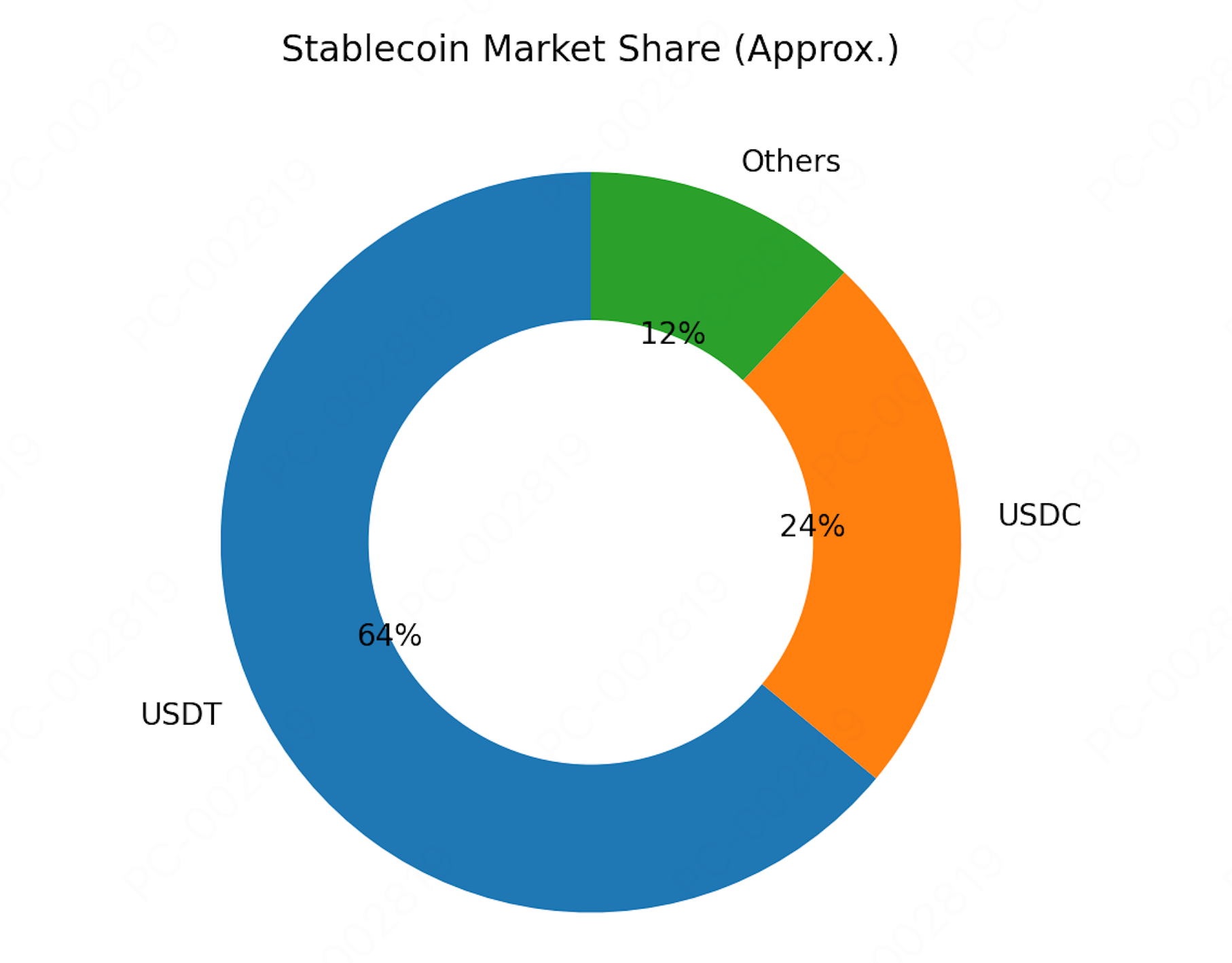
As of January 28, 2026, at 07:00 UTC, Tether's USDT maintains a net circulation of $186.34 billion, representing approximately 64% of the total stablecoin market, while the broader ecosystem has reached $290 billion in outstanding supply across all major issuers. According to Kaiko
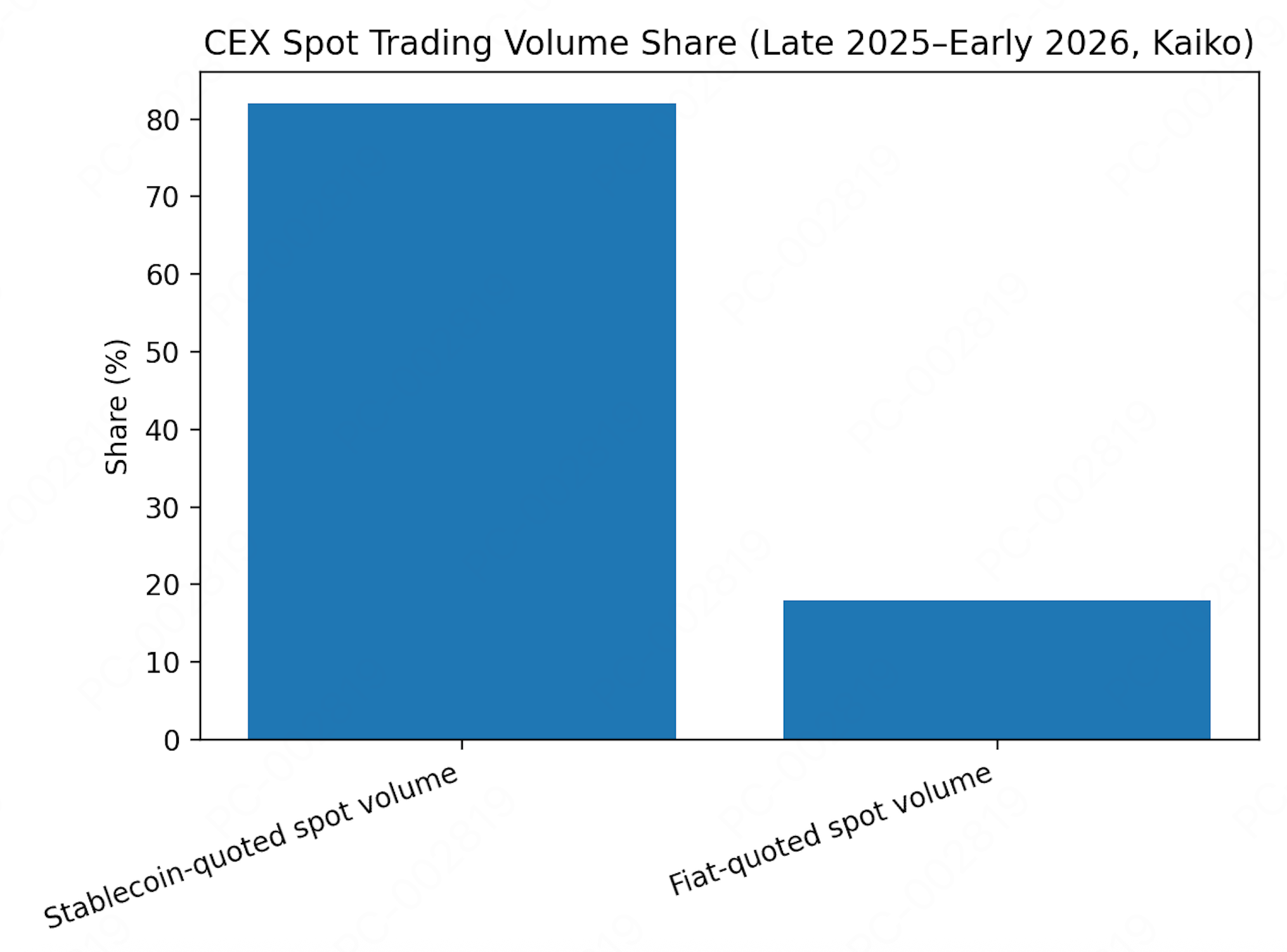
Research data from late 2025, stablecoins now facilitate approximately 82% of all centralized exchange (CEX) spot trading volume, establishing themselves as the de facto quoting currency for digital asset markets globally.
Tether Transparency [1] | Kaiko Research [2] This dominance represents a fundamental shift from stablecoins' original conception as mere trading instruments to their current role as critical financial infrastructure. The concentration of liquidity around a handful of dollar-pegged assets, particularly USDT, has created unprecedented efficiency in crypto markets but also introduces systemic dependencies that regulators and market participants are only beginning to fully comprehend.
The Quoting Hegemony: Why Stablecoins Dominate CEX Trading
The ascendancy of stablecoins as the primary trading pairs on cryptocurrency exchanges reflects both structural advantages
and network effects that have accumulated over multiple market cycles. Stablecoins represent ~82% of total CEX spot trading volume (Source: Kaiko Research). This market-wide aggregate differs from individual quote currency distributions on platforms like Binance and MEXC, where stablecoin-denominated pairs often exceed 95% of the total pair count and volume structure.
Several factors drive this dominance: 24/7
Settlement Efficiency: Unlike traditional banking systems that operate within specific hours and time zones, stablecoins enable continuous settlement across global markets. This is particularly valuable for cryptocurrency trading, which never closes. The ability to instantly move value between exchanges and trading venues without banking delays provides a significant arbitrage advantage that traders have increasingly capitalized on.
Regulatory Arbitrage: For exchanges operating in jurisdictions with complex banking relationships or limited fiat access, stablecoins offer a pragmatic solution. Platforms can maintain dollar exposure without navigating the compliance hurdles associated with traditional banking partnerships. This has been particularly evident in Asian markets, where USDT has become the default dollar proxy for retail and institutional traders alike.
Technical Integration: Stablecoins' native compatibility with blockchain infrastructure allows for seamless integration into trading engines, custody solutions, and DeFi protocols. This creates a virtuous cycle where increased adoption drives better technical support, which in turn facilitates further adoption. The concentration of trading volume around stablecoin pairs has profound implications for market structure. It means that liquidity is increasingly denominated in synthetic dollars rather than native fiat, creating a parallel financial system with its own dynamics and dependencies.
The concentration of trading volume around stablecoin pairs has profound implications for market structure. It means that liquidity is increasingly denominated in synthetic dollars rather than native fiat, creating a parallel financial system with its own dynamics and dependencies.
Cross-Chain Settlement Rails: Distribution Across Networks
The stablecoin ecosystem has evolved into a multi-chain environment where different networks serve distinct purposes and user bases. The distribution of USDT and USDC across various blockchains reveals strategic positioning and specializationwithin the broader market.
Snapshot time: 2026-01-28 07:00 UTC Total supply (same day): USDT $186.34B / USDC $71.46B Per-chain supplies derived
from: issuer transparency + on-chain contract queries Cross-Chain Settlement Rails (January 28, 2026, 07:00 UTC)
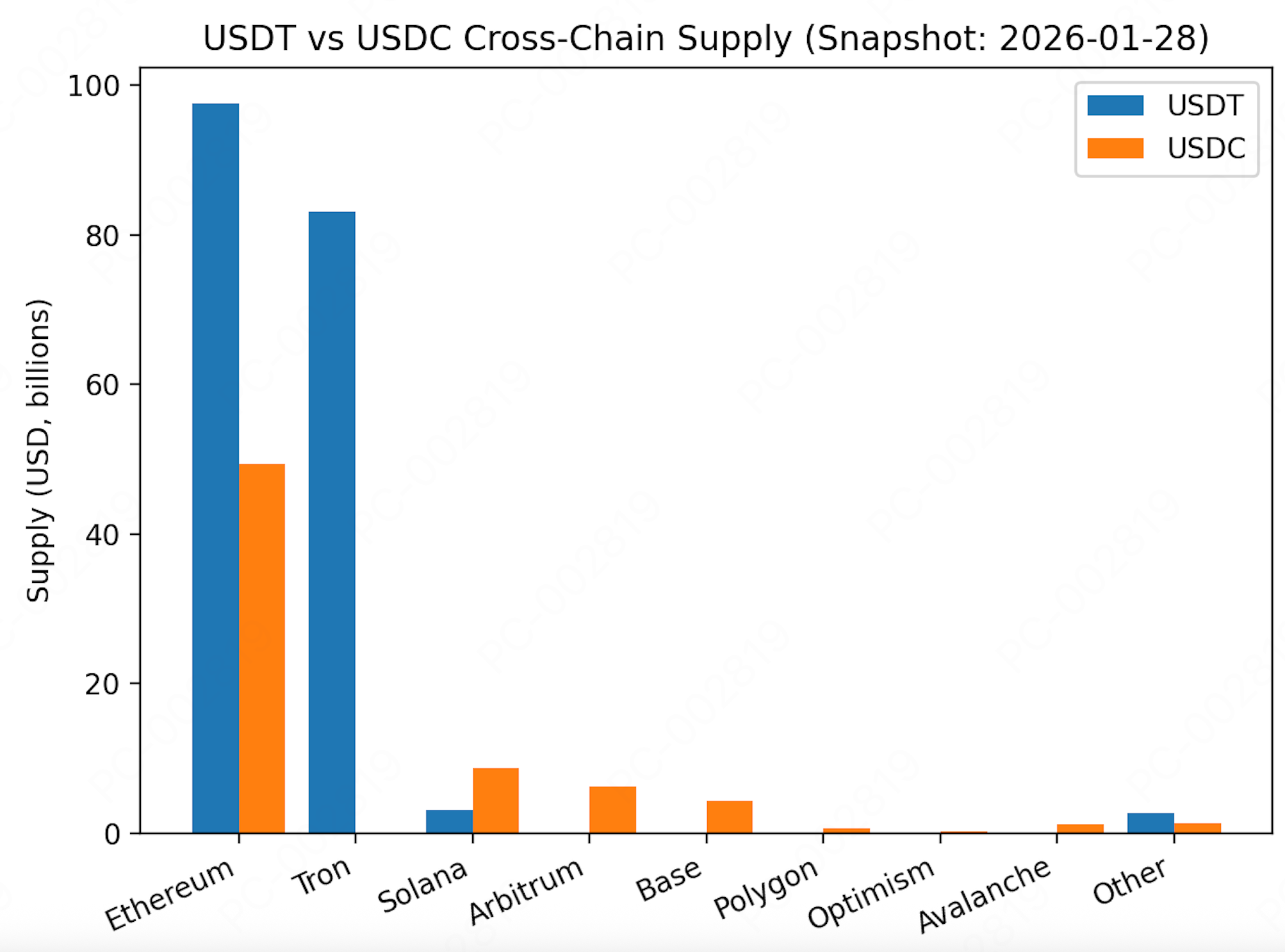
Blockchain | USDT Supply | % of USDT | USDC Supply | % of USDC | Primary Use Case | Source Type |
Ethereum | $97.49B | 52.3% | ~$49.30B | ~69.0% | DeFi, institutional settlement | Issuer + on-chain |
Tron | $83.11B | 44.6% | Minimal | <1% | Low-fee transfers/remittance corridors | Issuer |
Solana | $3.09B | 1.7% | $8.67B | ~12.1% | HFT / low-fee on-chain activity | Issuer + Solscan |
Arbitrum | Minimal | <1% | $6.18B | ~8.6% | L2 DeFi scaling | On-chain |
Base | Minimal | <1% | $4.29B | ~6.0% | Consumer apps | On-chain |
Polygon | Minimal | <1% | $0.554B | ~0.8% | Enterprise / payments pilots | On-chain |
Optimism | Minimal | <1% | $0.220B | ~0.3% | L2 apps | On-chain |
Avalanche | Minimal | <1% | ~$1.20B | ~1.7% | DeFi / alt-L1 usage | Est/aggregator-consistent |
Other chains | $2.65B | 1.4% | ~$1.24B | ~1.7% | Long tail | Residual |
Note: Solana USDC is taken from same-day on-chain supply snapshots (e.g., Solscan), aligned to the 2026-01-28 UTC timestamp, other values from direct on-chain queries and issuer transparency reports. Tether Transparency | Etherscan | Arbiscan | Basescan
The distribution patterns reveal distinct strategic positioning:
USDT's Dual-Chain Dominance: Tether maintains approximately 97% of its supply on just two networks—Ethereum (52.3%) and Tron (44.6%). This bifurcation reflects a deliberate strategy: Ethereum serves DeFi and institutional users who value composability with sophisticated financial applications, while Tron caters to payment and remittance use cases where low fees and fast finality are prioritized over programmability.
USDC's Multi-Chain Expansion: Circle has pursued a broader distribution strategy, with significant presence across Ethereum (68.3%), Arbitrum (8.7%), Base (6.0%), and several other Layer-2 networks. This reflects USDC's orientation toward developer ecosystems and applications that benefit from Ethereum's security while leveraging Layer-2 scaling solutions for improved user experience.
Network Specialization: The data suggests emerging specialization patterns. Solana has positioned itself as the preferred network for high-frequency trading and market-making activities, with its sub-second finality and low fees appealing to algorithmic trading firms. Meanwhile, Ethereum Layer-2 solutions like Arbitrum and Optimism are capturing DeFi and governance applications that require Ethereum's security guarantees with improved scalability.
The Volume Illusion: Transfer Activity ≠ Payment Adoption
One of the most persistent misconceptions in stablecoin analysis involves interpreting transfer volume as evidence of payment adoption. While stablecoins process enormous settlement value,approximately $35 trillion annually according to 2025 estimates, the nature of this activity differs significantly from traditional payment networks.
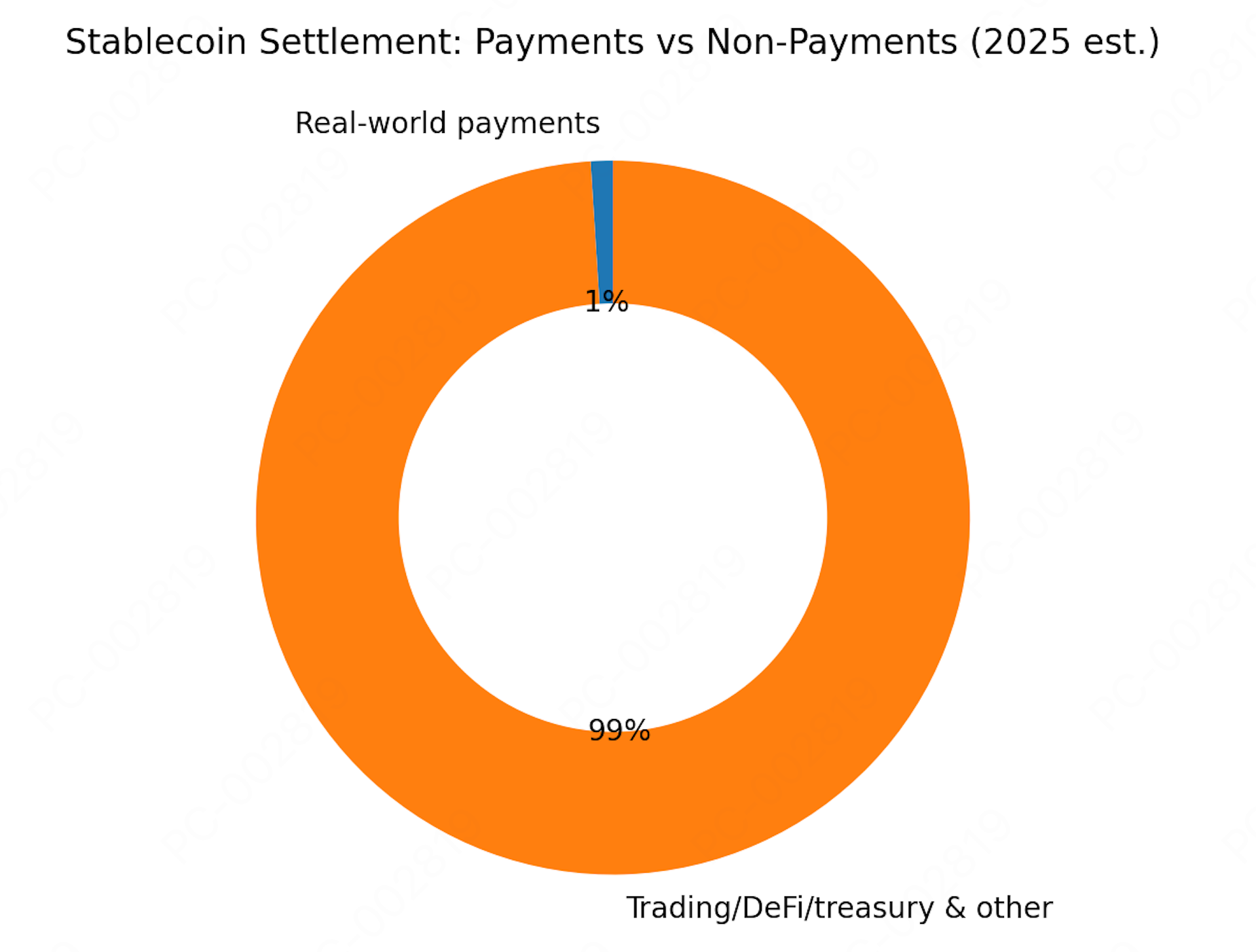
Research from Visa and blockchain analytics firm Artemis suggests that real-world payments represent only a small fraction (~1%) of total stablecoin settlement activity. The overwhelming majority of transfer volume reflects trading activity, DeFi liquidations, arbitrage movements, and treasury management operations rather than consumer payments for goods and services. CoinDesk
Several factors contribute to this disparity:
Velocity Amplification: In trading environments, the same stablecoin units can change hands multiple times within short periods, creating volume multiples that far exceed the underlying economic activity. A single USDT unit might facilitate dozens of trades between different asset pairs within a day, generating reported volume far exceeding its nominal value.
DeFi Composability: The programmable nature of stablecoins enables complex financial operations that generate substantial transfer volume without corresponding economic output. Liquidation events, collateral rebalancing, and yield farming strategies all create chain activity that appears as "volume" but represents financial engineering rather than economic exchange.
Exchange Internalization: Major exchanges often internalize stablecoin transfers between user accounts without on-chain settlement, meaning that reported trading volume may not correspond to blockchain activity. This creates a divergence between exchange-reported metrics and on-chain verifiable data.
This distinction matters because it suggests that stablecoins' current utility is primarily financial rather than commercial. While they have become indispensable infrastructure for digital asset markets, their adoption as general-purpose payment instruments remains limited to specific niches and use cases.
Systemic Trade-offs: Efficiency vs. Concentration Risk
The concentration of stablecoin liquidity around a small number of assets, particularly USDT, creates significant trade-offs between efficiency and systemic risk. These trade-offs manifest across several dimensions:
Liquidity Network Effects: The dominance of USDT creates powerful network effects where its utility increases with adoption, but simultaneously creates dependency on a single issuer. This concentration is evident in trading pairs, where USDT typically offers the deepest liquidity and tightest spreads across most cryptocurrency exchanges.
Cross-Chain Fragmentation: While stablecoins exist on multiple blockchains, liquidity often fragments across these environments. Bridging solutions attempt to mitigate this fragmentation, but they introduce additional trust assumptions and technical risks. The collapse of several cross-chain bridges in 2022-2023 demonstrated the vulnerabilities inherent in these interconnection systems.
Regulatory Asymmetry: Different stablecoin issuers operate under varying regulatory frameworks and compliance standards. USDT's reserve composition and attestation practices differ significantly from USDC's fully reserved, short-term Treasury model. These differences create asymmetric risk profiles that may not be fully priced by markets.
Policy Vulnerability: Stablecoin ecosystems remain vulnerable to policy shifts in both the crypto and traditional financial sectors. Banking relationships, reserve requirements, and regulatory classifications can change rapidly, potentially disrupting the stability of these critical settlement layers.
The fundamental trade-off is between the efficiency gains from standardization and the systemic risks from concentration. While multiple stablecoins exist, the market has consistently favored concentration around a dominant player, suggesting that network effects outweigh diversification benefits in this specific context.
Monitoring Framework: Key Metrics to Watch
For market participants seeking to understand the evolution of stablecoin markets, several metrics provide insight into changing dynamics:
Supply Distribution Changes: Shifts in the cross-chain distribution of stablecoin supplies can signal changing user preferences or technical migration patterns. For example, increasing USDC supply on Layer-2 networks might indicate growing adoption of scaling solutions for everyday applications.
Reserve Composition Quality: The quality and transparency of stablecoin reserves remain critical indicators of systemic risk. Monthly attestations from major issuers provide windows into the asset backing these synthetic dollars, with composition changes potentially signaling shifting risk profiles.
On-Chain Velocity: Tracking the velocity of stablecoins across different networks can reveal changing usage patterns. Increasing velocity on payment-oriented networks like Tron might suggest growing adoption for remittances, while decreasing velocity on Ethereum could indicate more stablecoin holding for collateral purposes.
Regulatory Developments: Policy changes in major jurisdictions, particularly the European Union's MiCA framework and potential U.S. stablecoin legislation, could significantly impact issuer operations and market structure.
Exchange Pair Dynamics: The evolution of trading pairs across major exchanges provides insight into changing market structure. An increase in fiat trading pairs might indicate improving banking integration, while stability in stablecoin dominance suggests continued reliance on crypto-native settlement layers.
These metrics should be monitored holistically rather than in isolation, as interactions between different factors often produce emergent behaviors that aren't apparent from single metrics.
Methodology and Data Constraints
This analysis unified data from multiple sources to create a consistent snapshot as of January 28, 2026, at 07:00 UTC.
The methodology prioritized primary sources where available and used cross-validation to ensure consistency:
USDT Data Sources: Net circulation figures came directly from Tether's transparency page, which reflects authorized and issued tokens excluding "authorized but not issued" amounts. This methodology ensures consistency with Tether's reserve reporting framework. Tether Transparency
USDC Data Sources: Ethereum USDC distribution was estimated based on holder concentration analysis and total supply metrics. Layer-2 figures came from direct on-chain TotalSupply queries of respective contracts at blocks approximating the snapshot time. Due to Circle's transparency report lag (most recent January 21, 2026), some figures represent extrapolations verified through multiple data points.
Exchange Volume Data: The 82% stablecoin share of CEX spot trading volume came from Kaiko Research's aggregate market analysis, which measures the percentage of total trading volume that involves stablecoin pairs rather than fiat pairs. This differs from exchange-specific quote currency distributions, which measure how trading pairs are denominated on individual platforms.
Limitations: Several limitations should be acknowledged. First, real-time cross-chain data synchronization is challenging due to different block times and update frequencies across networks. Second, some figures represent estimates based on available data rather than perfect measurement. Third, attribution of transfer volume to specific use cases (trading vs. payments) involves estimation and classification decisions that may not capture all nuances.
Despite these limitations, the unified dataset provides a coherent view of stablecoin market structure as of the snapshot date, with mathematical consistency between component figures and overall totals.
FAQ
What’s the difference between “stablecoin dominance” and “stablecoin adoption”? Dominance describes market structure (how much trading/settlement uses stablecoins). Adoption depends on the use case—most activity is still tied to trading, liquidity moves, and on-chain settlement, not everyday payments.
Does higher stablecoin transfer volume mean more real-world payments? Not necessarily. Transfer volume measures value moved on-chain, which often reflects exchange/DeFi/treasury flows. Research suggests verifiable real-world payments remain a small share of total stablecoin volume.
Why is USDT split mainly between Ethereum and Tron? It often comes down to network cost and settlement preferences: Ethereum anchors DeFi and institutional settlement, while Tron has become a major low-fee rail for transfers in some corridors.
Is USDC “safer” than USDT (or vice versa)? This article doesn’t rank stablecoins. Different stablecoins have different issuance structures, disclosures, and distribution patterns. Users should review issuer disclosures and understand that stablecoins can face operational and regulatory risks.
What metrics should I watch if I want to track stablecoin-driven liquidity? Focus on (1) issuer supply changes, (2) cross-chain distribution shifts, (3) stablecoin share of exchange spot volume, (4) peg deviations, and (5) major policy/regulatory updates that can affect issuance or redemption.
Conclusion: Infrastructure in Transition
Stablecoins have emerged as critical infrastructure for digital asset markets, providing settlement layers that combine the efficiency of blockchain technology with the stability of dollar denomination. Their dominance in trading activity, evidenced by the 82% share of CEX spot volume, reflects both practical advantages and network effects that have accumulated over multiple market cycles.
Exchanges have also started listing newer, compliance-positioned stablecoin experiments such as USAT. Public cross-chain and usage data is still limited at this stage, so it should be treated as an early signal rather than a mature liquidity benchmark.
However, this dominance comes with significant trade-offs. The concentration of liquidity around a small number of assets, particularly USDT, creates systemic dependencies that introduce new risks even as they deliver efficiency benefits. The distinction between transfer volume and payment adoption suggests that stablecoins' utility remains primarily financial rather than commercial, though this may evolve as regulatory clarity improves and technical infrastructure matures.
Market participants should monitor the evolving landscape with attention to both the opportunities presented by this efficient settlement infrastructure and the risks inherent in its concentrated structure. As regulatory frameworks develop and technical innovation continues, the stablecoin ecosystem will likely continue its transition from speculative instrument to financial infrastructure—but the path will undoubtedly involve both progress and unexpected challenges.
References:
Disclaimer:
This analysis provides educational insights into stablecoin market structure and should not be construed as investment advice. Market participants should conduct their own research and consider their risk tolerance before engaging with digital assets. All data reflects market conditions as of January 28, 2026, and may change rapidly as the ecosystem evolves.
Oportunitate de piață
Pret Polytrade (TRADE)
$0.04897
$0.04897$0.04897
USD
Polytrade (TRADE) graficul prețurilor în timp real