This paper introduces a flexible Transformer-based model for detecting anomalies in system logs. By embedding log templates with a pre-trained BERT model and incorporating positional and temporal encoding, it captures both semantic and sequential context within log sequences. The approach supports variable sequence lengths and configurable input features, enabling extensive experimentation across datasets. The model performs supervised binary classification to distinguish normal from anomalous patterns, using a [CLS]-like token for sequence-level representation. Overall, it pushes the boundaries of log-based anomaly detection by integrating modern NLP and deep learning techniques into system monitoring.This paper introduces a flexible Transformer-based model for detecting anomalies in system logs. By embedding log templates with a pre-trained BERT model and incorporating positional and temporal encoding, it captures both semantic and sequential context within log sequences. The approach supports variable sequence lengths and configurable input features, enabling extensive experimentation across datasets. The model performs supervised binary classification to distinguish normal from anomalous patterns, using a [CLS]-like token for sequence-level representation. Overall, it pushes the boundaries of log-based anomaly detection by integrating modern NLP and deep learning techniques into system monitoring.

Transformer-Based Anomaly Detection Using Log Sequence Embeddings

2025/11/04 01:52

Abstract

1 Introduction

2 Background and Related Work

2.1 Different Formulations of the Log-based Anomaly Detection Task

2.2 Supervised v.s. Unsupervised

2.3 Information within Log Data

2.4 Fix-Window Grouping

2.5 Related Works

3 A Configurable Transformer-based Anomaly Detection Approach

3.1 Problem Formulation

3.2 Log Parsing and Log Embedding

3.3 Positional & Temporal Encoding

3.4 Model Structure

3.5 Supervised Binary Classification

4 Experimental Setup

4.1 Datasets

4.2 Evaluation Metrics

4.3 Generating Log Sequences of Varying Lengths

4.4 Implementation Details and Experimental Environment

5 Experimental Results

5.1 RQ1: How does our proposed anomaly detection model perform compared to the baselines?

5.2 RQ2: How much does the sequential and temporal information within log sequences affect anomaly detection?

5.3 RQ3: How much do the different types of information individually contribute to anomaly detection?

6 Discussion

7 Threats to validity

8 Conclusions and References

\

3 A Configurable Transformer-based Anomaly Detection Approach

In this study, we introduce a novel transformer-based method for anomaly detection. The model takes log sequences as inputs to detect anomalies. The model employs a pretrained BERT model to embed log templates, enabling the representation of semantic information within log messages. These embeddings, combined with positional or temporal encoding, are subsequently inputted into the transformer model. The combined information is utilized in the subsequent generation of log sequence-level representations, facilitating the anomaly detection process. We design our model to be flexible: The input features are configurable so that we can use or conduct experiments with different feature combinations of the log data. Additionally, the model is designed and trained to handle input log sequences of varying lengths. In this section, we introduce our problem formulation and the detailed design of our method.

\ 3.1 Problem Formulation

We follow the previous works [1] to formulate the task as a binary classification task, in which we train our proposed model to classify log sequences into anomalies and normal ones in a supervised way. For the samples used in the training and evaluation of the model, we utilize a flexible grouping approach to generate log sequences of varying lengths. The details are introduced in Section 4

\ 3.2 Log Parsing and Log Embedding

In our work, we transform log events into numerical vectors by encoding log templates with a pre-trained language model. To obtain the log templates, we adopt the Drain parser [24], which is widely used and has good parsing performance on most of the public datasets [4]. We use a pre-trained sentence-bert model [25] (i.e., all-MiniLML6-v2 [26]) to embed the log templates generated by the log parsing process. The pre-trained model is trained with a contrastive learning objective and achieves state-ofthe-art performance on various NLP tasks. We utilize this pre-trained model to create a representation that captures semantic information of log messages and illustrates the similarity between log templates for the downstream anomaly detection model. The output dimension of the model is 384.

\ 3.3 Positional & Temporal Encoding

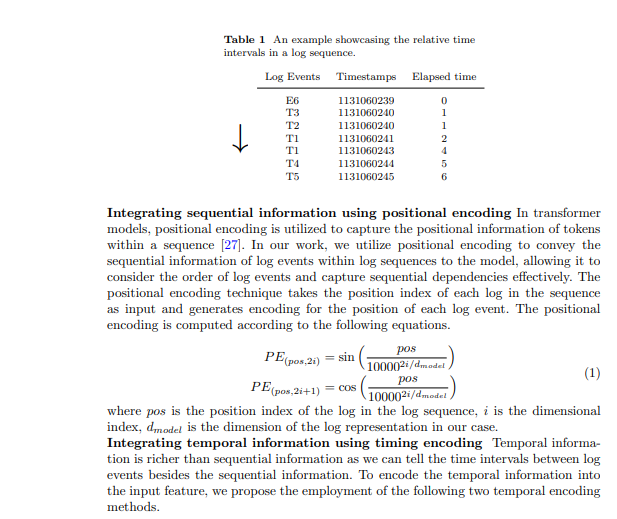
The original transformer model [27] adopts a positional encoding to enable the model to make use of the order of the input sequence. As the model contains no recurrence and no convolution, the models will be agnostic to the log sequence without the positional encoding. While some studies suggest that transformer models without explicit positional encoding remain competitive with standard models when dealing with sequential data [28, 29], it is important to note that any permutation of the input sequence will produce the same internal state of the model. As sequential information or temporal information may be important indicators for anomalies within log sequences, previous works that are based on transformer models utilize the standard positional encoding to inject the order of log events or templates in the sequence [11, 12, 21], aiming to detect anomalies associated with the wrong execution order. However, we noticed that in a common-used replication implementation of a transformer-based method [5], the positional encoding was, in fact, omitted. To the best of our knowledge, no existing work has encoded the temporal information based on the timestamps of logs for their anomaly detection method. The effectiveness of utilizing sequential or temporal information in the anomaly detection task is unclear.

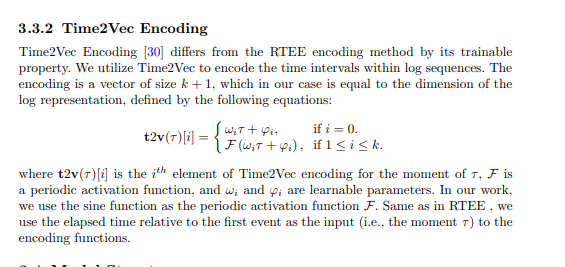
\ In our proposed method, we attempt to incorporate sequential and temporal encoding into the transformer model and explore the importance of sequential and temporal information for anomaly detection. Specifically, our proposed method has different variants utilizing the following sequential or temporal encoding techniques. The encoding is then added to the log representation, which serves as the input to the transformer structure.

\
3.3.1 Relative Time Elapse Encoding (RTEE)

We propose this temporal encoding method, RTEE, which simply substitutes the position index in positional encoding with the timing of each log event. We first calculate the time elapse according to the timestamps of log events in the log sequence. Instead of using the log event sequence index as the position to sinusoidal and cosinusoidal equations, we use the relative time elapse to the first log event in the log sequence to substitute the position index. Table 1 shows an example of time intervals in a log sequence. In the example, we have a log sequence containing 7 events with a time span of 7 seconds. The elapsed time from the first event to each event in the sequence is utilized to calculate the time encoding for the corresponding events. Similar to positional encoding, the encoding is calculated with the above-mentioned equations 1, and the encoding will not update during the training process.

\
3.4 Model Structure

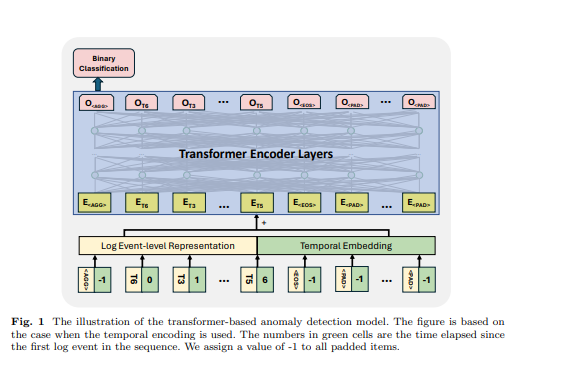
The transformer is a neural network architecture that relies on the self-attention mechanism to capture the relationship between input elements in a sequence. The transformer-based models and frameworks have been used in the anomaly detection task by many previous works [6, 11, 12, 21]. Inspired by the previous works, we use a transformer encoder-based model for anomaly detection. We design our approach to accept log sequences of varying lengths and generate sequence-level representations. To achieve this, we have employed some specific tokens in the input log sequence for the model to generate sequence representation and identify the padded tokens and the end of the log sequence, drawing inspiration from the design of the BERT model [31]. In the input log sequence, we used the following tokens: is placed at the start of each sequence to allow the model to generate aggregated information for the entire sequence, is added at the end of the sequence to signify its completion, is used to mark the masked tokens under the self-supervised training paradigm, and is used for padded tokens. The embeddings for these special tokens are generated randomly based on the dimension of the log representation used. An example is shown in Figure 1, the time elapsed for , and are set to -1. The log event-level representation and positional or temporal embedding are summed as the input feature of the transformer structure.

\ 3.5 Supervised Binary Classification Under this training objective, we utilize the output of the first token of the transformer model while ignoring the outputs of the other tokens. This output of the first token is designed to aggregate the information of the whole input log sequence, similar to the token of the BERT model, which provides an aggregated representation of the token sequence. Therefore, we consider the output of this token as a sequence-level representation. We train the model with a binary classification objective (i.e., Binary Cross Entropy Loss) with this representation.

\
:::info Authors:

  1. Xingfang Wu
  2. Heng Li
  3. Foutse Khomh

:::

:::info This paper is available on arxiv under CC by 4.0 Deed (Attribution 4.0 International) license.

:::

\

Sorumluluk Reddi: Bu sitede yeniden yayınlanan makaleler, halka açık platformlardan alınmıştır ve yalnızca bilgilendirme amaçlıdır. MEXC'nin görüşlerini yansıtmayabilir. Tüm hakları telif sahiplerine aittir. Herhangi bir içeriğin üçüncü taraf haklarını ihlal ettiğini düşünüyorsanız, kaldırılması için lütfen service@support.mexc.com ile iletişime geçin. MEXC, içeriğin doğruluğu, eksiksizliği veya güncelliği konusunda hiçbir garanti vermez ve sağlanan bilgilere dayalı olarak alınan herhangi bir eylemden sorumlu değildir. İçerik, finansal, yasal veya diğer profesyonel tavsiye niteliğinde değildir ve MEXC tarafından bir tavsiye veya onay olarak değerlendirilmemelidir.

Ayrıca Şunları da Beğenebilirsiniz

Summarize Any Stock’s Earnings Call in Seconds Using FMP API

Summarize Any Stock’s Earnings Call in Seconds Using FMP API

Turn lengthy earnings call transcripts into one-page insights using the Financial Modeling Prep APIPhoto by Bich Tran Earnings calls are packed with insights. They tell you how a company performed, what management expects in the future, and what analysts are worried about. The challenge is that these transcripts often stretch across dozens of pages, making it tough to separate the key takeaways from the noise. With the right tools, you don’t need to spend hours reading every line. By combining the Financial Modeling Prep (FMP) API with Groq’s lightning-fast LLMs, you can transform any earnings call into a concise summary in seconds. The FMP API provides reliable access to complete transcripts, while Groq handles the heavy lifting of distilling them into clear, actionable highlights. In this article, we’ll build a Python workflow that brings these two together. You’ll see how to fetch transcripts for any stock, prepare the text, and instantly generate a one-page summary. Whether you’re tracking Apple, NVIDIA, or your favorite growth stock, the process works the same — fast, accurate, and ready whenever you are. Fetching Earnings Transcripts with FMP API The first step is to pull the raw transcript data. FMP makes this simple with dedicated endpoints for earnings calls. If you want the latest transcripts across the market, you can use the stable endpoint /stable/earning-call-transcript-latest. For a specific stock, the v3 endpoint lets you request transcripts by symbol, quarter, and year using the pattern: https://financialmodelingprep.com/api/v3/earning_call_transcript/{symbol}?quarter={q}&year={y}&apikey=YOUR_API_KEY here’s how you can fetch NVIDIA’s transcript for a given quarter: import requestsAPI_KEY = "your_api_key"symbol = "NVDA"quarter = 2year = 2024url = f"https://financialmodelingprep.com/api/v3/earning_call_transcript/{symbol}?quarter={quarter}&year={year}&apikey={API_KEY}"response = requests.get(url)data = response.json()# Inspect the keysprint(data.keys())# Access transcript contentif "content" in data[0]: transcript_text = data[0]["content"] print(transcript_text[:500]) # preview first 500 characters The response typically includes details like the company symbol, quarter, year, and the full transcript text. If you aren’t sure which quarter to query, the “latest transcripts” endpoint is the quickest way to always stay up to date. Cleaning and Preparing Transcript Data Raw transcripts from the API often include long paragraphs, speaker tags, and formatting artifacts. Before sending them to an LLM, it helps to organize the text into a cleaner structure. Most transcripts follow a pattern: prepared remarks from executives first, followed by a Q&A session with analysts. Separating these sections gives better control when prompting the model. In Python, you can parse the transcript and strip out unnecessary characters. A simple way is to split by markers such as “Operator” or “Question-and-Answer.” Once separated, you can create two blocks — Prepared Remarks and Q&A — that will later be summarized independently. This ensures the model handles each section within context and avoids missing important details. Here’s a small example of how you might start preparing the data: import re# Example: using the transcript_text we fetched earliertext = transcript_text# Remove extra spaces and line breaksclean_text = re.sub(r'\s+', ' ', text).strip()# Split sections (this is a heuristic; real-world transcripts vary slightly)if "Question-and-Answer" in clean_text: prepared, qna = clean_text.split("Question-and-Answer", 1)else: prepared, qna = clean_text, ""print("Prepared Remarks Preview:\n", prepared[:500])print("\nQ&A Preview:\n", qna[:500]) With the transcript cleaned and divided, you’re ready to feed it into Groq’s LLM. Chunking may be necessary if the text is very long. A good approach is to break it into segments of a few thousand tokens, summarize each part, and then merge the summaries in a final pass. Summarizing with Groq LLM Now that the transcript is clean and split into Prepared Remarks and Q&A, we’ll use Groq to generate a crisp one-pager. The idea is simple: summarize each section separately (for focus and accuracy), then synthesize a final brief. Prompt design (concise and factual) Use a short, repeatable template that pushes for neutral, investor-ready language: You are an equity research analyst. Summarize the following earnings call sectionfor {symbol} ({quarter} {year}). Be factual and concise.Return:1) TL;DR (3–5 bullets)2) Results vs. guidance (what improved/worsened)3) Forward outlook (specific statements)4) Risks / watch-outs5) Q&A takeaways (if present)Text:<<<{section_text}>>> Python: calling Groq and getting a clean summary Groq provides an OpenAI-compatible API. Set your GROQ_API_KEY and pick a fast, high-quality model (e.g., a Llama-3.1 70B variant). We’ll write a helper to summarize any text block, then run it for both sections and merge. import osimport textwrapimport requestsGROQ_API_KEY = os.environ.get("GROQ_API_KEY") or "your_groq_api_key"GROQ_BASE_URL = "https://api.groq.com/openai/v1" # OpenAI-compatibleMODEL = "llama-3.1-70b" # choose your preferred Groq modeldef call_groq(prompt, temperature=0.2, max_tokens=1200): url = f"{GROQ_BASE_URL}/chat/completions" headers = { "Authorization": f"Bearer {GROQ_API_KEY}", "Content-Type": "application/json", } payload = { "model": MODEL, "messages": [ {"role": "system", "content": "You are a precise, neutral equity research analyst."}, {"role": "user", "content": prompt}, ], "temperature": temperature, "max_tokens": max_tokens, } r = requests.post(url, headers=headers, json=payload, timeout=60) r.raise_for_status() return r.json()["choices"][0]["message"]["content"].strip()def build_prompt(section_text, symbol, quarter, year): template = """ You are an equity research analyst. Summarize the following earnings call section for {symbol} ({quarter} {year}). Be factual and concise. Return: 1) TL;DR (3–5 bullets) 2) Results vs. guidance (what improved/worsened) 3) Forward outlook (specific statements) 4) Risks / watch-outs 5) Q&A takeaways (if present) Text: <<< {section_text} >>> """ return textwrap.dedent(template).format( symbol=symbol, quarter=quarter, year=year, section_text=section_text )def summarize_section(section_text, symbol="NVDA", quarter="Q2", year="2024"): if not section_text or section_text.strip() == "": return "(No content found for this section.)" prompt = build_prompt(section_text, symbol, quarter, year) return call_groq(prompt)# Example usage with the cleaned splits from Section 3prepared_summary = summarize_section(prepared, symbol="NVDA", quarter="Q2", year="2024")qna_summary = summarize_section(qna, symbol="NVDA", quarter="Q2", year="2024")final_one_pager = f"""# {symbol} Earnings One-Pager — {quarter} {year}## Prepared Remarks — Key Points{prepared_summary}## Q&A Highlights{qna_summary}""".strip()print(final_one_pager[:1200]) # preview Tips that keep quality high: Keep temperature low (≈0.2) for factual tone. If a section is extremely long, chunk at ~5–8k tokens, summarize each chunk with the same prompt, then ask the model to merge chunk summaries into one section summary before producing the final one-pager. If you also fetched headline numbers (EPS/revenue, guidance) earlier, prepend them to the prompt as brief context to help the model anchor on the right outcomes. Building the End-to-End Pipeline At this point, we have all the building blocks: the FMP API to fetch transcripts, a cleaning step to structure the data, and Groq LLM to generate concise summaries. The final step is to connect everything into a single workflow that can take any ticker and return a one-page earnings call summary. The flow looks like this: Input a stock ticker (for example, NVDA). Use FMP to fetch the latest transcript. Clean and split the text into Prepared Remarks and Q&A. Send each section to Groq for summarization. Merge the outputs into a neatly formatted earnings one-pager. Here’s how it comes together in Python: def summarize_earnings_call(symbol, quarter, year, api_key, groq_key): # Step 1: Fetch transcript from FMP url = f"https://financialmodelingprep.com/api/v3/earning_call_transcript/{symbol}?quarter={quarter}&year={year}&apikey={api_key}" resp = requests.get(url) resp.raise_for_status() data = resp.json() if not data or "content" not in data[0]: return f"No transcript found for {symbol} {quarter} {year}" text = data[0]["content"] # Step 2: Clean and split clean_text = re.sub(r'\s+', ' ', text).strip() if "Question-and-Answer" in clean_text: prepared, qna = clean_text.split("Question-and-Answer", 1) else: prepared, qna = clean_text, "" # Step 3: Summarize with Groq prepared_summary = summarize_section(prepared, symbol, quarter, year) qna_summary = summarize_section(qna, symbol, quarter, year) # Step 4: Merge into final one-pager return f"""# {symbol} Earnings One-Pager — {quarter} {year}## Prepared Remarks{prepared_summary}## Q&A Highlights{qna_summary}""".strip()# Example runprint(summarize_earnings_call("NVDA", 2, 2024, API_KEY, GROQ_API_KEY)) With this setup, generating a summary becomes as simple as calling one function with a ticker and date. You can run it inside a notebook, integrate it into a research workflow, or even schedule it to trigger after each new earnings release. Free Stock Market API and Financial Statements API... Conclusion Earnings calls no longer need to feel overwhelming. With the Financial Modeling Prep API, you can instantly access any company’s transcript, and with Groq LLM, you can turn that raw text into a sharp, actionable summary in seconds. This pipeline saves hours of reading and ensures you never miss the key results, guidance, or risks hidden in lengthy remarks. Whether you track tech giants like NVIDIA or smaller growth stocks, the process is the same — fast, reliable, and powered by the flexibility of FMP’s data. Summarize Any Stock’s Earnings Call in Seconds Using FMP API was originally published in Coinmonks on Medium, where people are continuing the conversation by highlighting and responding to this story
Paylaş
Medium2025/09/18 14:40