

Cardano vs Solana: Key Differences in Architecture & Design Philosophy
TL;DR
- Solana vs. Cardano: Solana focuses on high throughput and speed using Proof-of-History (PoH), while Cardano emphasizes security, decentralization, and sustainability through its Proof-of-Stake (PoS) model.
- Speed vs. Security: Solana achieves faster transaction processing at the cost of centralization, whereas Cardano prioritizes security and decentralization, with slower transaction speeds.
- Ecosystem Development: Both ecosystems are expanding, with Solana leading in DeFi and NFTs due to its speed, and Cardano growing steadily with a focus on sustainability and governance.
- Use Case Considerations: While Solana offers low-cost and high-speed transactions, Cardano offers greater security and a scientifically-backed approach to governance and development.
Introduction
1. Consensus Mechanisms: Speed vs. Security
1.1Solana: Proof-of-History (PoH) and Proof-of-Stake (PoS)
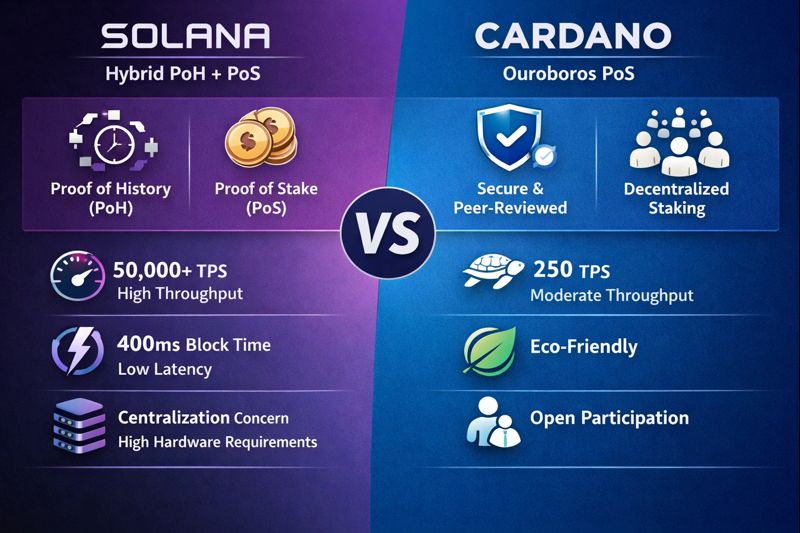
- Proof-of-History (PoH): By introducing a historical record of events, Solana is able to create a sequence of events that can be validated more efficiently. This reduces transaction validation times and increases throughput, resulting in one of the fastest blockchains in existence.
- Proof-of-Stake (PoS): Solana’s PoS mechanism allows token holders to stake SOL tokens to participate in block validation. This ensures decentralization while maintaining speed and efficiency.
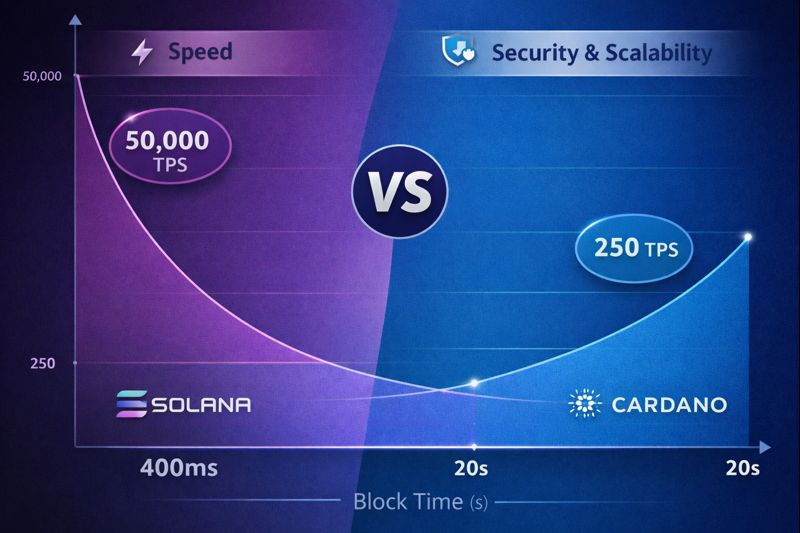
- High Throughput: Solana can handle around 50,000 transactions per second (TPS), making it one of the fastest blockchains available.
- Low Latency: The block time on Solana is as low as 400 milliseconds, allowing for quick transaction finality.
1.2Cardano: Ouroboros Proof-of-Stake (PoS)
- Security: Ouroboros is designed to ensure that Cardano’s blockchain remains secure, with rigorous cryptographic guarantees about the validity of blocks and transactions.
- Decentralization: Ouroboros promotes greater decentralization than Solana, as anyone holding ADA tokens can stake and participate in governance, helping to secure the network without needing expensive hardware.
2. Speed vs. Security: Which Blockchain Is Faster?
Solana: Speed at Scale
Cardano: Security and Scalability
- Block time on Cardano is around 20 seconds, which is slower than Solana but still competitive.
- Cardano's scalability is enhanced by upcoming upgrades such as Hydra, which will allow the network to handle even more transactions per second.
3. Ecosystem Development: DeFi, NFTs, and Adoption
3.1Solana’s Ecosystem: Speed Driving DeFi and NFTs
- High-speed DeFi applications: Solana’s speed is well-suited for high-frequency trading and other DeFi applications that require fast transaction confirmation.
- NFTs on Solana: Due to low gas fees and quick transaction finality, Solana has become a hotbed for NFT projects, especially among creators looking for cost-effective options.
3.2Cardano’s Ecosystem: Security and Governance
- Cardano’s approach to governance through Project Catalyst also adds another layer of value to the ecosystem by allowing ADA holders to vote on proposals for future development.
- Cardano’s NFTs and DeFi projects are built with a focus on sustainability and long-term growth, making it an attractive platform for projects that prioritize security and decentralization.
4. Speed vs. Security: Which One is Better for Your Use Case?
4.1When to Choose Solana:
4.2When to Choose Cardano:
5. FAQ Section
6. Conclusion
Popular Articles
Who is Charles Hoskinson? Cardano Founder Background & Vision
Charles Hoskinson is a prominent figure in the cryptocurrency space, best known as the co-founder of Ethereum and the founder of Cardano. Hoskinson has played a significant role in shaping the future
Cardano Price Analysis: Understanding ADA's Market Cap & Price Potential
As Cardano’s ADA continues to grow in the crypto space, one question often arises: Can ADA reach $10? While thecryptocurrency market is known for its volatility, understanding market cap and price pre
The Rise of CommerceFi: Why Crypto Payments Are Going Mainstream
Crypto cycles are predictable. A new infrastructure wave arrives. Liquidity pours into Layer 1 ecosystems. A token meta monopolizes attention. Eventually the narrative burns out and the market looks f
How Much Was Bitcoin in 2014? A Year of Crisis and Recovery
Bitcoin faced one of its toughest years in 2014, starting at $754.22, briefly peaking at $919.20 in early January, then crashing to around $321-$379 by year's end.This guide explores what happened to
Related Articles
Who is Charles Hoskinson? Cardano Founder Background & Vision
Charles Hoskinson is a prominent figure in the cryptocurrency space, best known as the co-founder of Ethereum and the founder of Cardano. Hoskinson has played a significant role in shaping the future
Cardano vs Solana: Key Differences in Architecture & Design Philosophy
When it comes to blockchain technology, two projects often discussed in the same breath are Cardano (ADA) and Solana (SOL). Both are third-generation blockchains designed to address the scalability an
Cardano Price Analysis: Understanding ADA's Market Cap & Price Potential
As Cardano’s ADA continues to grow in the crypto space, one question often arises: Can ADA reach $10? While thecryptocurrency market is known for its volatility, understanding market cap and price pre
The Rise of CommerceFi: Why Crypto Payments Are Going Mainstream
Crypto cycles are predictable. A new infrastructure wave arrives. Liquidity pours into Layer 1 ecosystems. A token meta monopolizes attention. Eventually the narrative burns out and the market looks f
