The post Crypto’s Meteoric Rise Could Make Or Break Africa appeared on BitcoinEthereumNews.com. Opinion by: Ure Utah, technical advisor to Nigeria’s minister of innovation With the value of digital currencies surging close to $4 trillion, the world is rushing to cash in. While Elon Musk’s Dogecoin (DOGE) and the US president’s Official Trump (TRUMP) coin grab headlines, Africa sits at the frontline of this worldwide financial upheaval. This is a crucial point. Unless African leaders act to regulate or harness crypto, what happens next will determine whether the continent’s 1.55 billion inhabitants build greater sovereignty over their future or usher in a new era of financial instability. The opportunities are vast. Leveraging crypto would unlock new pools of capital, reroute remittance flows and potentially reshape the entire sovereign debt market. African governments owe the International Monetary Fund (IMF) $42.2 billion — a third of the organization’s outstanding credit. Egypt alone owes a staggering $7.42 billion. These debts strain national budgets and hinder growth projects.  The high-risk gamble The risks are, however, stratospheric. Widespread adoption of stablecoins could drain deposits from local bank branches, destabilizing the monetary control of central banks. Africa’s most fragile currencies — like those of Sierra Leone, Uganda and Guinea — could buckle under this kind of volatility. Cryptocurrency claims to democratize. As with every disruptive technology absorbed into global capitalism, however, it promises inclusion while reinforcing exclusion. We already see it making the rich richer. The African risk rating In Africa, the stakes are high. The population is young, and some African economies — like oil-rich Niger and Senegal — are among the fastest growing. Still, weak regulation and relatively low levels of financial literacy mean that communities least able to absorb losses are also the most exposed. If remittance flows — worth more than $95 billion annually to Africa — migrate onto blockchain rails, traditional banks and regulators… The post Crypto’s Meteoric Rise Could Make Or Break Africa appeared on BitcoinEthereumNews.com. Opinion by: Ure Utah, technical advisor to Nigeria’s minister of innovation With the value of digital currencies surging close to $4 trillion, the world is rushing to cash in. While Elon Musk’s Dogecoin (DOGE) and the US president’s Official Trump (TRUMP) coin grab headlines, Africa sits at the frontline of this worldwide financial upheaval. This is a crucial point. Unless African leaders act to regulate or harness crypto, what happens next will determine whether the continent’s 1.55 billion inhabitants build greater sovereignty over their future or usher in a new era of financial instability. The opportunities are vast. Leveraging crypto would unlock new pools of capital, reroute remittance flows and potentially reshape the entire sovereign debt market. African governments owe the International Monetary Fund (IMF) $42.2 billion — a third of the organization’s outstanding credit. Egypt alone owes a staggering $7.42 billion. These debts strain national budgets and hinder growth projects.  The high-risk gamble The risks are, however, stratospheric. Widespread adoption of stablecoins could drain deposits from local bank branches, destabilizing the monetary control of central banks. Africa’s most fragile currencies — like those of Sierra Leone, Uganda and Guinea — could buckle under this kind of volatility. Cryptocurrency claims to democratize. As with every disruptive technology absorbed into global capitalism, however, it promises inclusion while reinforcing exclusion. We already see it making the rich richer. The African risk rating In Africa, the stakes are high. The population is young, and some African economies — like oil-rich Niger and Senegal — are among the fastest growing. Still, weak regulation and relatively low levels of financial literacy mean that communities least able to absorb losses are also the most exposed. If remittance flows — worth more than $95 billion annually to Africa — migrate onto blockchain rails, traditional banks and regulators…

Crypto’s Meteoric Rise Could Make Or Break Africa

Opinion by: Ure Utah, technical advisor to Nigeria’s minister of innovation

With the value of digital currencies surging close to $4 trillion, the world is rushing to cash in. While Elon Musk’s Dogecoin (DOGE) and the US president’s Official Trump (TRUMP) coin grab headlines, Africa sits at the frontline of this worldwide financial upheaval.

This is a crucial point. Unless African leaders act to regulate or harness crypto, what happens next will determine whether the continent’s 1.55 billion inhabitants build greater sovereignty over their future or usher in a new era of financial instability.

The opportunities are vast. Leveraging crypto would unlock new pools of capital, reroute remittance flows and potentially reshape the entire sovereign debt market. African governments owe the International Monetary Fund (IMF) $42.2 billion — a third of the organization’s outstanding credit. Egypt alone owes a staggering $7.42 billion.

These debts strain national budgets and hinder growth projects. 

The high-risk gamble

The risks are, however, stratospheric. Widespread adoption of stablecoins could drain deposits from local bank branches, destabilizing the monetary control of central banks. Africa’s most fragile currencies — like those of Sierra Leone, Uganda and Guinea — could buckle under this kind of volatility.

Cryptocurrency claims to democratize. As with every disruptive technology absorbed into global capitalism, however, it promises inclusion while reinforcing exclusion. We already see it making the rich richer.

The African risk rating

In Africa, the stakes are high. The population is young, and some African economies — like oil-rich Niger and Senegal — are among the fastest growing. Still, weak regulation and relatively low levels of financial literacy mean that communities least able to absorb losses are also the most exposed.

If remittance flows — worth more than $95 billion annually to Africa — migrate onto blockchain rails, traditional banks and regulators risk being sidelined altogether, upending monetary policy across dozens of nations.

Look at the contrast. In the US, Trump’s pro-crypto policies have shored up America’s borrowing power by tying stablecoins to Treasury markets, with Tether holding over $120 billion in government debt. In Europe, tokenization experiments remain tightly regulated. Meanwhile, China is weaponizing its digital yuan to extend influence across Belt and Road partners. 

Africa has no such buffers. Which is precisely why African leaders must act now to corral crypto to reduce reliance on IMF bailouts, ease sovereign debt burdens and boost Africa’s ability to finance growth on its own terms.

A framework for regulatory evolution

Strong regulation is not a luxury; it’s the only way to protect citizens from fraud while giving investors the confidence that African tokenized projects are serious and credible. With that in place, Africa could capture billions in environmental, social and governance-aligned global capital (projected to reach $35 trillion-$50 trillion by 2030). 

Investment in financial literacy and decentralized finance (DeFi) skills is desperately needed so that communities can use digital assets safely. And tokenized infrastructure projects can put crypto to work for the public good.

Real-life lessons from the world beyond Africa

There are models to build on. The World Food Programme’s Building Blocks project used blockchain to distribute cash to vulnerable populations, including Syrian refugees in Jordan. This was redeemable at local markets, where users purchased goods using iris scan technology. Last year, Building Blocks supported 65 organizations, enhancing efficiency and aid distribution to save $67 million. 

Inspiration can also come from the Global North, where using crypto and blockchain for social good is already underway. Estonia has pioneered blockchain-based e-voting, increasing voter trust, preventing fraud and speeding up results. US-based Climate Collective is tokenizing rainforests and other natural assets to preserve ecosystems and monetize carbon reduction. These use cases underscore a simple truth: Crypto can work for communities, not just markets. 

Related: The one thing these 6 global crypto hubs all have in common

Earlier this year, the $210-million Immaculata Living Project was launched in Chicago — the world’s largest university-backed, crypto-powered real estate project. A collaboration between private companies and the American Islamic College is both a social enterprise and a commercial venture.

That dual nature makes it important. By blending profit with purpose, Immaculata shows how crypto can deliver community benefits while attracting investors. In a sector often criticized for speculation, it offers a blueprint for how digital finance can underpin financially sustainable and socially transformative projects. 

The redevelopment will restore the crumbling, century-old Immaculata campus and add a 22-story tower with hundreds of senior living apartments and homes for young professionals — fully equipped with on-site catering, wellness events, care facilities, AIC courses and a diverse activity program.

From experimentation to implementation

This is an opportunity to use crypto to democratize property ownership, whereby anyone can buy whatever size share in an apartment they can afford. It lets investors go direct and build wealth from the ground up in a firmly regulated way.

Importantly, the intention is that Immaculata be a blueprint for utilizing digital currency as a force for both private investment and public good, creating 50 new jobs, improving access to further education and building a new, socially cohesive community that unites people of different generations and faiths under “one roof” — without spending taxpayer dollars.

Tokenization doesn’t have to remain an experiment in the West. Housing projects in Lagos, clean energy grids in Nairobi or new university campuses in Accra could all be financed this way, giving global investors a stake while letting local communities share in the returns.

African leaders must seize this opening to rewrite capital rules — or allow digital finance to widen the gap between rich and poor.

Opinion by: Ure Utah, technical advisor to Nigeria’s minister of innovation.

This article is for general information purposes and is not intended to be and should not be taken as legal or investment advice. The views, thoughts, and opinions expressed here are the author’s alone and do not necessarily reflect or represent the views and opinions of Cointelegraph.

Source: https://cointelegraph.com/news/crypto-make-or-break-africa?utm_source=rss_feed&utm_medium=feed&utm_campaign=rss_partner_inbound

Market Opportunity
RISE Logo
RISE Price(RISE)
$0.003582
$0.003582$0.003582
+0.27%
USD
RISE (RISE) Live Price Chart
Disclaimer: The articles reposted on this site are sourced from public platforms and are provided for informational purposes only. They do not necessarily reflect the views of MEXC. All rights remain with the original authors. If you believe any content infringes on third-party rights, please contact service@support.mexc.com for removal. MEXC makes no guarantees regarding the accuracy, completeness, or timeliness of the content and is not responsible for any actions taken based on the information provided. The content does not constitute financial, legal, or other professional advice, nor should it be considered a recommendation or endorsement by MEXC.

You May Also Like

Young Republicans were more proud to be American under Obama than under Trump: data analyst

Young Republicans were more proud to be American under Obama than under Trump: data analyst

CNN data analyst Harry Enten sorts through revealing polls and surveys of American attitudes, looking for shifts, and his latest finding is an indictment of President
Share
Alternet2026/02/10 22:18
Vitalik Buterin Outlines Ethereum’s AI Framework, Pushes Back Against Solana’s Acceleration Thesis

Vitalik Buterin Outlines Ethereum’s AI Framework, Pushes Back Against Solana’s Acceleration Thesis

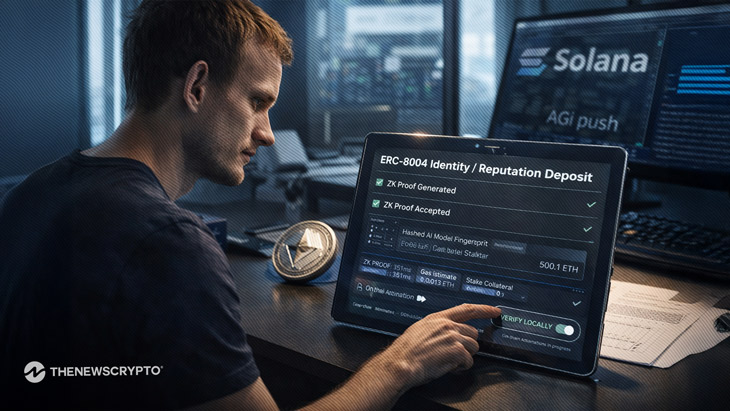
Ethereum co-founder Vitalik Buterin has reacted to Solana’s artificial general intelligence acceleration initiative. He did this through the establishment of his
Share
Thenewscrypto2026/02/10 18:40
Vitalik Buterin Reveals Ethereum’s Bold Plan to Stay Quantum-Secure and Simple!

Vitalik Buterin Reveals Ethereum’s Bold Plan to Stay Quantum-Secure and Simple!

Buterin unveils Ethereum’s strategy to tackle quantum security challenges ahead. Ethereum focuses on simplifying architecture while boosting security for users. Ethereum’s market stability grows as Buterin’s roadmap gains investor confidence. Ethereum founder Vitalik Buterin has unveiled his long-term vision for the blockchain, focusing on making Ethereum quantum-secure while maintaining its simplicity for users. Buterin presented his roadmap at the Japanese Developer Conference, and splits the future of Ethereum into three phases: short-term, mid-term, and long-term. Buterin’s most ambitious goal for Ethereum is to safeguard the blockchain against the threats posed by quantum computing.  The danger of such future developments is that the future may call into question the cryptographic security of most blockchain systems, and Ethereum will be able to remain ahead thanks to more sophisticated mathematical techniques to ensure the safety and integrity of its protocols. Buterin is committed to ensuring that Ethereum evolves in a way that not only meets today’s security challenges but also prepares for the unknowns of tomorrow. Also Read: Ethereum Giant The Ether Machine Takes Major Step Toward Going Public! However, in spite of such high ambitions, Buterin insisted that Ethereum also needed to simplify its architecture. An important aspect of this vision is to remove unnecessary complexity and make Ethereum more accessible and maintainable without losing its strong security capabilities. Security and simplicity form the core of Buterin’s strategy, as they guarantee that the users of Ethereum experience both security and smooth processes. Focus on Speed and Efficiency in the Short-Term In the short term, Buterin aims to enhance Ethereum’s transaction efficiency, a crucial step toward improving scalability and reducing transaction costs. These advantages are attributed to the fact that, within the mid-term, Ethereum is planning to enhance the speed of transactions in layer-2 networks. According to Butterin, this is part of Ethereum’s expansion, particularly because there is still more need to use blockchain technology to date. The other important aspect of Ethereum’s development is the layer-2 solutions. Buterin supports an approach in which the layer-2 networks are dependent on layer-1 to perform some essential tasks like data security, proof, and censorship resistance. This will enable the layer-2 systems of Ethereum to be concerned with verifying and sequencing transactions, which will improve the overall speed and efficiency of the network. Ethereum’s Market Stability Reflects Confidence in Long-Term Strategy Ethereum’s market performance has remained solid, with the cryptocurrency holding steady above $4,000. Currently priced at $4,492.15, Ethereum has experienced a slight 0.93% increase over the last 24 hours, while its trading volume surged by 8.72%, reaching $34.14 billion. These figures point to growing investor confidence in Ethereum’s long-term vision. The crypto community remains optimistic about Ethereum’s future, with many predicting the price could rise to $5,500 by mid-October. Buterin’s clear, forward-thinking strategy continues to build trust in Ethereum as one of the most secure and scalable blockchain platforms in the market. Also Read: Whales Dump 200 Million XRP in Just 2 Weeks – Is XRP’s Price on the Verge of Collapse? The post Vitalik Buterin Reveals Ethereum’s Bold Plan to Stay Quantum-Secure and Simple! appeared first on 36Crypto.
Share
Coinstats2025/09/18 01:22