Lending

Lending protocols form the backbone of the decentralized money market, allowing users to lend or borrow digital assets without intermediaries. Using smart contracts, platforms like Aave and Morpho automate interest rates based on supply and demand while requiring over-collateralization for security. The 2026 lending landscape features advanced permissionless vaults and institutional-grade credit lines. This tag covers the evolution of capital efficiency, liquidations, and the integration of diverse collateral types, including LSTs and tokenized RWAs.

15846 Articles
Created: 2026/02/02 18:52
Updated: 2026/02/02 18:52
Penny Token at $0.035 Emerges as the Best Crypto to Buy Amid Dogecoin’s (DOGE) Choppy Price

Penny Token at $0.035 Emerges as the Best Crypto to Buy Amid Dogecoin’s (DOGE) Choppy Price

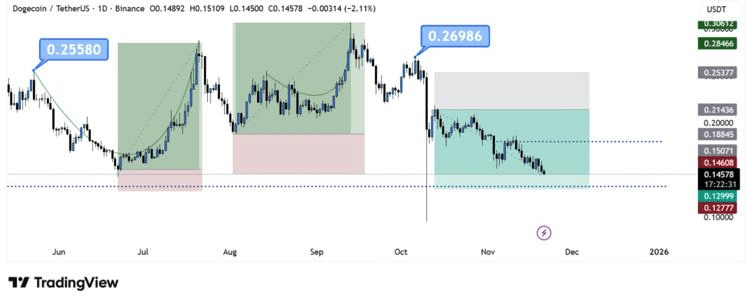
The post Penny Token at $0.035 Emerges as the Best Crypto to Buy Amid Dogecoin’s (DOGE) Choppy Price  appeared on BitcoinEthereumNews.com. Dogecoin (DOGE) hasn’t had it easy lately; it’s had quite the rollercoaster ride with its prices fluctuating wildly while its hype hasn’t seemed quite as unstoppable. It leaves market players wondering if it’ll be about to slowly recover or if just around the corner it’ll be headed yet again to break out. In all this market hullabaloo, Mutuum Finance (MUTM) opportunistically makes its move. The presale has garnered it incredible attention in the market, and it’s already over 95% complete in Phase 6 to raise nearly $19 million in the process, indicating it doesn’t just have market players clamoring for it simply for nothing. They’re opting for real utility. Dogecoin Struggles as Market Slide  Dogecoin (DOGE) continues to show its usual fluctuations as it constantly pushes towards reaching its resistance but then holds back and falls towards its support level. Since it lost its hold on staying above $0.188, it hasn’t recovered yet and instead has maintained its downtrend; it looks like if it falls further along this trend, it may go to the $0.13 level of support. The continued falls towards its target level and inability to sustain its momentum make it difficult for traders to invest in Dogecoin (DOGE), leading to increased interests in new platforms like Mutuum Finance (MUTM), which have shown good early momentum. MUTM Presale Phase 6, Final Window for Early Investors Mutuum Finance (MUTM) shows promise to be one of the forefront DeFi cryptos in 2025; it has already garnered over $19 million from 18,230 contributors. At present in Phase 6 priced at $0.035, MUTM boasts an incredible 250% growth from its Phase 1 level of $0.01. Given that over 95% of Phase 6 tokens have been sold out, it’s one of the last chances to purchase tokens at such a reduced rate. As…

Author: BitcoinEthereumNews
Naver Financial to Acquire Upbit in $10B Merger: A New Era for Korean Fintech

Naver Financial to Acquire Upbit in $10B Merger: A New Era for Korean Fintech

TLDR Naver to fully acquire Dunamu via $10B stock swap to strengthen digital finance. Upbit integration boosts Naver’s reach in blockchain, payments, and asset services. Massive new share issuance dilutes Naver stake but unlocks innovation synergy. Merger aligns fintech power with crypto growth as digital finance accelerates. Upbit’s high profits fuel Naver’s bid to lead [...] The post Naver Financial to Acquire Upbit in $10B Merger: A New Era for Korean Fintech appeared first on CoinCentral.

Author: Coincentral
Playing the Long Game with a Portfolio Career Why the future belongs to multi-skilled leaders

Playing the Long Game with a Portfolio Career Why the future belongs to multi-skilled leaders

The technology sector has long been shaped by barriers. Funding gaps, uneven representation, and workplace cultures that favor certain groups have made progress inconsistent. Yet across the industry, a new kind of professional is changing the pattern. These are people who build careers around range, adaptability, and collaboration rather than narrow specialization. This shift reflects […] The post Playing the Long Game with a Portfolio Career Why the future belongs to multi-skilled leaders appeared first on TechBullion.

Author: Techbullion
Top 8 Sectors That Will Lead the Next Crypto Boom, According to Coinbase Ventures

Top 8 Sectors That Will Lead the Next Crypto Boom, According to Coinbase Ventures

Key Takeaways Coinbase Ventures has outlined eight priority sectors for 2026, focusing heavily on AI-integrated and real-world-asset (RWA) crypto products. […] The post Top 8 Sectors That Will Lead the Next Crypto Boom, According to Coinbase Ventures appeared first on Coindoo.

Author: Coindoo
PA Daily News | Coinbase plans to invest in four major areas including RWA perpetual contracts; Texas becomes the first U.S. state to officially purchase Bitcoin.

PA Daily News | Coinbase plans to invest in four major areas including RWA perpetual contracts; Texas becomes the first U.S. state to officially purchase Bitcoin.

Today's top news highlights: The selection process for the Federal Reserve Chair is nearing completion, and Hassett is reportedly the top choice. Six departments, including the Ministry of Industry and Information Technology, have announced support for platform companies to apply technologies such as AI and blockchain to create multi-scenario, immersive consumer experiences. Coinbase plans to invest in four major areas in 2026, including RWA perpetual contracts and specialized trading terminals. Texas launches Bitcoin reserve program, with an initial $5 million purchase of IBIT from BlackRock. Amundi, Europe's largest asset manager, sold approximately $135 million worth of Strategy shares in Q3. MegaETH's pre-deposit campaign failed due to a technical glitch, abandoning plans to expand the fundraising to $1 billion. Analyst Murphy: BTC faces less resistance as it returns to $90,000; key resistance level is $92,000. Macro The South African Reserve Bank has listed cryptocurrencies and stablecoins as new financial risks. According to Bloomberg, the South African Reserve Bank (SRB) has warned that crypto assets and stablecoins, due to a lack of comprehensive regulation, have become a new risk threatening the country's financial sector. In its semi-annual Financial Stability Assessment, the SRB noted that the digital and cross-border nature of cryptocurrencies allows them to circumvent existing foreign exchange control laws, while digital assets are not yet subject to regulation. Herco Steyn, the SRB's chief macroprudential expert, stated that the risk stems from an "incomplete regulatory framework." He anticipates progress next year but warned that if progress stalls, "regulation will be inadequate." Currently, the SRB is working with the Treasury to develop new regulations to regulate cross-border crypto asset transactions and amend foreign exchange control laws to include digital assets. The SRB emphasized that as crypto asset adoption increases, the domestic regulatory framework needs to be continuously adjusted in line with market developments and risks. Data shows that the South African crypto industry is dominated by three major platforms: Luno, VALR, and Ovex. As of July, they had nearly 7.8 million registered users; and total assets reached 25.3 billion rand as of December 2024. Six departments, including the Ministry of Industry and Information Technology, have announced support for platform companies to apply technologies such as AI and blockchain to create multi-scenario, immersive consumer experiences. According to Jinshi News, six departments, including the Ministry of Industry and Information Technology, issued the "Implementation Plan on Enhancing the Matching of Supply and Demand for Consumer Goods and Further Promoting Consumption." The plan proposes the orderly development of platform consumption, including new business models such as live-streaming e-commerce, instant retail, curated retail, and circular e-commerce. It encourages platform companies to legally and compliantly utilize artificial intelligence technology to identify user needs and match them with recommended products and services. The plan supports platform companies in applying digital technologies such as virtual reality, metaverse, artificial intelligence, and blockchain to create multi-scenario, immersive consumption experiences. It also guides platform companies to conduct brand and quality-driven consumption promotion activities. Finally, the plan emphasizes the responsibility of platform companies, strengthening the review of operator qualifications and the verification of product information, and improving the rapid handling mechanism for consumer disputes. Spain plans to increase the tax burden on cryptocurrency gains by amending its laws. According to Criptonoticias, the Sumar parliamentary group in Spain has submitted a bill to the Chamber of Deputies to amend three of the country's tax laws related to cryptocurrencies. OpenAI co-founder Sam Altman's ex-boyfriend was robbed at his home, losing $11 million in cryptocurrency. According to the New York Post, San Francisco police and sources revealed that a tech investor who had dated OpenAI CEO Sam Altman was robbed at gunpoint on the evening of November 22, with $11 million worth of cryptocurrency assets stolen. The robbers, posing as UPS deliverymen, entered the victim's Dolan Street residence carrying a white box. Surveillance footage shows the robbers forcing the victim to hand over electronic devices at gunpoint after he opened the door, and then stealing cryptocurrency assets from his phone and laptop by binding him. According to sources, the suspects tortured the victim after binding him, beating him while he was on speakerphone, with a foreign accent repeatedly reciting the victim's personal information. Police responded to the call that evening and found the victim with minor injuries. They are currently investigating how the robbers transferred the cryptocurrency using the stolen devices. The homeowner, 31-year-old Lachy Groom, is a venture capitalist and the ex-boyfriend of 40-year-old Sam Altman. Property records show he purchased the home from the Altman brothers in 2021 for $1.8 million. Bitwise DOGE ETF receives NYSE Arca listing approval and could list as early as Wednesday. According to The Block, NYSE Arca, a subsidiary of the New York Stock Exchange Group, approved Bitwise's application for listing and registration of a Dogecoin ETF on Tuesday. The Bitwise Dogecoin ETF (ticker symbol BWOW) could list as early as Wednesday. According to a previous registration statement, the Bitwise Dogecoin ETF aims to expose investors to the value of this meme cryptocurrency, and Coinbase Custody will serve as the fund's custodian. U.S. Bancorp, the fifth-largest bank in the United States, is testing its self-developed stablecoin on the Stellar platform. According to The Block, US Bancorp stated that it is testing its self-developed stablecoin on the Stellar blockchain. The bank's choice of the Stellar blockchain appears to be based on considerations of transaction security and control. Mike Villano, Senior Vice President of Corporate Innovation at the bank, stated, "For our customers, we must consider other safeguards around the 'Know Your Customer' (KYC) principle, such as the ability to reverse transactions. After further development on the Stellar platform, we found that a major advantage of the platform is its underlying operational layer's ability to freeze assets and suspend online transactions." According to data from the Federal Reserve, as of September 30, US Bancorp was the fifth-largest bank in the United States, managing $671 billion in assets. Polymarket announced that it has received approval from the U.S. CFTC to re-enter the U.S. market. According to PR Newswire, prediction market platform Polymarket announced that the U.S. Commodity Futures Trading Commission (CFTC) has issued a revised designation allowing Polymarket to operate an intermediary trading platform, subject to full compliance with all applicable requirements for federally regulated exchanges. This approval will enable Polymarket to directly connect brokerage firms and clients and facilitate trading on U.S. trading venues. Currently, Polymarket is permitted to implement an intermediary access model, allowing users to trade through futures commission brokers and utilize traditional market infrastructure, custody, and reporting channels. The selection process for the Federal Reserve Chair is nearing completion, and Hassett is reportedly the top choice. According to Jinshi News, sources familiar with the matter revealed that as the selection process for the new Federal Reserve Chairman enters its final weeks, White House National Economic Council Director Kevin Hassett is considered the leading candidate for the position among President Trump's advisors and allies. Sources indicated that if Hassett were appointed, Trump would be able to place a close ally he knows and trusts within the Fed. Some also stated that Hassett is seen as someone who can bring Trump's interest rate-cutting philosophy to the Fed, which is precisely the direction Trump has long sought to control. However, they also pointed out that Trump is known for his unpredictable personnel and policy decisions, so nothing is certain until the official announcement. Hassett is considered to share Trump's economic views, including the belief that interest rates need to be lowered. In a Fox News interview on November 20, he stated that if he were the Fed Chairman, he would "cut rates now" because "the data suggests we should." Opinion Analyst Murphy: BTC faces less resistance as it returns to $90,000; key resistance level is $92,000. Analyst Murphy points out that based on current data, a return to $90,000 for BTC is not difficult, and $90,000 is not a strong resistance level. The average cost of short-term holders suggests that BTC may encounter strong selling pressure only when it enters the $92,000 to $99,000 range. Meanwhile, options market data shows that call activity at a strike price of $92,000 is significantly higher than at $90,000, especially sell calls at $92,000, which will create strong resistance in the market. Murphy emphasizes that the key battle above $92,000 is the core area determining BTC's trend, especially near the $98,000 level, which is BTC's "fair price" line over the past decade. However, recent market sentiment has been dampened by massive realized losses, making it difficult to generate effective buying power in the short term. BTC's future trend will still depend on market sentiment and the performance of key resistance zones. Tom Lee: ETH may fall back to $2,500 in the short term, but is expected to rise to $7,000-$9,000 in January next year. In a video, Fundstrat co-founder and BitMine chairman Tom Lee said that ETH may fall back to $2,500, but he believes that this slight drop is nothing compared to the upcoming supercycle surge. He believes that ETH may have 3-4 times the upside potential, meaning that ETH could reach $7,000-$9,000 in January. Eric Trump denied predicting that Ethereum would rise to $8,000 within 38 days. When asked about rumors on the X platform that he predicted Ethereum would break $8,000 in the next 38 days, Eric Trump, the second son of US President Donald Trump, said that people should not spread fake news, that he had never made such a statement, and that while he hoped to see this happen, he had not made any such predictions. Strategy claims that even if BTC falls to its average cost of $74,000, its BTC assets would still be 5.9 times that of its convertible bonds. Strategy stated on the X platform: "If the price of Bitcoin falls to our average cost of $74,000, we still have assets equivalent to 5.9 times our convertible debt, which we call the Bitcoin debt rating. If the price of Bitcoin falls to $25,000, the ratio will be 2.0 times." Project Updates Binance Alpha listed on PORT3, reaching a high of $0.0129. According to the official page, Binance Alpha has listed PORT3. It reached a high of $0.0129, and its current market capitalization is hovering around $6-8 million. Previously, it was reported that Port3 Network was hacked using the BridgeIn vulnerability to issue more tokens, causing PORT3 to plummet 77.4% in 24 hours. Subsequently, Port3 initiated a token migration plan and burned over 160 million tokens. Binance Wallet has added on-chain stock trading. According to official sources, Binance Wallet has added on-chain stock trading. Simply open the Binance App, enter your wallet, click "Market," and select "On-Chain Stocks" to trade, with a minimum transaction fee of 0%. Coinbase plans to invest in four major areas in 2026, including RWA perpetual contracts and specialized trading terminals. According to official news, Coinbase Ventures has released its 2026 investment outlook, highlighting four key areas for investment next year: RWA perpetual contracts, specialized trading terminals, next-generation DeFi protocols, and AI and robotics. Specialized trading terminals will focus on Prop AMMs and prediction market trading terminals; next-generation DeFi protocols will focus on perpetual market composability, uncollateralized lending/credit, and on-chain privacy; and AI and robotics will focus on human identity verification, AI-enabled on-chain development, and security. Coinbase Ventures stated that its team is actively seeking investments in these areas and welcomes discussions with relevant projects. Upbit will list the PLUME token on the Korean won market. According to an official announcement, South Korean cryptocurrency exchange Upbit will list the PLUME token on the Korean won market. Polygon is gathering community feedback on whether the POL token code should be changed back to MATIC. Sandeep Nailwal, co-founder of Polygon and CEO of the Polygon Foundation, posted on the X platform that due to repeated community feedback that the MATIC token code is more recognizable than POL, the question arose regarding whether to request exchanges to change the token code back from POL to MATIC. Sandeep stated that he personally prefers to maintain the status quo and continue using POL. However, feedback received suggests that project decisions should not be based solely on the opinions of the crypto community, as the crypto community represents less than 5% of the total cryptocurrency trading community. He expressed a desire to understand the opinions of a broader community, but did not guarantee that exchanges would agree to the change. SKALE has partnered with Base to launch the L3 network "SKALE on Base," designed specifically for AI agent workloads. According to The Block, Layer 1 blockchain SKALE has partnered with Layer 2 network Base to launch an Ethereum Layer 3 network. Project representatives stated that the network, named "SKALE on Base," is "designed specifically for AI agent workloads," particularly well-suited for application scenarios like the x402 payment protocol, incubated by Coinbase and designed specifically for AI. They stated, "Agents require higher-quality block space to run on-chain. SKALE Expand allows the deployment of SKALE Manager (the core smart contract facilitating the operation of the SKALE chain) onto any EVM blockchain, bringing SKALE's gas-free transactions, instant determinism, and privacy protection to other EVM ecosystems." SKALE on Base enables AI agents to leverage SKALE's scalable infrastructure, as well as Base's liquidity, users, entry points, and distribution channels. The network will also introduce a computing resource credit system, meaning AI agents and users won't need to manage gas fees when using on-chain applications. Users can pre-purchase credit on Base using USDC or SKL. Tuesday's launch marks the first deployment of the SKALE Expand multi-chain initiative. The plan aims to transform SKALE into "an AI proxy layer capable of supporting multiple Layer 1 and Layer 2 networks while keeping users and liquidity on their original chains." MegaETH's pre-deposit campaign failed due to a technical glitch, abandoning plans to expand the fundraising to $1 billion. According to Cointelegraph, MegaETH's pre-deposit campaign failed on Tuesday due to a series of technical glitches. The campaign was designed to provide verified users with a controlled window to lock in their MEGA token allocations. The team stated on the X platform that the technical glitches stemmed from a configuration error and rate limiting issue with the KYC system. Simultaneously, a Safe multi-signature transaction intended for subsequent increases was executed prematurely, resulting in new deposits flowing in and causing the total fundraising amount to exceed the original $250 million limit. The protocol provider stated that this allocation was obtained by users who continuously refreshed the page and happened to be randomly opened by the system. Ultimately, MegaETH froze the total deposits at $500 million and abandoned its original plan to expand the fundraising to $1 billion. The team stated that it will soon release a rollback plan and withdrawal options, reiterating that user assets are always safe, but admitted that this operation did not meet its own standards and that no excuses were needed. Coinbase has launched spot trading of Irys (IRYS). According to an official announcement, Coinbase has launched spot trading of Irys (IRYS). Irys (IRYS) is now available on coinbase.com and the Coinbase App. Coinbase users can log in to buy, sell, exchange, send, receive, or store Irys assets. Important data Ethena Labs is suspected of withdrawing $34.15 million worth of ENA tokens from a centralized exchange (CEX) through two new wallets. According to Onchain Lens monitoring, Ethena Labs is withdrawing ENA from exchanges. The newly created wallet "0xa19" received 105.35 million ENA from Coinbase Prime, worth $28.7 million. Wallet "0x631" further withdrew 20 million ENA from Bybit, worth $5.45 million. Currently, this wallet holds 305.15 million ENA, with a total value of $88.67 million. Bitcoin spot ETFs saw a total net inflow of $129 million yesterday, with Fidelity FBTC leading the way with a net inflow of $171 million. According to SoSoValue data, Bitcoin spot ETFs saw a total net inflow of $129 million yesterday (November 25th, Eastern Time). The Bitcoin spot ETF with the largest single-day net inflow was Fidelity ETF FBTC, with a net inflow of $171 million, bringing its historical total net inflow to $11.984 billion. This was followed by BlackRock ETF IBIT, with a net inflow of $83.0088 million, bringing its historical total net inflow to $62.637 billion. The Bitcoin spot ETF with the largest single-day net outflow was Ark Invest and 21Shares ETF ARKB, with a net outflow of $75.9213 million, bringing its historical total net inflow to $1.734 billion. As of press time, the total net asset value of Bitcoin spot ETFs was $114.072 billion, with an ETF net asset ratio (market capitalization as a percentage of Bitcoin's total market capitalization) of 6.54%, and a historical cumulative net inflow of $57.613 billion. WLFI officially spent 7.79 million USD to purchase 46.56 million WLFI tokens in the past 5 hours. According to Lookonchain monitoring, the WLFI team is buying back WLFI tokens on-chain. In the past 5 hours, they have spent 7.79 million USD1 to purchase 46.56 million WLFI tokens at an average price of $0.1674. A wallet suspected to be associated with Fenbushi Capital deposited 10,400 ETH into Binance 10 hours ago. According to Lookonchain's monitoring, a wallet suspected of being associated with Fenbushi Capital deposited 10,400 ETH, worth $29.88 million, into Binance 10 hours ago. USDe TVL has fallen to $7.6 billion, a drop of over 50% compared to October. According to The Block, Ethena's synthetic stablecoin USDe's total value locked (TVL) has fallen from $14.8 billion in October to $7.6 billion currently, a drop of over 50%. Affected by a weak market environment and reduced leverage demand, perpetual funding fees have compressed, and the stablecoin's current annualized yield is approximately 5.1%, lower than the double-digit yields at the beginning of the year. Despite the decline in TVL, USDe usage is on the rise, with on-chain transaction volume exceeding $50 billion last month. The sharp contraction in TVL is largely due to the liquidation of leveraged arbitrage strategies prevalent in DeFi protocols, especially in lending markets like Aave. These arbitrage strategies involve repeatedly depositing pledged USDe (sUSDe) as collateral, borrowing USDC at a high loan-to-value ratio, then exchanging it back for sUSDe, and repeating this process to achieve effective leverage of 10x or even higher. This trade can continue to be profitable as long as the annualized yield of USDe exceeds the borrowing cost of USDC; however, as the yield has declined and is now below the 5.4% cost of borrowing USDC on AAVE, some people have closed out their arbitrage trades. An ancient whale is suspected of dumping 20,000 ETH, worth $58.14 million, after eight months. According to on-chain analyst @ai_9684xtpa, an "ancient whale" holding 254,900 ETH in the ETH ICO market appears to have sold 20,000 ETH after eight months, worth $58.14 million, at a cost as low as $0.31. Ten hours ago, he deposited 20,000 ETH into FalcoinX at a price of $2,906.79. The last time this whale transferred tokens to an exchange, the price was only $1,452.04. He currently holds 3,070 ETH on-chain, worth $9.07 million. Multicoin Capital purchased another 60,000 AAVE tokens, worth $10.68 million. According to on-chain analyst Yu Jin, Multicoin Capital purchased 60,000 AAVE tokens (US$10.68 million) through Galaxy Digital OTC four hours ago. In the past month and a half, they have accumulated 338,000 AAVE tokens (US$60.46 million) at an average price of US$219, resulting in a paper loss of US$13.5 million. After the sharp drop on October 11th, they purchased 210,000 AAVE tokens (US$51.32 million) at US$244; on November 25th, they purchased 61,637 AAVE tokens (US$10.94 million) at US$177; and on November 26th, they purchased 60,000 AAVE tokens (US$10.68 million) at US$178. Investment and Financing/Acquisition Robinhood and Susquehanna are acquiring a majority stake in MIAXdx (formerly LedgerX) to gain a deeper involvement in the prediction market. According to Bloomberg, Robinhood and hedge fund Susquehanna International Group are taking over a regulated exchange previously linked to the now-bankrupt crypto firm FTX, giving the two companies a new foothold in the prediction market space. The two companies are acquiring a majority stake in MIAXdx (formerly LedgerX), a U.S.-based derivatives exchange formerly owned by FTX and now operated by Miami International Holdings (MIH). Financial details of the deal were not disclosed, but MIH stated it will sell 90% of the exchange to the group led by Robinhood. Robinhood stated it will become the “controlling partner” in the new joint venture, while Susquehanna will act as the “first-day liquidity provider” to ensure clients have counterparties for their trades. Both acquiring parties already have close ties to prediction markets. Susquehanna has stated it is a market maker for the prediction market Kalshi, while Robinhood provides Kalshi event contracts to its retail investment clients. This new deal will give Robinhood and Susquehanna direct control over the infrastructure needed to list and clear event contracts on their own terms. Digital asset lending platform CreatorFi secures $2 million in strategic investment. Digital asset lending platform CreatorFi announced a strategic partnership with the Aptos Foundation and Aptos Labs. As part of the partnership, CreatorFi will launch its platform on Aptos and receive a total of $2 million in strategic funding to accelerate its development. Developed by Insomnia Labs, CreatorFi is a fintech platform that transforms digital media revenue into loanable assets, providing risk-adjusted pre-approved financing for creators, studios, and media companies. Institutional holdings Amundi, Europe's largest asset manager, sold approximately $135 million worth of Strategy shares in Q3. According to BitcoinTreasuries.NET, Amundi, Europe's largest asset management company, disclosed that it sold 772,620 shares of Strategy (MSTR) stock in the third quarter, worth $135 million. Texas launches Bitcoin reserve program, with an initial $5 million purchase of IBIT from BlackRock. According to The Block, a post from the Texas Blockchain Council indicates that the state has made its first allocation to the Texas Strategic Bitcoin Reserve, purchasing approximately $5 million worth of BlackRock's Bitcoin Spot ETF (IBIT) last week. This transaction appears to be the first use of authorized funds under SB 21, enacted by Greg Abbott in June. This act established a state-level Bitcoin reserve managed by the Texas Fiscal Trust. Lee Bratcher, chairman of the Texas Blockchain Council, revealed on Twitter that the purchase occurred on November 20th, marking both the reserve's first allocation and the first instance of a state government purchasing Bitcoin in the US. However, state officials have not yet released any documents or statements to confirm the transaction. According to the Texas Fiscal Trust's latest 13F filing, the company holds approximately $667 million in SPY (S&P 500 ETF) and $34 million in the Janus Henderson Fund. If, as stated by Lee Bratcher, the purchase of $5 million worth of IBIT (as part of a $10 million Bitcoin allocation) will make it the third-largest holding in this portfolio.

Author: PANews
Deutsche Börse Enhances Multi-Stablecoin Platform Under MiCA Regulations

Deutsche Börse Enhances Multi-Stablecoin Platform Under MiCA Regulations

Deutsche Börse Integrates Euro-Pegged Stablecoin from AllUnity Deutsche Börse, a leading market infrastructure provider, has announced plans to incorporate the EURAU stablecoin issued by AllUnity into its digital asset infrastructure. This strategic move follows previous collaborations involving Circle’s Euro Coin and Societe Generale-Forge’s EUR CoinVertible, showcasing the exchange’s expanding focus on digital finance solutions. The [...]

Author: Crypto Breaking News
Chainlink’s Nazarov says DeFi could reach mass adoption by 2030

Chainlink’s Nazarov says DeFi could reach mass adoption by 2030

The post Chainlink’s Nazarov says DeFi could reach mass adoption by 2030 appeared on BitcoinEthereumNews.com. On November 25, Sergey Nazarov, co-founder of Chainlink, stated that decentralized finance (DeFi) has already reached 30% of its way to widespread acceptance and may be fully adopted globally by 2030.  Nazarov claimed that the main factors pushing DeFi into the mainstream will be more transparent regulations, institutional involvement, and U.S. policy leadership. He added that DeFi, which is peer-to-peer financial services based on blockchain networks, could achieve 50% global adoption if more precise regulations and laws can demonstrate its dependability. Michael Egorov, the inventor of Curve Finance, had a similar view. He stated that legal and regulatory uncertainty, along with the obligation to adhere to Know Your Customer (KYC) and Anti-Money Laundering regulations, are the primary challenges to DeFi adoption. Nazarov reveals institutional push for DeFi adoption • Institutional adoption accelerating with greater regulatory clarity• Why highly reliable infra matters more than ever• CRE unlocking the next phase of tokenization@SergeyNazarov discusses these trends and much more on @CryptoMichNL’s New Era Finance Podcast ↓ https://t.co/QuCeklyV4O — Chainlink (@chainlink) November 25, 2025 According to Sergey Nazarov, institutional involvement in Web3 has increased, and the majority of the sessions at the most recent SmartCon had a distinct institutional focus. He claimed that big financial firms are increasingly using blockchain technology since the sector has matured, and adoption is accelerating.  Nazarov stated that the world has changed for DeFi, and the transformation is moving more quickly toward institutional adoption. “When we’re thinking about DeFi, it’s something of a buzzword, but really we should be looking to on-chain markets and on-chain applications and thinking about the features of these applications as well as where there’s an actual intermediary involved.” Michael Selig, Chief Counsel for the crypto task force at the U.S. Securities and Exchange Commission. According to Nazarov, DeFi global acceptance will reach around…

Author: BitcoinEthereumNews
Is HyperEVM dragging Hyperliquid down?

Is HyperEVM dragging Hyperliquid down?

When Hyperliquid was hit hardest by FUD, big names like @smartestmoney and @CL207 were buying in. And that guy who publicly shorted the stock is being purged. Hyperliquidated. If you're selling/shorting $HYPE at a high price because of team unstaking or unlocking, I think that's fine. However, you need to understand that the short-term decline in $HYPE doesn't mean Hyperliquid's fundamentals have deteriorated. On the contrary, with the launch and expansion of Hyperliquid Hip-3, I believe Hyperliquid's fundamentals are improving. This is something that anyone with a clear understanding can see. Also, I recently read an article (I won't post a link to which one), and I'd like to briefly share my thoughts on it. The core argument of that article was that "the lack of alignment between the HyperEVM ecosystem and $HYPE has led to the market's valuation rating of Hyperliquid remaining at the application level of Aave and Uniswap, rather than the infrastructure level of Layer 1/Layer 2". I think it's fair to say that the HyperEVM ecosystem and $HYPE are not yet aligned. The only truly valuable protocol in the HyperEVM ecosystem right now is $HYPE's LSD protocol. However, one misconception to overcome is that the team launched HyperEVM not to raise the valuation of $HYPE, but to hope that the HyperEVM ecosystem projects can generate synergies with Hyperliquid's core PerpDEX product. We cannot apply the traditional fat protocol, thin application theory to Hyperliquid—many projects launch Layer 1 to facilitate token sales, but we haven't seen this in the Hyperliquid team's behavior. Furthermore, most Layer 1 projects strive to develop their ecosystems to ensure their mainnet tokens have a support pool, i.e., sufficient exit liquidity. Moreover, it has been proven that using higher values to determine the valuation of infrastructure is itself a long-standing misjudgment of value in the crypto world. I recommend reading this article. https://obviously.substack.com/p/crypto-is-priced-for-network-effects Fees Don't Lie. Layer 1 companies account for 90% of the total market capitalization, but their fees only account for 12% of the total fees. Cryptocurrency valuations are still based on the "fat protocol, thin application" theory. However, the data shows the opposite. Hyperliquid might be able to change this. Applications are the most direct value capture layer, and the value of $HYPE lies in the long-term, substantial investment of fee revenue in the buyback of its own token. In the long run, the value of $HYPE is not driven by the narratives of HyperEVM and Hip-3, but by its fees. Hyperliquid doesn't need the HyperEVM ecosystem as exit liquidity for $HYPE; in fact, its product fees are the exit liquidity for $HYPE. Ethereum is similar; it has a burning mechanism, but it can't capture enough fees. Layer 2 leverages Ethereum's security but hasn't been able to feed the value it creates back into $ETH. Therefore, many see Lightner as a turning point for Ethereum, hoping that as a Layer 2 component, Lightner can create incremental value for Ethereum. Let's return to the topic of HyperEVM. Initially, developers on HyperEVM followed the logic of developing on other chains, building a complete DeFi ecosystem and memes for HyperEVM, such as LSD, lending, and DEX products. However, apart from LSD, these products did not provide any added value to Hyperliquid's core product, PerpDEX. This also prevented HyperEVM from aligning with $HYPE. However, as I mentioned above, although Hyperliquid hasn't yet produced a phenomenal DeFi product that resonates with its core offerings, Hyperliquid doesn't currently need its ecosystem as a reservoir for $HYPE. Therefore, ecosystem projects and developers have ample time to develop. We've already seen such products emerge and develop (for example, @harmonixfi and @hyperbeat, which are about to go public at TGE), but gaining users and trust will still take time. Therefore, I think this is a problem that we don't need to worry about at all. Finally, returning to first principles, all the work and product updates by the Hyperliquid team serve its core product. To judge Hyperliquid's valuation ceiling solely through traditional cryptocurrency thinking is like the blind men and the elephant.

Author: PANews
Coinbase Ventures eyes RWA perpetuals, AI in 2026 investment outlook

Coinbase Ventures eyes RWA perpetuals, AI in 2026 investment outlook

Coinbase has released its 2026 investment priorities, focusing on RWA perpetuals, specialized trading, DeFi innovations, and AI and robotics.

Author: The Block
Paxos Acquires Fordefi as DeFi Integrations Accelerate Across Industry

Paxos Acquires Fordefi as DeFi Integrations Accelerate Across Industry

The post Paxos Acquires Fordefi as DeFi Integrations Accelerate Across Industry appeared on BitcoinEthereumNews.com. Blockchain infrastructure company Paxos has acquired Fordefi, a New York-based institutional crypto wallet and custody technology startup. Paxos said the deal brings its regulated custody infrastructure together with Fordefi’s multi-party computation (MPC) wallet technology and decentralized finance integrations, providing institutions with a single platform to issue stablecoins, tokenize assets, and manage onchain transactions. While transaction terms were not disclosed in today’s announcement, a Paxos spokesperson told Fortune the deal was worth more than $100 million. Founded in 2021, Fordefi developed one of the first institutional MPC wallets built for DeFi, incorporating governance features that enable companies to authorize and sign onchain transactions. The startup will continue to operate independently for now, with Paxos planning to integrate its technology into its broader infrastructure over time.  Paxos is a regulated blockchain infrastructure company that provides custody, tokenization and stablecoin services for major enterprises, including PayPal, Mastercard and Interactive Brokers.  The company is licensed in the United States, Europe and Singapore, and issues several stablecoins, including PayPal USD (PYUSD), Pax Dollar (USDP), Pax Gold (PAXG), and Global Dollar (USDG). Related: UAE’s new financial law pulls DeFi and Web3 into regulatory scope DeFi sees wider rollout across exchanges Across the crypto industry, companies are increasingly embedding DeFi protocols into their products, offering users direct access to onchain lending, tokenized assets and yield tools. In June, Kraken expanded its onchain efforts by partnering with Solana-based DeFi Development Corp, using its xStocks platform to bring Kraken shares onchain. The deal was built on a May partnership that enabled Kraken to offer tokenized US equities to users in select non-US markets. By September, Coinbase integrated the Morpho lending protocol directly into its app, allowing users to lend USDC without needing to navigate separate DeFi platforms or external wallets. The exchange said users could earn up to 10.8%…

Author: BitcoinEthereumNews